
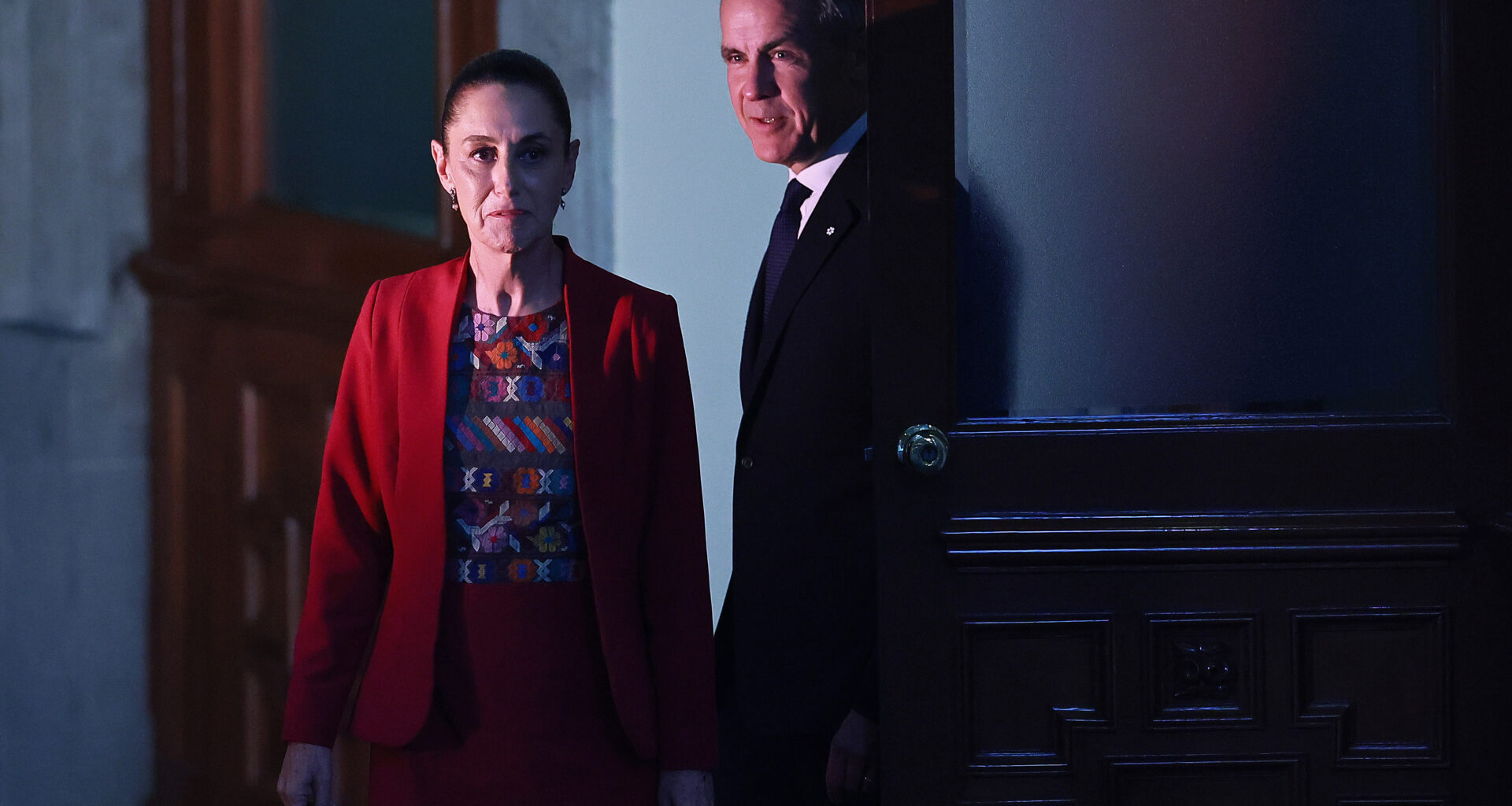
Prime Minister Mark Carney and President of Mexico Claudia Sheinbaum walk to a press conference at Palacio Nacional in Mexico City on Sept. 18.Manuel Velasquez/Getty Images
Three months out from the formal review date for the North American trade pact, Canada and Mexico are on different paths.
In March, Mexico’s trade team began “technical discussions” with the Office of the United States Trade Representative (USTR), starting to hash out new rules around regional content in vehicles, supply-chain security and foreign investment.
Canada, by contrast, appears to be largely on the sidelines.
Dominic LeBlanc, Canada’s minister responsible for U.S. trade, said Monday that his team has re-engaged with the Trump administration over the past month, after almost no contact following the breakdown of trade talks in October. But he offered few details, and nothing to suggest that Ottawa has begun substantive talks with USTR ahead of the July 1 review date for the United States-Mexico-Canada Agreement.
LeBlanc says he’s confident Mexico will not quit USMCA for separate deal with U.S.
For some observers, Washington’s differing treatment of its two USMCA partners is a sign that the trilateral agreement is in trouble and could collapse into separate bilateral deals – an idea U.S. officials have floated several times in recent months.
More optimistic observers suggest that the U.S. and Mexico are simply getting to work early on some of the thornier bilateral issues between the two countries. They point to the 2018 negotiations that created the USMCA, where Washington and Mexico City effectively reached a deal without Ottawa, then brought the Canadians back to the table at the last minute.
What’s clear is that Ottawa and Mexico City are taking different approaches to the USMCA review, based on distinct negotiating strategies, domestic political calculations and visions for the continental economy in a world upended by U.S. President Donald Trump’s protectionism.
Mexican President Claudia Sheinbaum has cultivated a close relationship with Mr. Trump, leaning into his personalized approach to deal-making. And the Mexicans are treating trade talks as one part of a broader reset in the U.S.-Mexico relationship, which also involves combatting drug cartels and addressing illegal immigration – top priorities for the Trump administration.
The USMCA review was mandated to take place six years after the agreement came into force in July, 2020.Rebecca Cook/Reuters
Mexico and Canada are also taking different stands on what some analysts call Fortress North America – the idea of tightening continental supply chains and reducing the amount of non-North American inputs going into local production.
“Mexico is doubling down on integration with the U.S. … trying to reduce their reliance on Asian manufacturing, so they can produce more in Mexico and they can export more to the U.S.,” said Diego Marroquín Bitar, a fellow at the Center for Strategic and International Studies in Washington.
“I don’t think Canada is willing to let go of the U.S. market, but they’re putting more human capital and time into trying to increase their ties with other economies,” he said, including with China, America’s chief geopolitical rival.
It remains to be seen how these different strategies will play out in the coming months. The mercurial Mr. Trump could easily cool on Ms. Sheinbaum and warm to Prime Minister Mark Carney, based on a perceived slight or compliment, or a shift in policy unrelated to trade, such as around drug cartels or defence.
And there are tough conversations ahead for both Ottawa and Mexico City around automobile content, Chinese investment and how much ground to give on a long list of U.S. grievances in the hope of getting some tariff relief and a bit more certainty about market access.
It’s not even clear what to make of the July 1 review date.
The agreement specifies that the three parties must meet on that date and agree to extend for 16 years or start the process of annual reviews for 10 years, after which the agreement ends. But of the 10 people The Globe and Mail spoke to for this article – trade experts, lawyers and industry representatives from all three countries – not a single one believed there would be a clear outcome on July 1.
Opinion: While Canada diversifies trade away from the U.S., Mexico chooses concessions
Part of this comes down to politics, and the assumption that Mr. Trump will want to reserve potential “wins” for closer to the November midterm elections. Part of it has to do with uncertainty about the scope of the review: The Trump administration has not sought trade promotion authority from Congress, so any substantive changes may need to come in side letters rather than in tweaks to the text of the agreement itself.
“My money is on us being in a scenario where it’s a constant negotiation,” said Kellie Meiman Hock, senior counsellor with strategic advisory firm McLarty Associates, and a former official with the U.S. State Department and USTR. “Nothing is ever settled with this administration, so hoping for a certain date where we agree on a determined outcome and certainty can reign in North American trade, I strongly believe that is not going to happen on July 1 or any other date.”
Still, as trade talks heat up, it’s evident that Mexico and the U.S. are the more deeply engaged partners across a range of issues. And Mexican negotiators are certainly more popular in Washington.
“If you talk to lawmakers up on Capitol Hill or folks within the [Trump] administration, about the current state of play, there’s a sense that, and I’m paraphrasing here, Mexicans are doing everything right and the Canadians are doing everything wrong,” said Kip Eideberg, senior vice-president of government and industry relations at the Association of Equipment Manufacturers, which represents both U.S. and Canadian companies.
“While the Canadians and the Americans are going through the motions, the Americans and the Mexicans are lining up wins for each other.”
Dominic LeBlanc, Minister responsible for Canada-U.S. Trade, said Monday he’s confident Mexico will not quit the USMCA in favour of an agreement with the U.S.Adrian Wyld/The Canadian Press
Unlike the NAFTA renegotiations in 2017 and 2018, there is little formal structure to the USMCA review, which was mandated to take place six years after the agreement came into force in July, 2020.
The main roadmap of how the talks might play out is testimony Jamieson Greer, the U.S. Trade Representative, gave to Congress in December, outlining the Trump administration’s priorities for the review.
These include addressing specific grievances with Canada and Mexico. For Canada, that includes dairy quota allocation, digital streaming rules and provincial bans on U.S. liquor. For Mexico, it includes the use of “third-country content” in manufactured goods, the enforcement of labour laws and the country’s restrictions on investment in the energy sector.
Mr. Greer said the U.S. would also push for tighter rules of origin (which lay out how much of a product must be made in North America to trade duty-free), as well as more alignment on external tariffs, screening of inbound investment and export controls. The goal here is to pull more manufacturing to the United States, boost U.S. content in products made in all three countries, and limit Chinese products entering the United States through Mexican and Canadian supply chains.
Marcelo Ebrard, Mexico’s Secretary of Economy who is leading the country’s trade team, said in a television interview last week that his government was steadily working through some 52 demands the U.S. has put to Mexico, and has put 12 demands to the U.S. in return.
Mexico’s Secretary of Economy, Marcelo Ebrard, speaks in Mexico City on March 9.ALFREDO ESTRELLA/AFP/Getty Images
That includes steps to align more with U.S. tariffs on China, to address long-standing concerns in Washington that Chinese products are entering the U.S. duty-free through Mexico. On Jan. 1, Mexico City placed tariffs on some 1,400 products from countries with which Mexico does not have a free-trade agreement. This was widely seen as targeted at China.
Canada has taken a different approach in recent months. Having previously marched in lockstep with Washington when it comes to industrial and trade policy related to China, Mr. Carney travelled to Beijing in January and cut a deal to allow 49,000 Chinese electric vehicles into Canada at a lower tariff level. He also invited Chinese investment into the Canadian auto sector and other key industries.
That move, combined with Mr. Carney’s speech in Davos about middle powers banding together to stand up to hegemons, were not well received in Washington, said Kimberly Breier, who served as USTR assistant secretary of state for Western Hemisphere affairs during the first Trump administration.
“Actually going so far as to cut a deal with the Chinese was just seen as really just too much. So that’s where I started to worry,” said Ms. Breier.
“Prior to that I’ve been saying, ‘Canada came later the first time; don’t worry about it. The negotiation with Mexico is more complex, it’s going to take longer.’ … After Davos, I was like, ‘Oh boy, we might really be at risk this time of losing the trilateral agreement,’” she said.
The official position in Ottawa is that there is nothing to be concerned about.
“We have always said that there would be bilateral and trilateral discussions as part of the CUSMA review – and it’s not unusual for bilateral discussions between each party to move at a different pace,” Gabriel Brunet, a spokesperson for Mr. LeBlanc, said in statement, using the Canadian name for the agreement.
Antonio Ortiz-Mena, a professor at Georgetown University, and former head of economic affairs at Mexico’s embassy in Washington, said that the differences between Canada and Mexico can be overplayed. The Trump administration is speaking more positively about Mexico. “However, actual U.S. policies toward both countries have been virtually the same,” he said, pointing to similar levels of tariffs on both countries.
Mr. Ortiz-Mena expects the final arrangement to be, in a sense, both bilateral and trilateral, with the USMCA preserved as the broad framework, but with certain chapters or side agreements added to address specific bilateral issues the U.S. has with Canada and Mexico respectively.
But there are more worrisome possible outcomes. Barry Appleton, a Canadian trade lawyer and professor at New York Law School, said that he does not think USMCA will survive, because Mexico City is much more willing to do transactional deals with Washington than Ottawa is.
He said he expects Mr. Trump and Ms. Sheinbaum to strike their own deal, with the Mexicans accepting concession in return for certainty. “It’s like a gigantic battleship. The guns are pointing in one direction, and they’re going to turn around, point north, and then we’re next.”
Editor’s note: This article has been updated to correct the first name of Jamieson Greer.