
Right to Food’s new headquarters are inside a building that previously housed a mattress factory.Hani Ramadhani/Supplied
Sometimes, come hell or high water, a building must be born. The need is too great, the people behind it are tireless and the cause is noble. Such was the case with the new national headquarters of Right to Food at 340 Gerrard St. E. in Toronto.
Hilditch Architect Inc. uncovered the hell when they peeled back the layers of the old, three-storey brick-and-beam building, says principal Mary O’Neill: “We found something quite alarming, which was on the top two floors, all of the existing timber had been completely charred.”
“There had been a massive fire in 1915,” she continues. “The building was a mattress factory, and they had stored all of the wool up on the second floor … the whole place just went up.”
Work on the building was full of surprises, including the remnants of a fire more than 100 years earlier.Simon Liao/Supplied
And while the building had managed to keep standing for more than 100 years – heavy timber will create a “protective char layer” and keep its strength – calculations by Blackwell Structural Engineers revealed the building couldn’t take another catastrophic event. So, before programmatic work could be done (and Right to Food could get to serving meals or teaching food skills), an entirely new Douglas fir skeleton had to be shoehorned into the building through the roof.
“That cost $850,000,” says Right to Food CEO Nick Saul, who jokes that for “a nanosecond” he thought about tearing down and replacing the building. “Despite all the gifts it gave,” he says with a hint of sarcasm, “it’s just too nice.”
The next ‘gift’ was water, says Ms. O’Neill. Despite the due diligence of “site investigation, boreholes and geotechnical investigations,” the building had another surprise in store.
“Once the contractor got started on site, they found there was some curious water seeping up from the ground [and they] weren’t sure where it was coming from,” she says. “It turned out it was from a leaking water main on the street that had been slowly infiltrating the site for months and months.”
“We had to contain the water and ship it off-site and dispose of it correctly, so that was a lot of cost.”
After unearthing some bones – bovine rather than human, thankfully – the rear dig for an exterior stair turned up an enormous oil tank that had been missed by a few feet during exploratory drilling.
“Just time and money, that’s all,” says Mr. Saul.
It makes the precautions, delays and materials shortages that plagued building projects during the COVID-19 pandemic look like a cakewalk. Speaking of which, on this sunny yet cold day in March, 2026, Mr. Saul, Ms. O’Neill and Hilditch associate Aerin Cartwright said they look forward to the bake oven that will soon grace the concrete pad out front. With a generous forecourt – the old mattress factory was set well back from the sidewalk – there’s room, too, for herb gardens, barrier-free planters and a big, trellis-shaded barbecue.
“So, we’re going to do pizzas and breads and lasagna, and the smells will be good,” says Mr. Saul.
It’s hoped that this will tickle the olfactory of those who might not know about Right to Food’s mission, a 13-year-old organization committed to “food not as something related to charity but a basic human right,” along with the creation of “places of belonging and care and connection,” he explains.
The 14,000-square-foot building has a generous forecourt with space for herb gardens, barrier-free planters and a big, trellis-shaded barbecue.Hani Ramadhani/Supplied
Before opening as the Sumac Community Food Centre at the Gerrard Street East location, Right to Food had rented space at Bloor Street West and Lansdowne Street. From there, the organization was able to support programming across the country, but they weren’t able to put boots on the ground and food into mouths in Toronto’s most vulnerable neighbourhoods. After raising tens of millions of dollars (much from the Arrell Family Foundation), the group purchased their new home, a 14,000-square-foot building.
But to make it bright, welcoming and dignified? That was a challenge, says Ms. O’Neill: “There was no front vestibule on the building, and the ceiling was very low. You nearly felt like you had to duck, and you opened the door, and a gale flew in.”
The new space includes a large commercial kitchen at the back.Simon Liao/Supplied
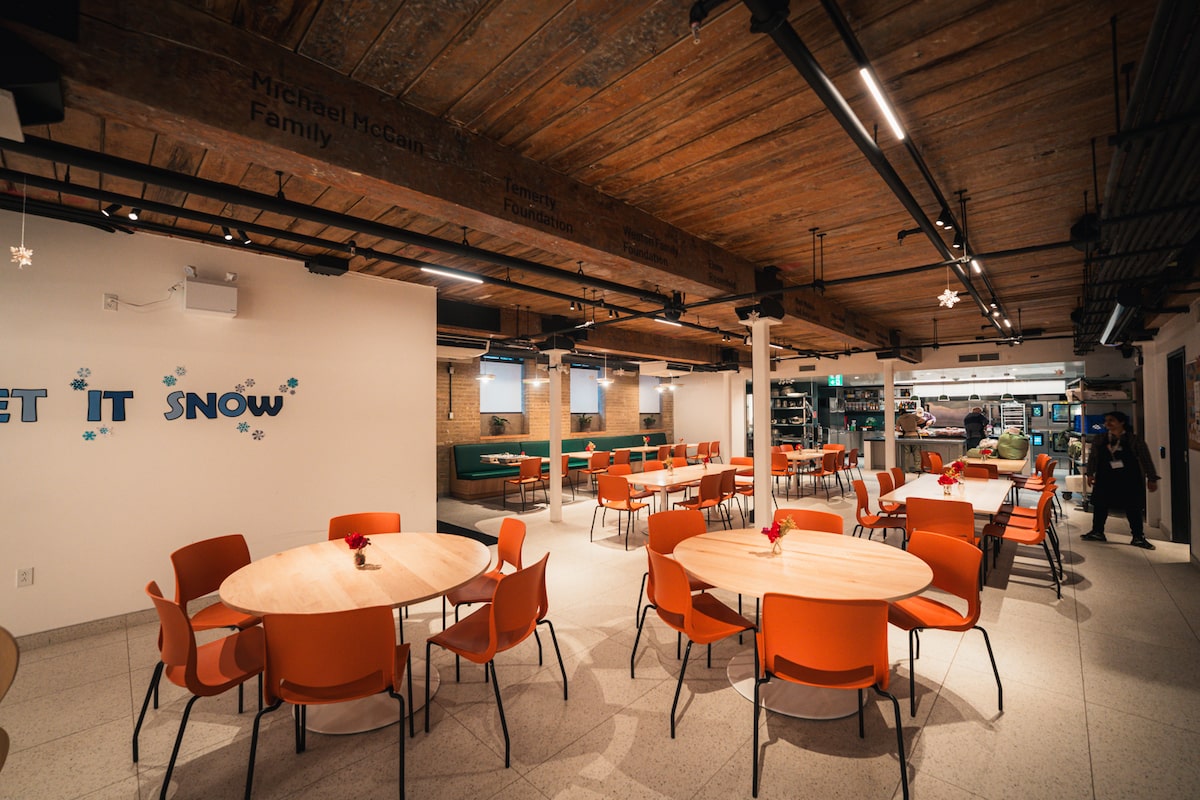
Now, a canopy leads to a glassy, modern foyer, which opens to a sun-drenched, double-height lobby with terrazzo tiles underfoot. Between the ramp and staircase to the big dining hall is a sheltered, cozy seating area featuring built-ins made by Sheridan College School of Craft and Design professor Connie Chisholm and her students.
Further in are more banquettes along an exposed brick wall, small meeting rooms along the opposite wall and an incredibly large commercial kitchen at the back: “It does the trick when you’re cooking meals for 200 people,” Mr. Saul says with a grin.
On the second floor, there is a more intimate kitchen and dining area where small community groups can hold events. “We had a program called ‘Mind Your Food’ in here this week – it’s about youth and resiliency,” says Mr. Saul. There’s also flexible space, a small children’s area (there are tiny stools with bites taken out of them and carrots for legs), and offices.
The second floor includes a small children’s area.Simon Liao/Supplied
The third floor contains Right to Food’s warm and welcoming offices. Here, history continues to shine via pockmarks on the old brick walls and deep window sills: “They’re about 40 centimetres thick,” says Ms. Cartwright. “On two walls we did interior insulation and then two walls we did spray foam on the outside so we could keep the exposed brick.”
That kind of care and respect paid to built heritage might not be the first thing on the minds of those who come here to dine. But in a space that looks more like a member’s-only supper club than a community kitchen, people will reclaim some dignity, says Mr. Saul: “When you’re feeling [like crap], and you walk in and eat a great meal – there’re linens, someone is taking care of you – it’s amazing.
“Never underestimate the power of a great meal, cooked with love and shared with others.”