
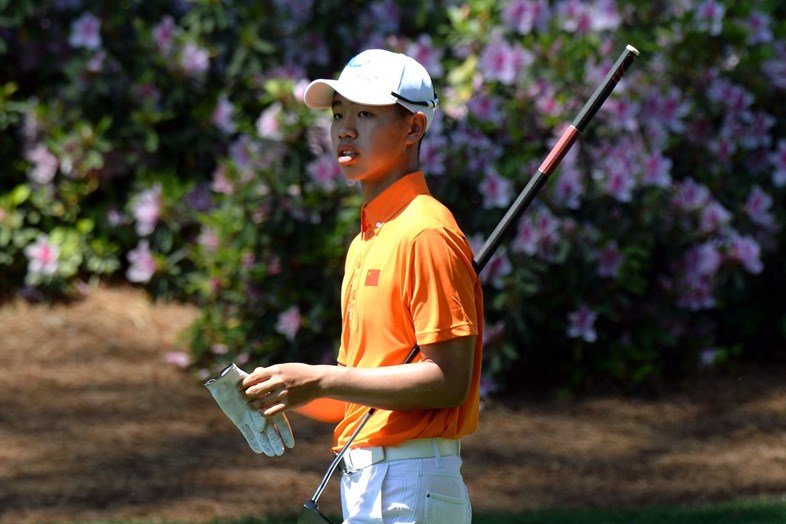
Guan Tianlang is now 27 years old. He has lived enough life since the spotlight dimmed that his time among the azaleas could reasonably be mistaken for a fever dream. Yet in this long phone call with TG, Guan reflects on his whirlwind and the years that followed with remarkable clarity.
“It doesn’t feel like that long ago,” he says. “I like watching the Masters and talking about the Masters. It’s an experience I would never trade.”
Guan is the son of a doctor who, after taking him to the driving range aged four, realised his talents and heavily invested in his future. He quickly began picking up junior titles around the world and, by 13, became the youngest player to compete on the European Tour at the China Open. His big breakthrough, though, came at the Asian-Pacific Amateur in November 2012. Guan shot 15-under across four rounds at Thailand’s Amata Spring Country Club to win by one shot and seal his place at the Masters. He became the youngest debutant at Augusta by two years after the 16-year-old Matteo Manassero.
Whatever transpired in the following April, Guan had already made Masters history.
But as the tournament grew closer, so did the concern for Guan. Gary Player worried that the slight teen would struggle to break 90. He could only carry the ball 240 yards off the tee and Augusta’s notorious greens annually destroy even some of the game’s most hardened souls. These days, the club hosts a ‘Drive, Chip and Putt’ event for hopefuls in his age category.
Yet the scale of his challenge never registered with the guileless Guan.
“Even before I went, there was a lot of attention built up to the tournament,” he recalls. “CNN and ESPN flew in to China to film with me. I got used to it a little bit. I played a few rounds before the week and I knew what my game was, relatively to the golf course. I wasn’t thinking too much about the results, rather than just doing what I’m able to do. It’s a big shift, but probably not as much as most people think.”
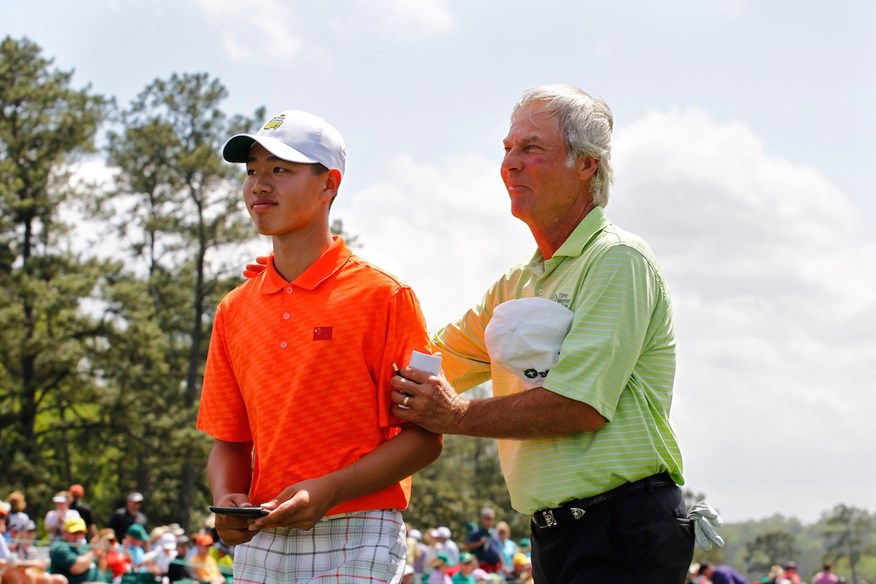
Guan had spent the past month preparing in Augusta, but things became real on the Monday morning of tournament week, when the gates opened to patrons and he played a practice round with the two-time champion Ben Crenshaw.
“It might be the only tournament where the practice round feels like the real tournament,” Guan points out. “The same amount of people and the course conditions are basically the same. So that really helped me prepare.”
What also helped was an impromptu back-nine practice session with Woods. Guan met the then World No.1 on the practice range after his morning knock with Crenshaw. They had already become acquainted during several of Woods’ lucrative trips to the Far East, so Guan felt “relatively comfortable” in his aura.

“It’s frightening to think that he was born after I won my first Masters,” Woods later said in his press conference. The sense of amazement soon rippled through the locker room. Crenshaw was paired with Guan and Manassero when the teenager carded a first-round 73, complete with four birdies and a series of par saves from treacherous positions. Guan required a hybrid club into most of the par-4 holes and saved his best approach until last as he converted a 20-foot birdie chance on the 18th. “He played like a veteran,” said a confounded Crenshaw. “He played about four of the most beautiful delicate pitches you’ve ever seen.”
Guan was asked by a giddy reporter if he already had what it takes to win the Green Jacket. “I think probably not this year,” he smiled nervously. “I think one day in the future.”
During his second round, Guan continued defying convention. With the winds ripping through the Georgia pines, he began methodically plotting his way around the course once more. The problem this time, though, was that Guan had become too methodical in the gusty conditions. On the 17th hole, with the cut in his sights, Guan was assessed a one-stroke penalty for slow play. It was the first instance of the rule being enforced in Masters history. Guan had been timed from the 12th hole and after an official warning on the 13th, was informed by referee John Paramor of the punishment on his penultimate hole after exceeding the 40-second time limit by a “considerable margin”.
Guan has a vivid recollection of the series of events that continue to be a source of debate and conjecture at Augusta all these years on.
“What started it was on the 4th hole, the par 3,” he recalls. “It was quite windy and there’s a lot of leaves and loose impediments on the green. When we got to the tee we were still waiting so we were on time. But when the group had finished, the maintenance guys were using blowers to blow off all the leaves. We waited for two minutes there. Then we just kept the gap for the next holes.
“We’re just slightly behind. I’m pretty much playing first all the time because I’m the shortest hitter. Then we got to 13. I was talking to my caddie about if I’m going to lay up or go for the green. So we just take some time there to discuss the options. There’s the first warning. Then we got to the approach shot on 17. Again, the winds are gusty and it’s not very consistent so we’re just trying to figure out is it into the wind or is it across. So I probably take a little too long there. That’s where the actual penalty happens.
“I actually hit a very good shot on 17 to have a birdie putt. [The penalty] probably affects me a little bit on the birdie putt. I’m not saying I would have made it otherwise, but I can feel a little influence there.”
Guan’s par-four became a bogey-five and his chances of making the cut were in jeopardy. He was unsure when he signed for a second-round 75 if the penalty had cost him dearly. Yet somehow, Guan managed to regroup and conjure the par he unknowingly needed on the 18th to make the cut on the number.
In the raw aftermath, Crenshaw was crestfallen for his playing partner. “This is not going to end pretty,” the American warned. “I feel terrible. He is 14 years old. I’m so sorry this has happened.”
Fred Couples, one shot behind the halfway lead, offered a less emotional view. “It feels hard to give a 14-year-old a penalty, but he’s in the field,” he said. “He beat a lot of guys yesterday, whatever age he is.”
Still, we have not seen a penalty of its kind at Augusta since, despite the ongoing backdrop of a slow play epidemic where serial offenders roam the fairways unpunished.
“It was the most unjust thing,” said the three-time champion Player, raising Guan’s penalty at last year’s Honorary Starters’ press conference. “It would have been the biggest faux pas in the world if he didn’t make the cut. He made it in spite of that. That’s one of the remarkable things.”
Remarkable, indeed. Guan’s feat in becoming the youngest player to make the weekend in a men’s major tournament may never be broken. He outscored multiple major winners and brushed off the flashpoint which overshadowed one of the most impressive achievements in Masters history. But Guan certainly never felt singled out or slighted by officials at Augusta. In fact, he says the penalty helped him learn a valuable lesson to change his routine.
“I wouldn’t say it’s unfair,” he insists. “If you actually go by the rules it’s what it is. But there’s so much grey area in the Rules of Golf. I just did not really use that to my advantage. I think that’s where a little more experience would definitely have helped.”
Guan completed rounds of 77 and 75 over the weekend to finish 58th and claim the prestigious Silver Cup as the low amateur. Almost unfathomably, he did not make a single three-putt across all four rounds at Augusta. At the time, Guan used a belly putter and one theory is that the ensuing anchoring ban stymied his progress. He disagrees, insisting he comfortably transitioned from his potent weapon long before the rule was actually enforced in 2016.
The harsh reality, though, is that Guan’s career was always going to be viewed through the prism of what he achieved as an eighth-grader at Augusta National. Dozens of Chinese journalists traveled to Georgia that week to report on a child billed as the country’s flag bearer in the sport. Guan was the Next Big Thing. The circus continued when he appeared on a sponsor’s exemption at a PGA Tour event in New Orleans two weeks later, where he again made the cut. Afterwards, Guan flew home to China to return to education and normal life, mercifully away from the media glare.
There is a duty of care often ignored with child prodigies, but Guan does not believe such early exposure to the limelight harmed him. The reasons Guan hasn’t yet developed into the golfer so many assumed he would be are more nuanced than that.
As he physically evolved in his adolescence, so did Guan’s golf swing as he continued his amateur career back in his homeland. He earned starts on the now disbanded PGA Tour China series and made some cuts, but struggled to reignite the noise around him. Eventually, he returned Stateside in 2017 to join the University of Arizona’s Wildcats.
“College was good,” he says. “It’s a good experience and a good decision for me. Golf-wise, I would say it’s not a game-changer. But overall as a person, it’s very beneficial. I developed a lot outside of golf.” Guan made friends and grew his confidence in a world 7,000 miles from home. But he was in and out of the Wildcards team and, after his sophomore year, decided to go back to China and turn professional in 2020. He immediately finished T4 in the Volvo China Open, but never bettered that result during his next four years competing on his home tour.
The breakthrough he went to America in search of never came.
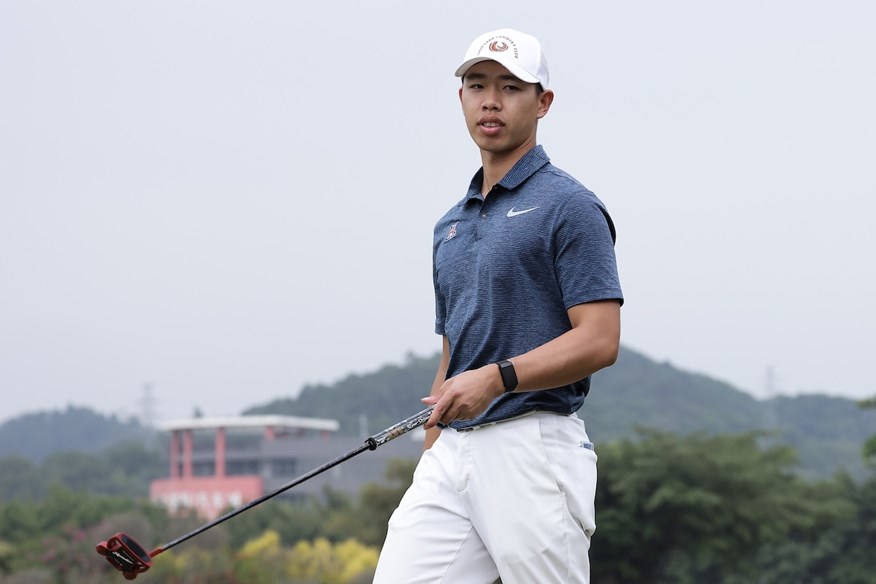
Reflecting back on his journey now, Guan explains that he became overwhelmed during his years after the Masters by the weight of knowing too much.
“When we grow up we tend to think about stuff more,” he says. “Phil Mickelson said if you want to be a really good golfer, you either be really smart or really dumb. When I was playing against him at Augusta at 14, I didn’t know much compared to Tiger or everybody else. But I knew how to hit the shots for myself and that’s about it.
“I knew how to play the 10th because I can’t get it all the way down the flat so I’m always on that downhill lie. I know how to hit the draw and fade from that lie. I don’t really know how to track my numbers or the psychology. Some of it but not as much. Then I transform more to the really smart guy. Now I know a lot about golf mechanics or techniques. It’s beneficial but sometimes there’s too much information.
“Like, how much information is enough information?”
It is a pertinent question that Guan still considers as he plots his next moves in the game. That intangible innocence of youth has long since eroded from the player now ranked 4,054th in the world.
“I’m a different player and a different person,” he says. “My game is very different and even the person is quite different as well. There’s still a lot of growing up to do from that age. Even personalities, everything changes. But I think I’m at a very good position in the way that I went through the good and bad. I know myself much better and that’s really valuable for the future. Because I think everybody has to go through some kind of it. But for me it’s just a little more radical, a little more extreme to most people.”
It’s also worth pondering how much joy Guan has been able to glean from his unique journey over the past decade. The life of a professional golfer is a privileged one and Guan says he’s lucky to have “my family and my team” to support his career without cashing in big checks. There are no guarantees, of course, but the expectation on Guan’s shoulders from a young age will forever alter perceptions of his success.
“I like practising and spending time trying to get better,” he says. “But there’s a period of time between now and then where it wasn’t as enjoyable. There’s probably days in the past where I don’t really want to play or like to play. It’s always an interesting relationship with golf. Some days you really love it and some days you don’t.
“It’s just ups and downs. That’s kind of why I came to the States [last] year, because I feel like I need something to help me break through, whether it’s from someone else or from myself. If someone thinks about it as a job, it’s quite difficult. If it’s just something that you want to do or your journey, that’s not as bad. But it definitely takes a toll on you sometimes.”
Like this article? See more TG content in your feed! Click here to add Today’s Golfer as a preferred source on Google.
Guan spent much of 2025 practising from a base in Las Vegas. After making it through pre-qualifying, he entered the First Stage of PGA Tour Q School in Alabama last October. He finished 18 shots shy of qualification for the next round. Guan has since planned to return to China, with the focus of simplifying his game and finding the “missing the piece” that he craves. This year, he says, will be about “exploration and experimenting” with his swing.
“You need to go deeper into the reason why you’re not hitting well or why you’re doing what you’re doing,” he explains. “When you actually understand it, that’s when you can actually simplify things.”
The end goal for Guan is to one day come full circle with a return to Augusta National and he will not give up on his childhood dream of contending in major championships. He remains fiercely ambitious and, throughout this conversation, Guan paints a refreshingly optimistic outlook on his game and the future.
“I’m not doing it for someone else,” he insists. “I’m not saying it’s superficial, but it’s really more for me and what I know I’m able to do.”
Still, the return of the Masters on his TV screen each spring reminds Guan of much simpler times.
“It’s a motivation for me to show that I have – you can say talent, but I don’t like to use the word talent – what it takes to be able to compete at the highest level,” he says.
“I know that’s in me. I know if I just keep doing the right thing, then I’ll be able to do that again.”