
For over three centuries, Amontons’ first law has been one of the most reliable principles in physics. Postulated by French physicist Guillaume Amontons in his 1699 treatise De la résistance causée dans les machines, the law states that the force of friction is directly proportional to the applied load, meaning heavier objects produce more friction, because greater weight increases contact between the tiny deformations in materials. It is an intuitive idea, and one that has served science and engineering remarkably well.
Yet the history of physics is a story of laws that eventually meet their limits. Newton’s laws of motion, for instance, break down at extreme scales, which is precisely where Einstein’s general theory of relativity steps in. It is partly why modern science prefers the word “theory” over “law”, a linguistic shift that acknowledges room for future discovery. The University of Konstanz experiment is the latest example of why that humility is warranted.
An Experiment Without Contact, Yet With Friction
According to the study published in Nature Materials, the researchers built a two-dimensional array of freely rotating magnetic elements and positioned it above a second magnetic layer. The two layers never come into physical contact, and yet a measurable friction between them exists. This friction is purely magnetic in nature, operating without any surface interaction whatsoever.
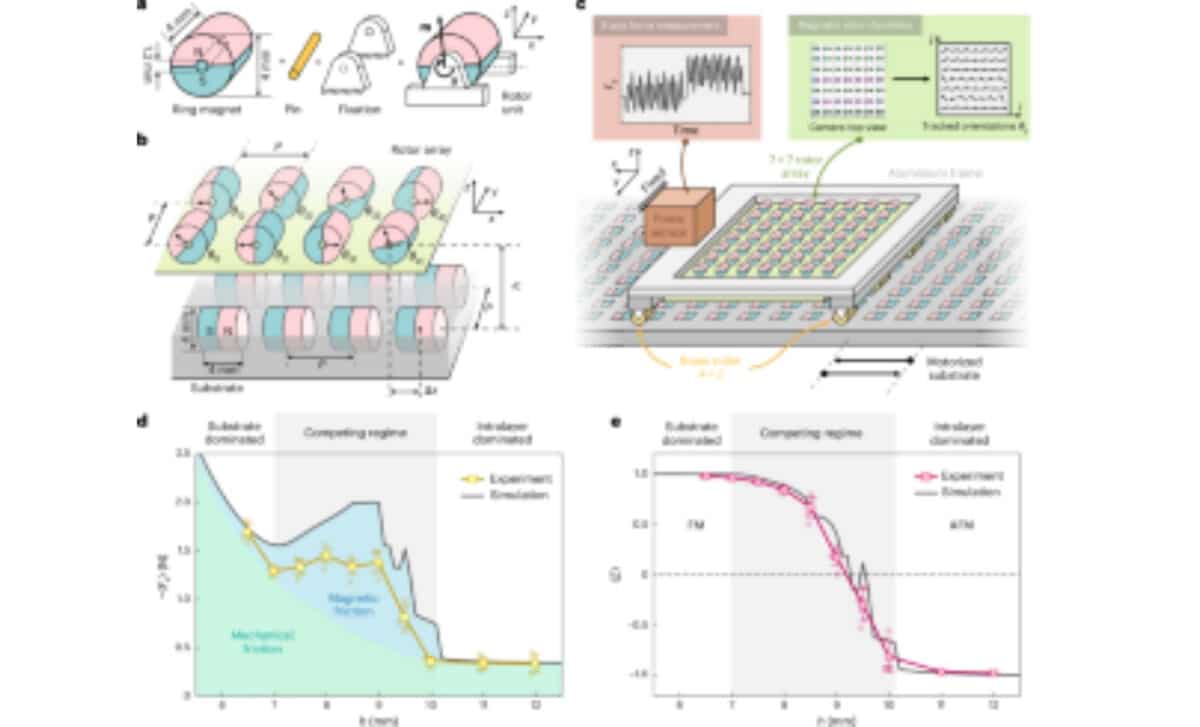 Experimental set-up, total friction and order parameter – © Nature Materials
The team then varied the distance between the two magnetic layers to observe how that friction changed. What they found directly contradicted Amontons: at both close and far distances, friction was at its weakest. At intermediate distances, however, friction increased.
Competing Interactions at the Heart of the Anomaly
The explanation lies in the internal magnetic dynamics that emerge at those intermediate distances. According to the researchers, when the layers are neither too close nor too far, competing interactions take over. In the top magnetic layer, magnetic moments point in parallel but opposite directions, a configuration known as antiparallel alignment, while the bottom layer settles into a same-direction parallel alignment. This unstable configuration forces the materials to constantly switch between parallel and antiparallel states as they slide, and it is that incessant reorganization that generates increased friction.
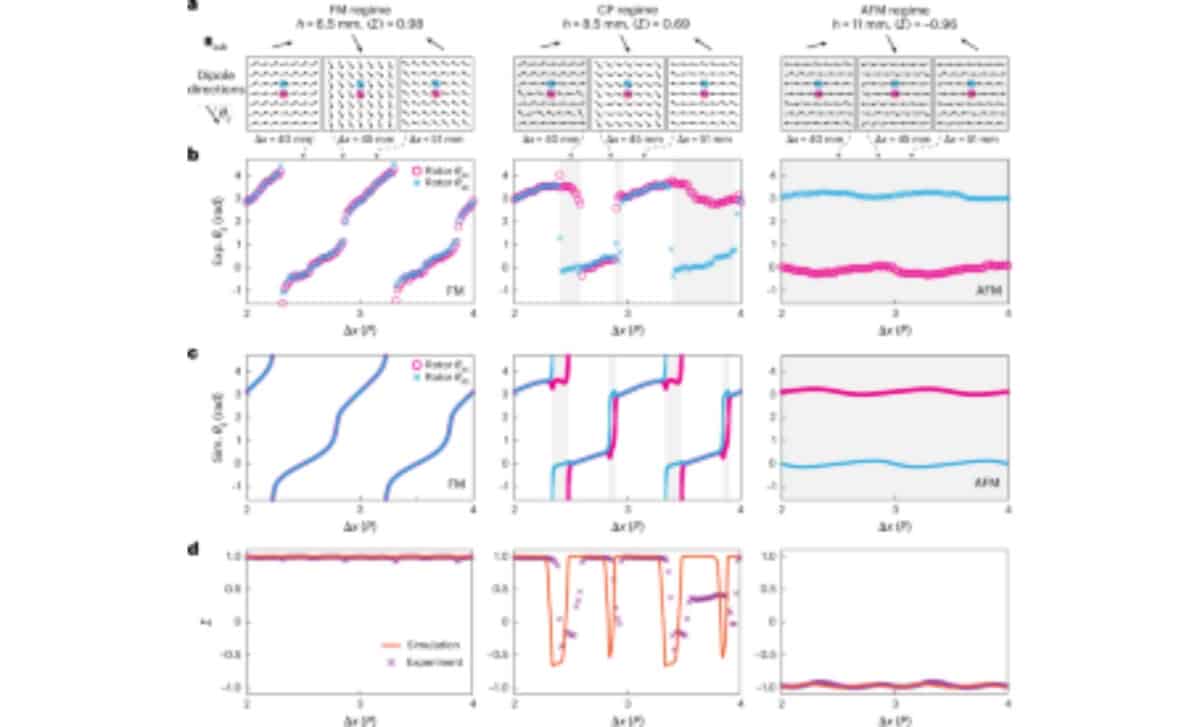 Magnetic moment configurations and dynamic responses at different h – © Nature Materials
Hongri Gu, of the Hong Kong University of Science and Technology, who co-authored the research while at the University of Konstanz, explained: “By changing the distance between the magnetic layers, we could drive the system into a regime of competing interactions where the rotors constantly reorganize as they slide.”
Friction With No Wear, No Roughness, No Contact
What makes this discovery particularly striking is the mechanism behind it. Clemens Bechinger, supervisor on the project at the University of Konstanz, stated in a press release: “What is remarkable is that friction here arises entirely from internal reorganization. There is no wear, no surface roughness, and no direct contact. Dissipation is generated solely by collective magnetic rearrangements.”
According to Popular Mechanics, the experiment was not designed simply to prove Amontons wrong, his law, the researchers acknowledge, continues to work remarkably well under normal circumstances. The broader aim was to understand magnetic behavior at the macroscale, given that whatever dynamics occur there are likely to occur at the microscopic level as well. That potential opens possibilities for a range of micro- and nanoelectromechanical devices, including magnetic bearings and atomically thin magnets.