
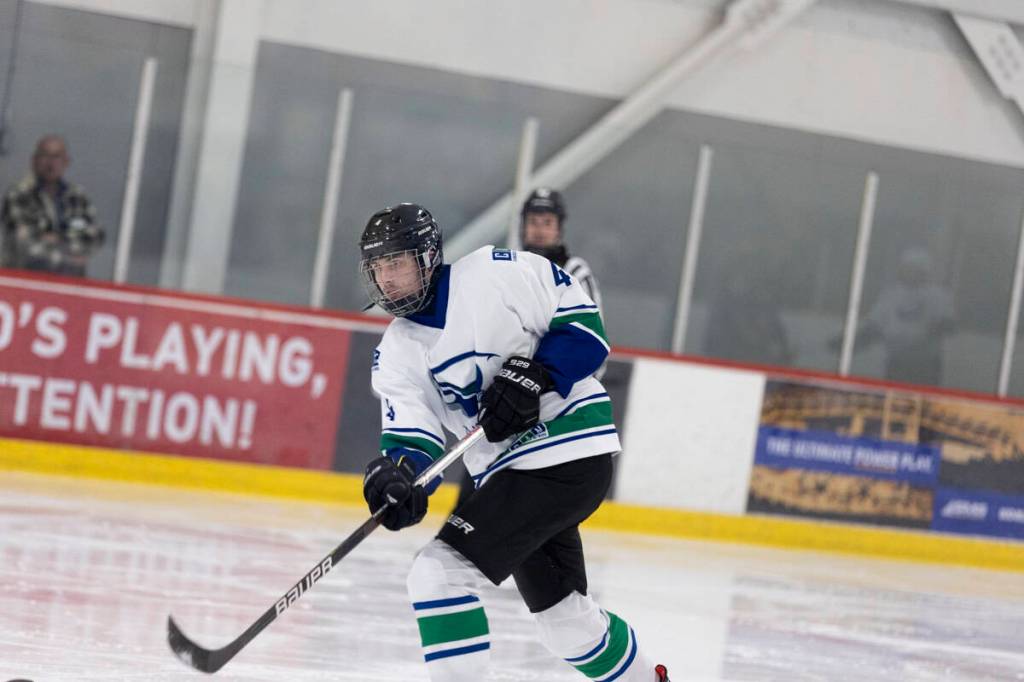
Hundreds of hockey players faced off in Surrey on Saturday in the 2026 CAN Adapted Hockey Tournament.
Over 250 athletes from 14 teams across British Columbia participated in the tournament. For the third consecutive year, the event was hosted by the Canucks Autism Network (CAN) and supported by the Canucks for Kids Fund.
Games were played in Fleetwood on three rinks of Surrey Sport and Leisure Complex from 8 a.m. to 5 p.m., including an all-star affair between Surrey Firefighters and senior players at 4:20 p.m.
The Vancouver Orcas and Surrey Stingrays, from the network’s hockey junior and senior teams, and the Coquitlam Sharks, from the junior program, have been busy preparing for the tournament and practising every week since October.
Junior (ages 5-18) and senior divisions (19+) also include Chilliwack Little Heroes, Vancouver Island Vision, Central Okanagan Wildcats, and other visiting teams.
Ryan Laface, a Langley resident, first joined CAN’s adapted hockey junior team when he was 10 years old, and he has played for the Surrey Stingrays every year since.
He moved up to the senior team in the first year it started and continues to play on the team today.
Laface said playing on the hockey team gives him something to do every week and is a lot of fun.
“It also gives me something that I could be proud of my effort for,” he said.
Laface has become a leader on the senior team and said it happened naturally, but he was quick to add that he is not the “main leader.”
“I think that consists of at least two to three other guys; we believe that we work as a team. There really isn’t any clear leader that stands out from the rest. It’s the kind of guy that can give wisdom, that has experience, and I feel like I fit that description. But so many guys on the senior team, and even on the junior team, could fit that description. It’s not just me,” he said.
Laface’s mother, Michelle, said she has seen the positive impact the Canucks hockey program has had on her son and on families like her own.
Michelle said Laface has always loved hockey, so when he was accepted into the CAN hockey program, “I thought for us, it was like winning the lottery,” she said. “Because for a child who’s on the spectrum and has special needs, they can’t always dress themselves. I mean, that seems like a simple thing for most parents, like getting ready for hockey, and at some point, they don’t want those parents in the locker rooms anymore.”
“This allows us to be with our child from start to finish, and it gives them a platform to play hockey, because otherwise they wouldn’t be able to play hockey, and in doing that, they learn life skills, cooperation, communication, teamwork, and how to treat other people. And also, too, social skills are hard, and they learn that, and learn life lessons, because not everything goes our way, and when we don’t win a game, or we don’t pass the puck properly, it’s OK, you know, but you just try harder.”
Michelle said she’s thankful for the sponsors and people from the Canucks Autism Network who help make this event happen every year.
The Canucks Autism Network has brought everyone on the teams together as a family, Michelle said.
“We look at our teams as families, not just team members, because the parents get to chat, and if their child needed any kind of therapy, we get to collaborate, and we find therapies and help for our children in ways that you know you wouldn’t find and support each other,” she said.
For more than a decade, adapted hockey teams from across the province have come together for a day of friendly competition hosted by CAN, founded in 2008.
Canucks Autism Network CEO Britt Andersen said the adapted hockey tournament is in a different city in B.C. every year, and the past three years it has been in the Lower Mainland and hosted by them.
Next year’s event will be in Kelowna and will be hosted by a local organization.
Many of the players are neurodivergent in some way, with many of them on the autism spectrum, so the game has been adapted in several ways to make it more accessible.
This includes ensuring the players have support from on-ice coaches, no buzzers, and a countdown when it is time for the lines to change. There are also sensory kits and sensory-friendly places available, and players can wear sunglasses and noise-cancelling headphones.
“This event highlights the power of adapted sport to foster friendships, build confidence, and ensure every individual feels like a valued part of our hockey community,” Andersen said.
A barbecue lunch was available to attendees by donation, and free for players and coaches, provided by the Surrey Fire Fighters.
-With files from Tom Zillich
About the Author: Anna Burns
I cover breaking news, health care, court, Vancouver Rise FC, Vancouver Goldeneyes and social issues-related topics for the Surrey Now-Leader. anna.burns@surreynowleader.com Follow Anna on Twitter.