
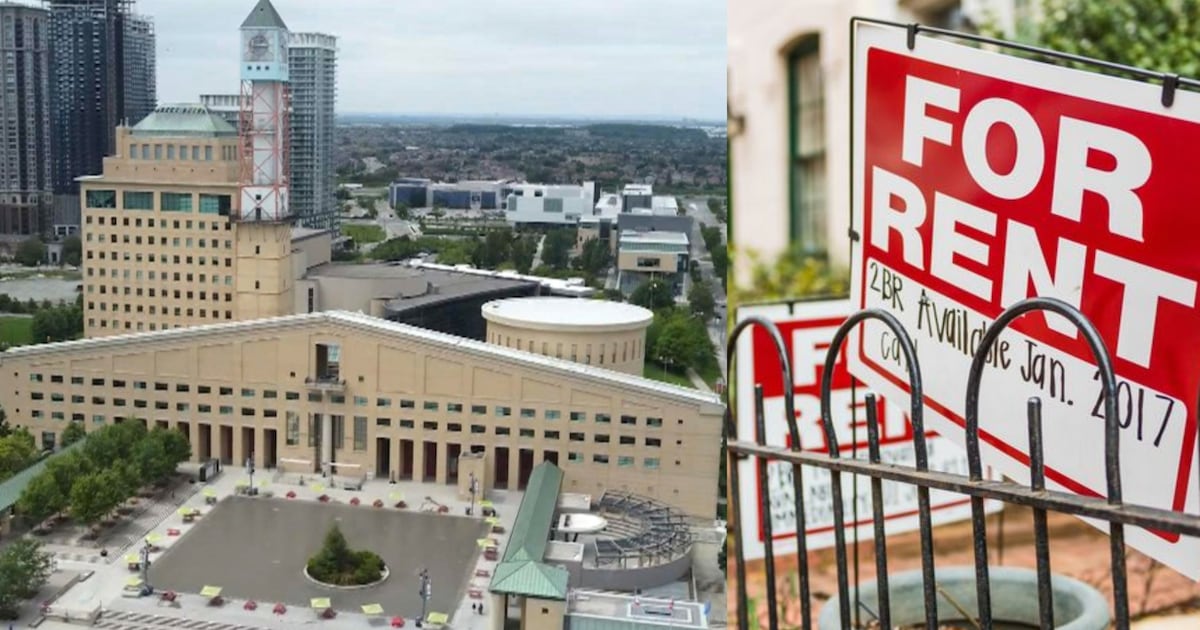
It’ll soon be harder for landlords in Mississauga to “renovict” tenants.
On Wednesday, Mississauga City Council approved the new Rental Repairs and Renovations Licensing bylaw.
Set to take effect on Sept. 1, the bylaw will impose a slew of requirements on landlords, notably requiring them to obtain a license from the city before evicting tenants for extensive renovations or repairs.
The city says it aims to better protect renters from “renovictions,” an unlawful practice where landlords do not follow the legal process of properly evicting tenants for extensive renovations or repairs, often pushing them out to raise the rent.
Developed with input from local tenants, landlords, and the wider community, the Rental Repairs and Renovations Licensing bylaw operates in conjunction with the Ontario Residential Tenancies Act (RTA).
“We’ve designed this ‘made in Mississauga’ by-law to be complimentary to the RTA’s N13 process,” Graham Walsh, Mississauga’s City Solicitor and Commissioner of Legislative Services, said in a news release.
Walsh said when putting together this new bylaw, he said staff “conducted benchmarking analysis and consulted with landlords and tenant advocacy groups.”
“What we heard is that moving is a significant financial burden on tenants, the licensing process can impose a financial burden on landlords, and communication between tenants and landlords tends to break down during the renoviction process,” Walsh said.
“This bylaw responds to those concerns by ensuring tenants are supported with their moving expenses, providing landlords with a scaled licence system, and requiring landlords to provide the City with proof that their tenants are being properly informed throughout the process.”
 For rent-1.8772240 For rent sign. What new by-law will entail
This new bylaw will require landlords to also apply for a Rental Repairs and Renovations Licence from the city within seven days of serving an N13 notice to their tenant.
They must also properly inform their tenant of a repair- or renovation-related eviction by posting a notice of their application for a Rental Repairs and Renovations Licence on their door and providing them with the city’s information package informing the tenant of their rights. They must also notify the municipality that this has been done.
Further, landlords will not be allowed to move forward with renovations or repairs until the building permit and licence are issued. They must also pay the licence fee, the cost of which is determined based on the landlord’s estimate for the duration of the work.
Compensation and accommodation
Compensation and accommodation for tenants are also part of this new bylaw.
Landlords will be required to make a one-time “moving contribution” payment to assist their renter with moving expenses. This applies regardless of whether or not the tenant chooses to return to the unit.
The payment is $1,000 for units that are 70 square metres or less, or $1,500 for those bigger than that size.
According to the new by-law, tenants who choose to return to their unit after a repair or renovation is done and their rent is higher than their current payment are also eligible to receive a rent top-up payment from their landlord after they have accessed any applicable compensation under the RTA.
This top-up payment, once it is triggered, must be paid until the tenant returns to the unit, the city noted.
“It is calculated as the difference between the tenant’s current rent and the average rent for a similar unit in Mississauga,” it said.
Lastly, if the tenant chooses to not return to their unit and the landlord has offered to provide them with an acceptable alternative unit, the bylaw requires the landlord to “consider factors like the rental rate of the new unit, size, and proximity to transportation and services.”
Enforcement
To enforce this new by-law, Mississauga says it will be taking a “balanced approach” that includes public education.
Penalties for landlords who fail to comply with it can be fined between $500 and $1,000. More serious offences can result in a fine up to $100,000, upon conviction, the city said.
Tenants can report landlords whom they believe aren’t following the Rental Repairs and Renovations Licensing bylaw to 311.
 CKTB – NEWS – For rent-1.3717317 For Rent sign in front of new house. Landlords must also follow N13 process
Aside from obeying the provisions of this new by-law, landlords in Mississauga must also follow the province’s N13 process, which outlines the legal steps they must take when undertaking extensive renovations or repairs that will displace their tenants as outlined in the RTA.
Among other things, they are required to obtain a building permit from the city before undertaking repairs or renovations where the unit needs to be vacated.
Under the N13 process, Mississauga landlords must get a building permit from the city before undertaking repairs or renovations that require vacant possession of a rental unit.
“Landlords must also compensate displaced tenants by either paying one or three months’ rent, depending on the size of the building, or by offering suitable alternative rental accommodation,” the city said.
Rental Housing Protection By-law also updated
Mississauga is also updating its Rental Housing Protection By-law for buildings with six or more units, with the goal of providing additional supports for tenants and landlords.
Currently, there is a requirement for landlords to undertake a one-to-one replacement of any rental units that are demolished or converted to condominium ownership.
New by-law ‘another important tool’: city
“(This bylaw) is another important tool the City can use to ensure affordable rental housing remains available in Mississauga,” the City of Mississauga said in a news release.
Mississauga Mayor Carolyn Parrish said this new bylaw is all about supporting landlords who are making excessive improvements to their properties, while also protecting tenants from being illegally evicted.
“We intend to improve communication between landlords and tenants and ensure that landlords and tenants are equipped with the information, supports and resources they need,” she said in a release.
“This bylaw – spearheaded through such effective advocacy by Councillor Martin Reid, who listened to his constituents – will be another tool at our disposal to help protect tenants and preserve affordable rental housing in Mississauga.”
 Carolyn Parrish
The city said in the end, renovictions can increase housing insecurity and contribute to the loss of affordable housing.
“Rental housing is important for our city. Rental homes provide an attainable option for people with a diverse range of housing needs, including providing affordability to moderate-income households,” it said.