
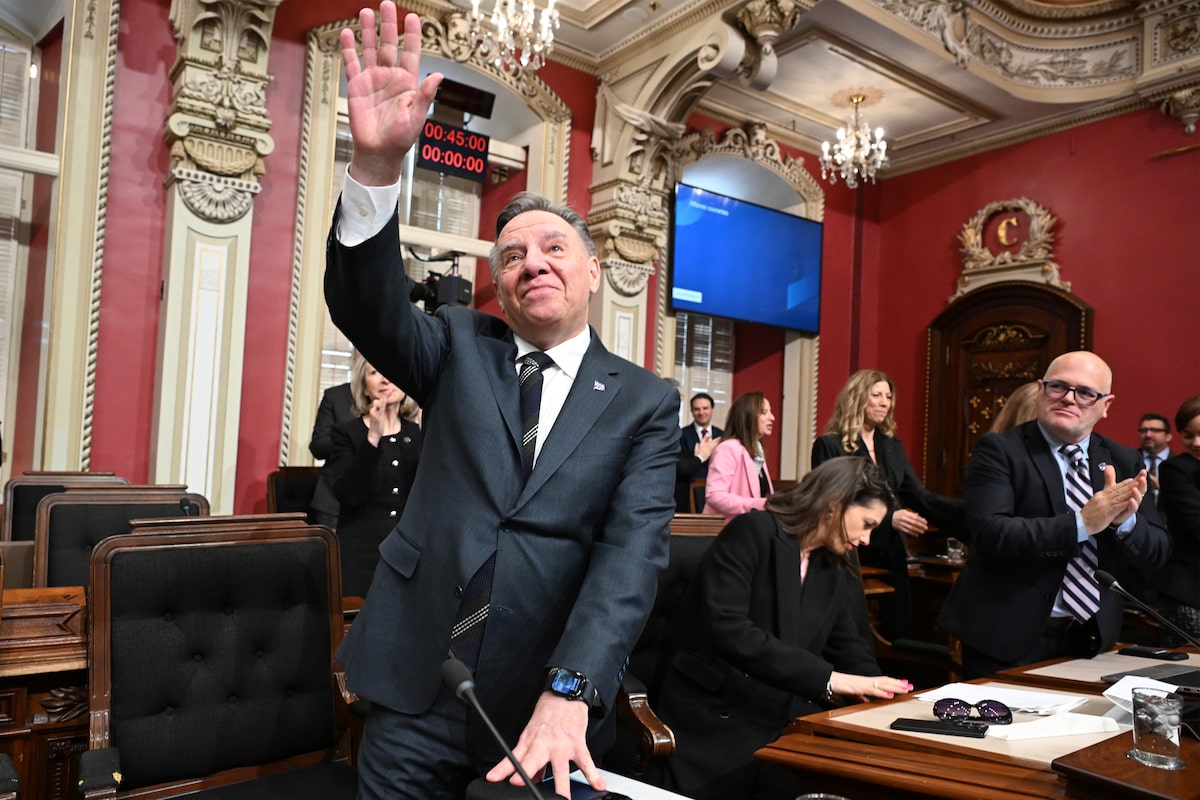
François Legault said Quebeckers should be proud of their history and culture, and urged them not to give in to pessimism in the face of war and instability.Jacques Boissinot/The Canadian Press
François Legault exhorted Quebeckers to defend their values and not give in to cynicism during an emotional farewell at the province’s National Assembly on Thursday, less than two weeks before he steps down as Premier after nearly eight years in power.
In his plain-spoken style, Mr. Legault recounted how he rose from humble beginnings to found the Coalition Avenir Québec and then led it to form government in 2018, calling his time as Premier the “greatest honour” of his life.
He defended the broad strokes of his legacy, including an interventionist approach to the economy and efforts to define and safeguard Quebec’s identity.
“We have the right to want to protect our values,” he said in his final address as Premier to the legislature. “It’s true that our nation is evolving with the arrival of newcomers, but we have the right to want Quebec to remain Quebec.”
Mr. Legault, 68, announced his resignation in January after he proved unable to reverse the Coalition Avenir Québec’s collapse in the polls over the last two years.
In Quebec City, the curtain rises on an unpredictable election year
On April 12, party members will choose his successor, who will become premier. A provincial election is scheduled for October.
In a rare display of solidarity, colleagues and opponents alike paid homage to Mr. Legault’s nearly 30-year political career in the National Assembly on Thursday, saying he left his mark on the province as he fought to protect its unique character.
“He has made it normal once again to defend our nation,” said Parti Québécois Leader Paul St-Pierre Plamondon. “He has restored to Quebec a certain sense of self.”
In a tearful speech, Government House Leader Simon Jolin-Barrette said Mr. Legault “succeeded in bringing issues of existential importance to the Quebec nation back to the forefront of the political debate,” including secularism, immigration and the protection of the French language.
“I am convinced that your legacy will have profoundly transformed Quebec,” he told the Premier.
Earlier in the day, the legislature voted to adopt the government’s latest secularism bill, which restricts communal prayer in public places and extends the province’s ban on religious symbols to daycare workers.
The legislation is part of Mr. Legault’s long-standing effort to reinforce secularism as one of Quebec’s defining values. It follows Bill 21, which in 2019 banned religious symbols for public servants in positions of authority, including teachers. That law was challenged at the Supreme Court of Canada last month.
On Thursday, Mr. Legault said Quebeckers should be proud of their history and culture. He fought back tears when speaking of his own upbringing in a municipality west of Montreal, where he was raised by parents who he said did not finish high school. His biggest regret, he added, is that his father died too young to see what he made of his life.
Mr. Legault co-founded Air Transat in 1986 before turning to politics. He joined the Parti Québécois and was first elected to the National Assembly in 1998. On Thursday, he cited PQ founder René Lévesque as his “greatest inspiration.”
In 2011, he co-founded the Coalition Avenir Québec, a nationalist party that rejected the idea of a third referendum on sovereignty. Under his leadership, the party formed majority governments in 2018 and 2022.
André Fortin, House Leader for the Liberal opposition, said that for many Quebeckers, Mr. Legault will forever be “inextricably linked” to the COVID-19 pandemic, when he formed a “unique bond” with an anxious electorate. “Never before have Quebeckers hung on every word of a political leader, day after day,” Mr. Fortin said.
But the CAQ has plummeted in popularity in recent years, eclipsed by the PQ in the polls. Two former cabinet ministers, Christine Fréchette and Bernard Drainville, are now vying to become premier.
Mr. Legault has been criticized for his management of Quebec’s economy, including for losing money on investments in electric vehicle and battery projects. Ms. Fréchette, the former economy minister, has promised to take a less interventionist approach. But on Thursday, the Premier defended his record, saying government assistance is required “to give us the means to achieve our ambitions.”
“If you don’t take risks, you don’t move forward,” he said. “And we mustn’t let failure paralyze us.”
With his wife, Isabelle Brais, looking on from the gallery, and with many of his colleagues wiping away tears, Mr. Legault urged Quebeckers not to yield to pessimism in the face of war and global instability.
“Cynicism must not replace hope,” he said. “Each of us here has a responsibility to offer hope – to give hope to future generations, to believe in the future, to believe in humanity, and to believe in ourselves.”