
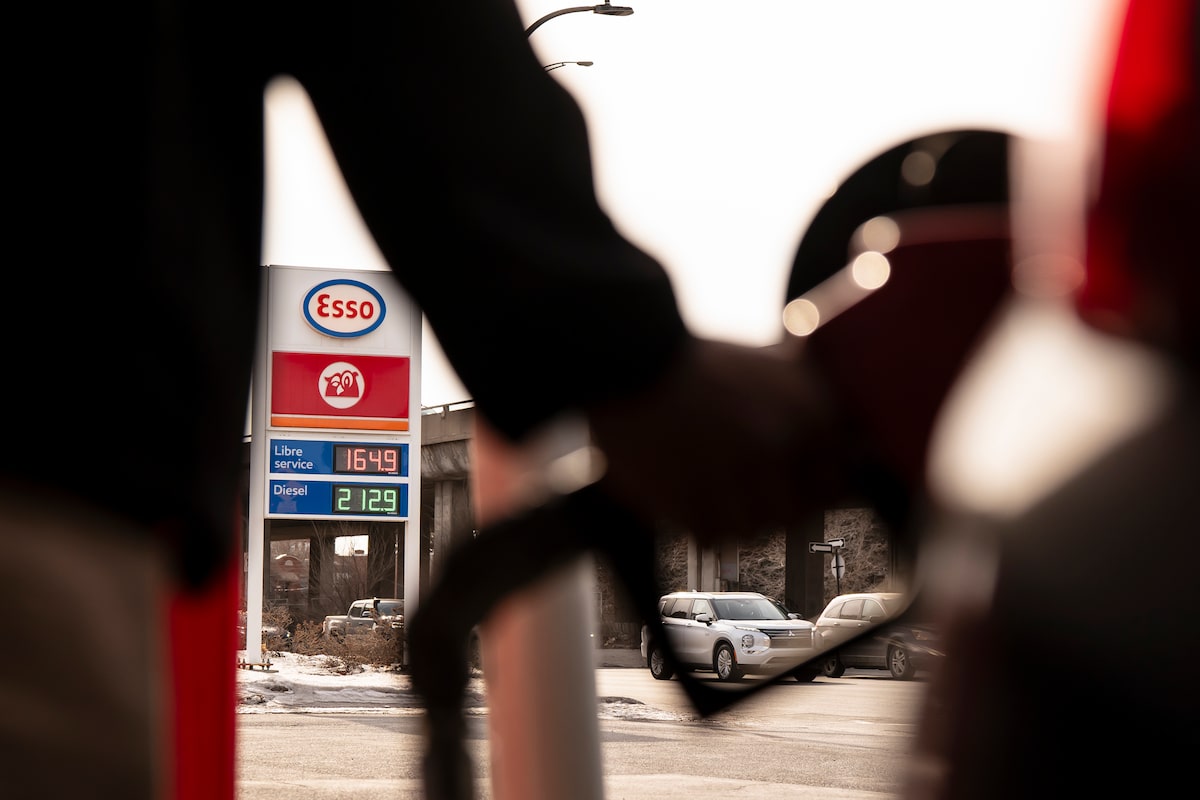
A person fills up their car with gas at a station in Montreal on March 5. Sustained increases in energy prices seep through the entire economy, writes Tim Shufelt.Christopher Katsarov/The Canadian Press
Back in January, 2020, it was obvious a global health emergency was afoot. A new deadly virus was known to be spreading human-to-human, the entire city of Wuhan, China, was in lockdown, and infections were confirmed across Asia, Europe and North America.
The TSX ended the month with a gain of 1.5 per cent. The S&P 500 index hit a record high in mid-February.
The stock market is an imperfect forecasting machine, often untroubled by the approach of disaster. Today the investor base seems to have faith that the oil supply disruption will be quickly undone, despite growing evidence to the contrary.
The conflict in the Middle East represents “the greatest global energy threat in history,” Fatih Birol, the head of the International Energy Agency, recently told the Financial Times.
“People understand that this is a major challenge, but I am not sure that the depth and the consequences of the situation are well understood.”
Oil shock resilience in March – or smoke and mirrors?
Parts of Asia are already rationing fuel, and Iranian missile strikes on Qatar effectively took one-fifth of the world’s liquefied natural gas supply offline. Gasoline prices in the United States and Canada have spiked to four-year highs.
The stock market isn’t too worried about it. Sure, there’s been lots of volatility, with indexes swerving from one day to the next, mostly in tandem with U.S. President Donald Trump’s mood swings.
But the S&P 500 index is down all of 4.3 per cent since the fighting began. The S&P/TSX Composite Index has lost a mere 3.6 per cent. That barely qualifies as a dip.
Financial markets are shrouded in complacency. Futures contracts show traders are betting on West Texas Intermediate returning to around US$70 a barrel by the end of the year.
And in the month or so since the bombs started falling, analysts have raised their estimates for S&P 500 earnings by 2.6 per cent – the strongest revision since the end of the COVID-19 recession, according to a National Bank of Canada note.
Why this confidence that the situation will quickly blow over? All signs point to conditions getting worse.
Emergency reserves of crude oil are being rapidly drawn down and the last tankers to make it through the Strait of Hormuz before it was shut down will soon make their deliveries.
Stocks end mixed as oil prices spike and worries linger before holiday break
“With the conflict now expected to last at least into deep April, the barrel math becomes increasingly grim,” Ryan McKay, commodity strategist at TD Securities, said in a note to clients.
Almost one billion barrels of oil and refined products could be lost by the end of April, while each additional month the strait is choked off will claim another 450 million barrels, Mr. McKay said.
A giant supply-demand imbalance can only be rectified by price. We saw that during the pandemic. Energy demand plummeted when much of the world was locked down, and crude oil prices soon went negative for the first time. This time, the market is working in the other direction.
It was only a matter of weeks ago that the burning question was, what happens if oil goes to US$100? Now energy analysts are floating the potential for US$200-a-barrel oil.
“That is not an outlandish possibility,” economist Paul Krugman wrote this week. “If oil really does go to $200 or more, it’s all too easy to envisage a full-blown global economic crisis, with an inflation surge and quite likely a recession.”
Sustained increases in energy prices seep through the entire economy. Consumers cut down on spending. They drive less. Airlines introduce fuel surcharges and cancel flights.
“Demand destruction has begun,” oil analysts at JPMorgan wrote in a recent note, pointing to efforts by Asian policy makers to cut down on energy use. The Philippines and Sri Lanka implemented four‑day workweeks to reduce diesel consumption. Schools were closed in Pakistan. In Vietnam and Thailand, workers were encouraged to stay home and reduce travel. Alternating driving days were put in place in Myanmar.
Aside from higher gas prices, North American consumers have been largely spared the pressures of an energy supply crunch, but that probably can’t last. “As market inventory buffers erode, the physical tightness seen thus far in Asia begins to cascade globally,” Mr. McKay wrote.
Even the stock market would have a tough time ignoring that.