
The jingle “Good things grow in Ontario” doesn’t ring true for a big part of the province’s finances in this year’s budget. Interest payments on Ontario debt are growing more than three times the spending on education.
If average spending growth rates projected in the 2026 budget continue, Ontario taxpayers will be paying more on interest payments on the debt than on all of social services combined by the start of next decade. By 2030, they could reach $18.6 billion.
The heartland province is projecting a deficit of $13.8 billion for 2026-27 as it grapples with U.S. tariff uncertainty and economic headwinds, but plans to return to balance with a $0.6 billion surplus by 2028-29, Finance Minister Peter Bethlenfalvy announced late last week. Lost by many in the media was the fact that payments to service Ontario’s debt are projected to grow the fastest for spending on any other top-line item.

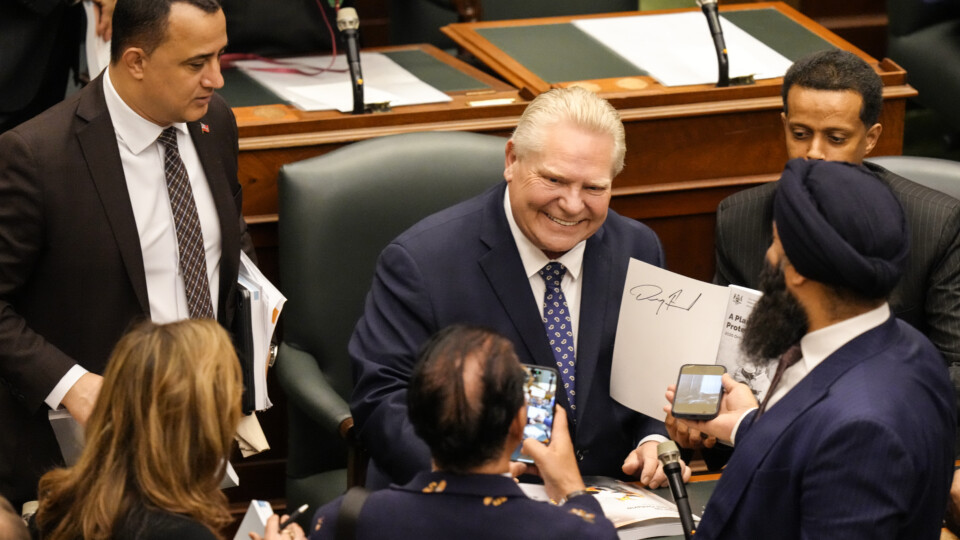
Premier Doug Ford’s 2026 budget—“A Plan to Protect Ontario”—projects an average growth rate of 6.9 percent for interest payments on the debt from the end of the last fiscal year (March 2025) until 2028-29. That far exceeds the average annual growth rate in spending on: health care at 4 percent, social services at 1.5 percent, the court system at 0.7 percent, education at 2 percent, and post-secondary education at -2.7 percent.
The Ontario government’s interest payments on the debt ($15.1 billion) over the past decade have consistently surpassed what Queen’s Park spends on postsecondary education ($14.2 billion last fiscal year) and the justice system ($7.2 billion last fiscal year).
Ford’s latest budget shows a 6 percent growth rate in debt interest payments from $15.1 billion (2024-25) to $16.0 billion (2025-26) by the end of this last fiscal year, concluding at the end of March. Projections for the debt interest payments show them growing another 7.5 percent year-over-year by the end of next fiscal year (2027-28), ballooning to $17.2 billion. The following year, the interest payments on the debt are expected to grow by another 8.1 percent to $18.6 billion. By 2028-29, they expect the growth rate to drop to 5.9 percent, hitting $19.7 billion that fiscal year. That’s just shy of the $20.1 billion the Ford government predicts it will spend for postsecondary education and the justice system combined for that same year.

Ford government’s spending on debt interest payments on track to surpass spending on social services by next decade
Back in 2019, Premier Ford released his first budget and admonished his predecessor, Kathleen Wynne, for letting Ontario’s finances get out of hand. He highlighted how the interest on the debt was a major burden on taxpayers.
“Interest on debt payments are the fourth largest line item in the budget after health care, education, and social services,” the 2019 budget read.
Last week, inside the Ford government’s eighth budget, interest payments on the debt remained the fourth-highest line item. However, by 2030-31, Ontarians could be paying more to cover interest payments on the provincial debt than the social services line item, which excludes schools and health care.
If the government’s 2026 predictions for the average growth rate come to fruition in the next decade, taxpayer spending on debt interest payments will surpass all social services spending.
View reader comments (0)
If the average projected growth rate of 6.9 percent is applied to the debt interest payments past the current projection years, Ontarians will be paying $22.5 billion in interest on the debt by 2030-31. Meanwhile, if budget 2026’s average growth rate in spending for social services continues, at 1.5 percent, the province will be spending $22.4 billion towards all social services by 2030-31.
This would mean more money from Ontario’s public coffers would be going towards interest payments on the provincial debt than all social services combined, including basic financial assistance and employment supports, income support for people with disabilities, group homes, supported living, day programs, foster care and protections services, child care subsidies for low income families, early years programs and services, homelessness and housing-related supports, Indigenous social programs, women’s shelters and violence-prevention services, employment and social inclusion programs, and various other community agencies delivering social programs.

Graeme Gordon is The Hub’s Senior Editor and Podcast Producer. He has worked as a journalist contributing to a variety of publications, including CBC,…
Read more
Doug Ford’s 2026 Ontario budget reveals that interest payments on the province’s debt are projected to grow at a significantly faster rate than spending on essential services like health care, education, social services, and the justice system. The budget projects a deficit of $13.8 billion for 2026-27, aiming for a surplus by 2028-29. However, the rapid growth of debt interest payments is a major concern, potentially surpassing social services spending by 2030-31. This trend raises questions about the province’s financial priorities and the long-term impact on taxpayers and public services.