
This story is part of the new Globe series Think Big, looking at Canada’s most important nation-building energy and natural resource projects and the trade infrastructure needed to support them.
A 16-storey headframe rises above an otherwise undisturbed expanse of prairie sky.
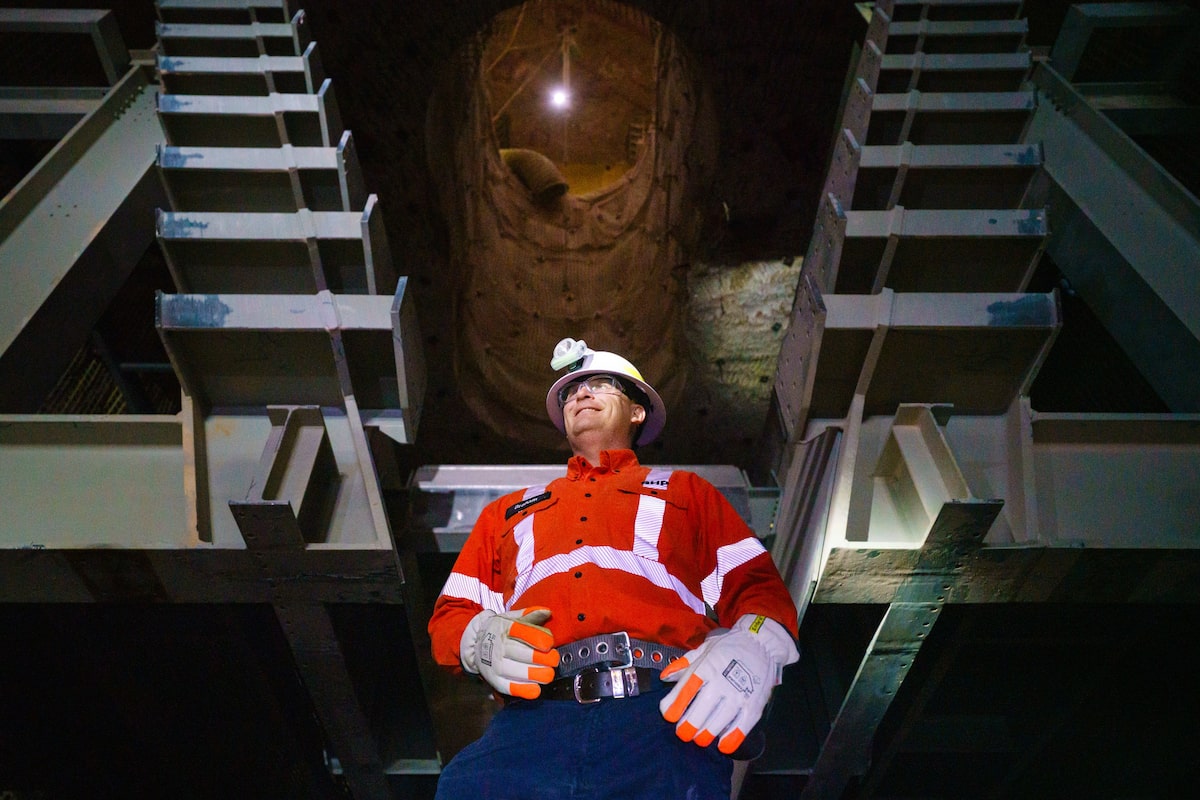
Beneath the structure is a chasm 1,000 metres deep that leads to a subterranean network of steel structures, conveyor belts and boring machines that will dig into the Earth for a century.
This is the $18-billion Jansen potash mine: the biggest investment in the history of Saskatchewan and in the history of the world’s largest mining company.
Australian juggernaut BHP Group Ltd. BHP-N is digging into the Prairie Evaporite Formation – the remains of an ancient inland sea – to extract a prized pink salt essential to global food production.
The potash from this mine will travel on 2,000 kilometres of rail to a port in British Columbia and then supply 10 per cent of the world’s demand by 2031.
“Jansen is the best undeveloped, now being developed resource out there,” said BHP chief executive officer Mike Henry. “And it’s going to be positioned very well in the markets over the decades to come.”
It is a lesson for Canada in how to build big.
A mining project of Jansen’s magnitude is a rare case across the country, as Canada’s reputation for cumbersome, costly regulatory approvals eclipses the nearly unparalleled natural resources hiding beneath her soil.
Prime Minister Mark Carney is trying to change this reputation and lure global investment, promising Canada is worth the wager and betting our fat deposits of critical resources will not only enrich citizens and the companies who take the leap, but also diversify global supplies of critical minerals.
Jansen is therefore coming online at a opportune moment: It is a telling test case in how Canada can once again build big things.
BHP CEO Mike Henry is the fourth leader to oversee BHP’s decades-long potash ambitions in Saskatchewan. Hanging on the wall in the company’s Toronto headquarters is a photo of the Jansen mine at an earlier stage in its construction.Fred Lum/The Globe and Mail
But Jansen is also a warning for Mr. Carney. In 2021, BHP forecast that the first stage of Jansen – now 75-per-cent complete – would cost $7.5-billion. The price tag has since climbed to $11.7-billion. The timeline has also shifted numerous times, pulled off course by a particularly volatile five years for critical minerals. And in mid-March, Mr. Henry announced that he will step down in July. The incoming CEO will be the fifth leader to oversee BHP’s decades-long potash ambitions in Saskatchewan.
Building big requires ambition and deep financial reserves. And this project is at the crux of a tumultuous geopolitical climate: trade in critical minerals is threatened by the turn toward protectionism by the United States, and tankers of fertilizer are stalled in the Strait of Hormuz because of its war with Iran.
The difficulties faced by BHP therefore present tough questions for other producers that wish to follow in its footsteps, while also testifying to the opportunity for governments and companies that accept the challenge.
One thousand metres underground, in the tunnels of a potash mine, the air is dry, hot and tastes like salt.
Potash is named after the centuries old technique of boiling wood ashes in a pot to make a rudimentary fertilizer, and in the tunnels of a mine it coats everything in a fine pink dust. It is so pervasive that the metal equipment working away down here cannot survive a return to the surface: The moisture of the air above ground will react with the salt and the metal will rust.
But the subterranean network of steel structures, conveyor belts and boring machines at the Jansen mine, 140 kilometres east of Saskatoon, will not surface any time soon. Jansen is here to stay.
A thousand metres underground, steel structures, boring machines and other heavy equipment are built to withstand the hot, dry conditions of the mine to extract potash ore.
The mine is being built in stages. Stage one aims to begin production in mid-2027 and to churn out 4.15 million tonnes of potash per year. Just this first portion will cost US$8.4-billion. Stage two is set for completion in 2031. The Jansen site has the potential for two additional stages, which would take the project to an ultimate production capacity of 16 to 17 million tonnes per year.
The project is a core part BHP’s shift to what it calls “future-facing commodities.”
The amount of land on Earth that is suitable for agricultural production is essentially static, while the global population is expected to reach 9.1-billion people in 2050, according to the United Nations. That means agricultural production must increase by 70 per cent between 2005 and 2050.
Farmers will need to be more efficient to boost their yields, said Karina Gistelinck, BHP asset president of potash. In other words, they will need more fertilizer. Especially farmers in emerging agricultural economies such as Brazil and China.
“That’s a very uncontestable sort of growth that no other commodities have,” said Ms. Gistelinck.
But BHP will be a newcomer in a captured potash arena.
Three nations lay claim to rich deposits of potash. Saskatchewan has the largest reserves and accounts for over 30 per cent of global production. Russia and Belarus are the other two major players.
Within Canada, BHP’s major competitor is the largest potash producer in the world: Saskatchewan’s Nutrien Ltd. NTR-N Born in 2018 from a merger between Saskatchewan’s potash miners, the company traces its legacy to 1958. The Nutrien web of six mines churn out 20 million tonnes of potash a year, which is distributed to more than 40 countries, where the company’s customer relationships stretch back decades.
Russia’s Uralkali – which owns and operates mines across the vast Verkhnekamskoye salt deposit – sold 12.8 million tonnes of product in 2024. Around 78 per cent is exported, with a focus on the emerging agricultural economies of China, India and Latin America.
Saskatchewan has the largest reserves of potash, a potassium-salt compound that is essential to all major agricultural production, and accounts for over 30 per cent of global production.
Russia and Belarus production also seems to be co-ordinated, said Joshua Mayfield, growth minerals analyst for Hallgarten & Co. The combined production of the two states surpassed Canadian output in 2024 and 2025, an effort that started after Russia invaded Ukraine and faced sanctions.
The Eastern European states have a competitive advantage when it comes to production costs. According to Uralkali’s latest annual report, the average annual salary of an Uralkali employee is US$16,140.
Smaller players are also rushing into the space. Global potash capacity is expected to rise 20 per cent between 2024 and 2029, according to a report from the International Fertilizer Association and smaller projects around the globe will contribute to this climb. Work is under way for potash mines in Brazil, Laos and a Chinese-backed project in Thailand. There are even plans for an expansion of a small mine in Manitoba.
To be competitive, Ms. Gistelinck said BHP knew it needed to lean into what the mining giant does best: scale and staying power.
When BHP moved forward with Jansen, it had not sold a single tonne of potash in its 140-year history. It also had no operating mines in Canada – the closest operating BHP mine is in Santiago, Chile.
Jansen represented a company-wide shift into what BHP told investors were “future facing commodities with attractive long-term fundamentals.” The two other commodities included in this category were copper and nickel.
The shift came as BHP divested from its oil and gas assets, and tried to broaden its portfolio beyond coal and iron ore, said Mr. Mayfield. Canberra increased royalties on coal in Australia in an attempt to pressure the miner to reduce production.
“The future facing commodities strategy is all about megatrends,” said Mr. Mayfield. “Feeding the world is a megatrend. Modernization is a megatrend. I just think potash fits.”
Investing in Canada was a clear choice, according to the company’s 2021 investor presentation. Saskatchewan was home to 60 per cent of total global reserve base, much of which was high-grade. Deposits in other parts of the world are either small, inaccessible or – in the case of Russia and Belarus – becoming depleted.
Once the mine is fully operational, many of the mine’s employees will live a short bus ride from the site at the Jansen Discovery Lodge, which has accommodation, dining, fitness and entertainment facilities.
But building in Canada came with challenges.
The federal government’s 2022 critical minerals strategy said it can take 25 years for a Canadian mine to start production, partly because of complex permitting and regulations. Canadian producers contend with a federal carbon tax not levied against competitors in other countries.
It doesn’t help that Saskatchewan is a landlocked province. The vast distances between the centre of the country and the Port of Vancouver are subject to minus-40-degree temperatures in the winter, and Canadian railroads and ports are increasingly prey to labour issues.
The province worked hard to make up for these drawbacks, said a statement from Warren Kaeding, Saskatchewan’s Minister of Trade and Export Development.
BHP had to pass through the same regulatory processes as any other similar project, however, Saskatchewan’s regulatory system is collaborative in nature and focused on making sure major projects move ahead with “certainty and without undue delays,” he said.
BHP told investors in 2021 that investing in Canada was a clear choice, with Saskatchewan being home to 60 per cent of total global reserve base of potash.
The province offered what Mr. Kaeding called “concierge service” – direct contact with relevant ministries and support connecting with other stakeholders. Any potential gaps in regulatory compliance are also identified and addressed in advance.
This is because the province sees investments of this scale as key to economic development, he said. Saskatchewan was part of the “Sylvite Four-Six” partnership between provincial, municipal and First Nations representatives to anticipate and capitalize on economic growth in the region.
“Historic investments like these create new jobs and opportunities that keep pace with our growing economy,” said Mr. Kaeding. “By promoting the province’s business-friendly regulatory environment to outside investors, the Government of Saskatchewan is helping to build and protect communities here at home.”
From 2021 to 2026, BHP spent $1-billion in procurement from Indigenous businesses, and once Jansen is operational, BHP’s goal is to have a 20 per cent Indigenous work force. The BHP Potash Academy – a collaboration with Carlton Trail College in Humboldt, Sask. – is a paid eight-month program. Graduates are guaranteed a job at Jansen.
The costs for Jansen have far surpassed budget – and counting. The original price tag for the project was that $7.5-billion. In July of last year, the price climbed to $10.3-billion and in January, BHP signalled that the price had jumped again – to the current forecast of $11.7-billion.
The company blamed longer-than-expected construction hours, as well as material quantities, for the cost overruns.
The timeline for the project has also changed. Brought forward to 2026 as potash prices boomed following Russia’s invasion of Ukraine, Jansen 1 was pushed back to mid-2027 last July. Jansen 2 is now scheduled to begin production in 2031.
Capital expenditures for this stage of the project could change again. BHP will update the market in the fourth quarter of this year.
The project has also withstood a barrage of unpredictable global disruptions. Commissioned in the middle of the global COVID-19 pandemic, BHP had to contend with a shutdown in shipping and supply chains, said Ms. Gistelinck. This is a particular challenge for BHP because it has no other site in Canada. If Jansen needed a piece of equipment, there’s no quick supply.
And now there is increased execution risk, said Mr. Mayfield.
Brandon Craig, currently the president of BHP Americas, will succeed Mike Henry to become CEO starting July 1.Pablo Sanhueza/Reuters
BHP’s incoming CEO – Brandon Craig – will take the helm around one year before Jansen begins production. Simultaneously, a war in the Middle East means tankers loaded with fertilizers are stuck behind the Strait of Hormuz, increasing prices and threatening demand destruction as farmers face high input costs.
Running underneath this crisis, U.S. President Donald Trump’s protectionism agenda is upending the landscape. For decades, international mining giants have benefited from increased globalism and the liberation of trade, said Ms. Gistelnck. A world shaped by the ideas of the current U.S. administration could be much more costly for globally-traded commodities.
But Mr. Henry sees opportunity in this crisis – especially for a critical mineral such as potash.
Disruption has raised questions of sovereignty and national security in the kinds of materials needed to fuel and feed citizens in Canada and worldwide, said Mr. Henry.
Ottawa’s Major Projects Office has shown particular interest in mining and critical minerals projects, and numerous other countries are drawing up or rolling out strategies on the subject.
“There’s been an explosion in interest in resources and metals and minerals,” said Mr. Henry. “There’s been so much greater awareness of the criticality of these to everyday life.”
BHP, and other companies that dig deep and build big, are betting that they will stand to gain, he said.
“This is a very exciting time to be in the industry.”