
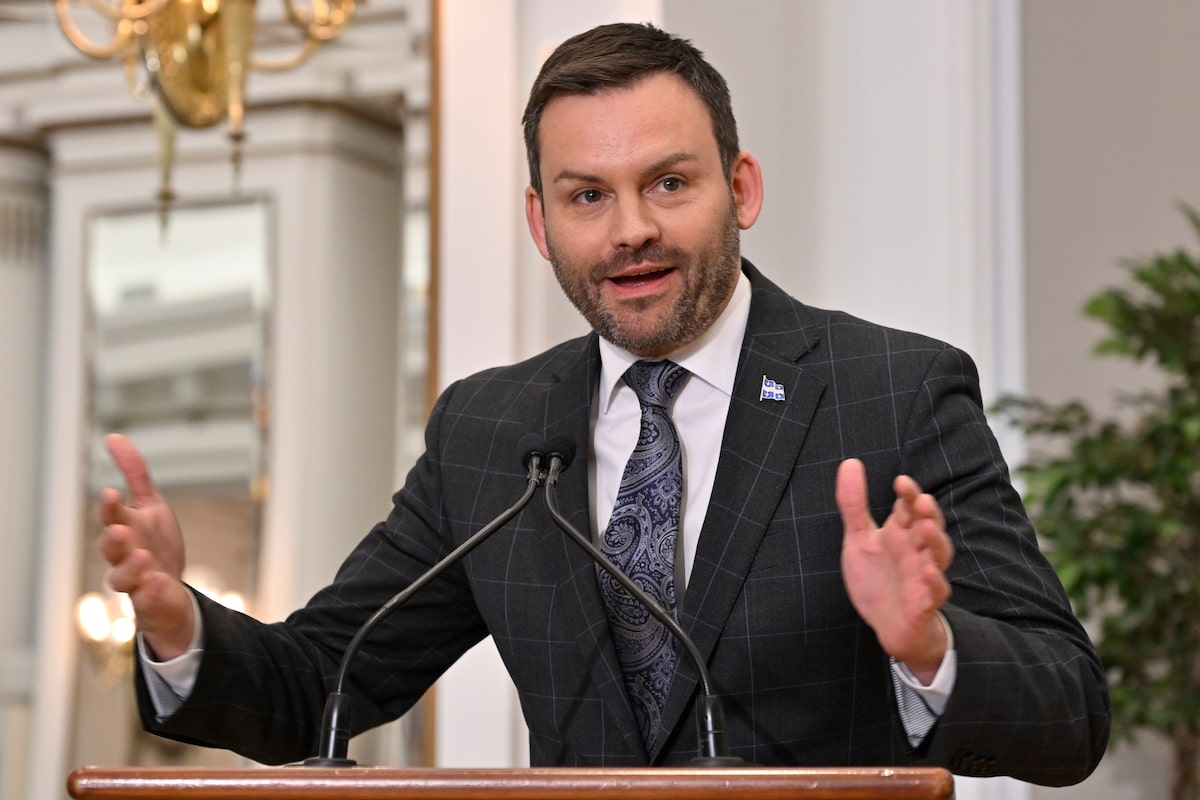
Parti Quebecois Leader Paul St-Pierre Plamondon at the legislature in Quebec City on March 3. The PQ Leader will need to do much better if he hopes to win over Quebeckers still skeptical about sovereignty, writes Konrad Yakabuski.Jacques Boissinot/The Canadian Press
The Parti Québécois has always faced a tough slog persuading voters that Quebec would be better off financially as an independent country than as a Canadian province. As long as Quebec has relied heavily on federal equalization payments, basic accounting has suggested quite the opposite.
This year, the province will receive $13.9-billion in equalization transfers from Ottawa. That sum is projected to rise to $15.2-billion in 2030.
Yet, despite billions of dollars in equalization payments – which aim to enable poorer provinces to provide comparable levels of public services at comparable levels of taxation to those offered in richer provinces – the Quebec government is projecting a deficit of $8.6-billion this year. Without equalization transfers, the shortfall would be significantly higher.
Quebeckers fund the federal equalization program, at least partially, through the taxes they send to Ottawa. As an independent country, the PQ has insisted, Quebec would recuperate those taxes and eliminate bureaucratic overlap to come out ahead.
Signs of weakness from the Parti Québécois have opponents circling
But believing the Péquiste math requires a giant leap of faith. That is because equalization is not the only federal program that favours Quebec.
According to Statistics Canada, the federal government spent about $27-billion more in Quebec in 2024 than it collected in taxes in the province. Federal expenditures exceeded federal revenues raised in Quebec by 32 per cent. That represents a whopping fiscal hole that an independent Quebec would need to fill.
When La Presse journalist Francis Vailles pointed this out in a column last week, PQ Leader Paul St-Pierre Plamondon’s first reaction was to shoot the messenger.
Under its previous owner, the influential Desmarais family, La Presse editorials had strongly backed the federalist side in the 1980 and 1995 referendums. But the all-digital newspaper is now a non-profit organization, and its journalistic standards are among the highest of any media outlet in the province.
Mr. St-Pierre Plamondon nevertheless accused Mr. Vailles and other La Presse opinion columnists of “vehiculating disinformation” and “federalist propaganda on questions surrounding Quebec independence.” He dismissed the $27-billion gap between federal spending and taxes in Quebec, insisting that “a large portion of this money never arrives in Quebec” and involves “bureaucratic expenses, paper-shuffling that happens in Ottawa and stays in Ottawa.”
Opinion: As an election approaches, the PQ begins to soft pedal its referendum plans
As far as rebuttals go, it was thin gruel. The PQ Leader will need to do much better if he hopes to win over Quebeckers still skeptical about sovereignty.
The methodology used by StatsCan to allocate federal spending in each province is imperfect. And the data do not capture the indirect costs and benefits of federal spending and taxation policies in each province.
But the StatsCan figures provide as accurate a picture of financial flows between Ottawa and the provinces as you are likely to find anywhere.
Université du Québec à Montréal economics professor and former PQ finance minister Nicolas Marceau offered a more nuanced criticism of the La Presse piece by pointing out that federal spending is increasingly being financed by borrowing. A fifth (give or take) of Ottawa’s rising debt burden – projected to top $1.4-trillion this year – inevitably falls on the shoulders of Quebec taxpayers. There is no free lunch.
“An independent Quebec could also choose to go into debt to inflate its spending, but this would not constitute proof of its prosperity,” Mr. Marceau opined. “The real question is not ‘how much Ottawa spends in Quebec’ but ‘who pays the bill.’ We do.”
Still, the debate over the financial sustainability of an independent Quebec is not one that favours the PQ, which promises to hold another sovereignty referendum if it wins the October provincial election. Quebeckers have always been wary of the financial risks of sovereignty. It is a big reason most still say they would vote No in a future referendum – if it gets to that.
It remains far from certain that the PQ will win the next election, much less obtain a mandate to hold a referendum. Polls increasingly point to a tightening race as the Quebec Liberal Party (QLP) rebounds under its new Leader Charles Milliard. The QLP has historically been the default choice of francophone federalists, a status it lost to the Coalition Avenir Québec in 2018, but which it appears to be recovering as CAQ support fades.
A Léger poll released last week had the PQ and QLP tied, each with the support of 33 per cent of voters. The QLP, which had fallen to 20 per cent in December as then-leader Pablo Rodriguez faced questions about the financing of his 2025 leadership campaign, appears to be benefitting now from Mr. Milliard’s arrival at the helm and voter aversion to another referendum.
Making the financial case for sovereignty will not get any easier for Mr. St-Pierre Plamondon. He will need much sharper pencils than the ones he has been using.