
When the Edmonton Oilers announced a coaching tweak in mid-February, it was an acknowledgement that things weren’t working in the team’s defensive zone. Coverage was poor, gaps between defence and forwards on outlet passes meant myriad icings and no real momentum going the other way, and the Oilers were spending far too much time in their own end chasing the puck.
The tipping point for the change, including Paul Coffey’s re-hiring, was an indifferent homestand (and a road loss to the Calgary Flames) leading up to the Olympic break. The deadline acquisitions of defenceman Connor Murphy and two-way centre Jason Dickinson from the Chicago Blackhawks reset the club’s attention to detail defensively. The organization also got lucky with improved health for defencemen Jake Walman and Ty Emberson, pushing the inexperienced Spencer Stastney out of the lineup.
The tweaks took some time to take hold, especially in net. As April arrived, and with Chicago in town on Thursday night, the Oilers arrived at the rink with a strong game plan and the ability to execute it consistently. The defence is calm, cool and collected, the passing routes are effective, the gap between forwards and defence are much improved, and the Oilers look like a unit of five men acquiring possession of the puck with extreme prejudice. Even the goaltending is above average.
How do we know it’s working?
StatPre-CoffeyPost-Coffey
Games
58
17
Point Pct
0.552
0.618
Goal Share
47
51
GF-60
2.47
3.05
GA-60
2.78
2.91
Shot Share
52
51
SA-60
25.32
24.86
HDSC Share
51
56
HDSCA-60
11.52
9.45
Save Pct
0.89
0.883
All on-ice numbers at five-on-five, via Natural Stat Trick
Coffey’s system is marching in lock step with the results from his previous run with the Oilers. The suppression of high-danger chances is key and results in less time defending. That feeds more time in the offensive zone, which leads to more Edmonton goals and an increased share of five-on-five goals.
Not all positives can be credited to Coffey, but the eye test confirms more organized play, highlighted by a large increase in successful breakouts. The GA-60 number would be better if the goaltending also improved. Which brings us to the second half of March.
The new system works for the goalies
There are several signs the Oilers are finding traction with the post-deadline roster. The most important advance is in goal, where the save percentages have finally stabilized. In the first 70 games of the 2025-26 season, the Oilers goaltenders (four in all) produced an overall save percentage of .875, No. 29 in the league. The team’s five-on-five save percentage (.886) was second last through mid-March.
Over the last five games leading up to the Thursday night game versus the Blackhawks, the outlets, the coverage and the lower number of high-danger chances have all created a calmer environment for the goaltenders. In Games 71-75, Edmonton’s overall save percentage was sixth best (.910) in the NHL while Oilers stoppers owned a .922 (No. 7) save percentage at five-on-five.
The long stretch passes are no longer a staple of the offence, the gap between defence and forwards is reduced, and the number of times a forward skates the puck past Edmonton’s blue line after taking a pass from a defenceman has increased. That means more support in the event of a turnover in the neutral zone.
The Oilers, who have been so predictable with the puck all year, are finally giving teams trouble. Being less predictable is a strength for the team currently. The coaching staff will have to adjust when opponents figure out a countermove. One criticism the coaching staff will have to wear: the fix shouldn’t have taken 70 games.
Third and fourth lines finally deliver
The Oilers’ third and fourth lines getting outscored five-on-five is an annual tradition in Edmonton. It is rare for the club’s depth lines to deliver anything close to 50 percent goal share, even though they are playing against mid-level or lower competition.
The Connor McDavid and Leon Draisaitl lines routinely outscore the top competition, and the rest of the roster gives it all back and more. From the start of the year through Coffey’s hiring, McDavid, Draisaitl —solo and combined — scored 87 goals and surrendered 74 (54 percent) at five-on-five. During the same period, Edmonton’s third and fourth lines combined to score 32 and allow 60 goals (35 percent), via Natural Stat Trick. The Oilers were a glorified expansion team without the two elite centres on the ice.
Since Coffey arrived, the third and fourth lines have combined for a 52 percent goal share (17-16 goals). That’s easily the best 17-game stretch for Edmonton’s depth lines in memory.
Part of the story surrounding the third and fourth lines’ success may involve increased time at five-on-five. Draisaitl’s injury has resulted in an average of four extra minutes per game (from 22 minutes to 26 minutes) for the bottom lines. Oilers coaches will no doubt return to big minutes for McDavid-Draisaitl when everyone is healthy, but keeping everyone involved might be a factor in the team’s current success when the top units are at rest.
Bottom line
The additions at the deadline, led by Murphy but including Dickinson and Colton Dach, were a key area of improvement. Both veterans are strong defensively, and Dach (when healthy) offers a rugged edge.
Coffey’s breakout template, added to the suppression of high-danger chances, has allowed the Oilers goaltenders to perform at a much higher level. Some questions still need to be answered, though, including the ability to sustain this level of coverage.
It took an enormous amount of time to find the solution, but heading into Thursday’s game, it appeared to have arrived.
Thursday night
The Oilers played a strong two-way game for most of the first period, but did give up a late breakaway (stopped by Tristan Jarry). After killing off an early penalty, Edmonton roared through the second period, dominating the scoreboard (two goals, 12 high-danger chances).
The third period saw the club defending too often, partly due to an upstart Chicago side with plenty of talent, and partly because the passing became an issue. Edmonton’s ability to send tape-to-tape passes waned in the third period, and the Blackhawks scored to make it 2-1 five minutes into the final frame.
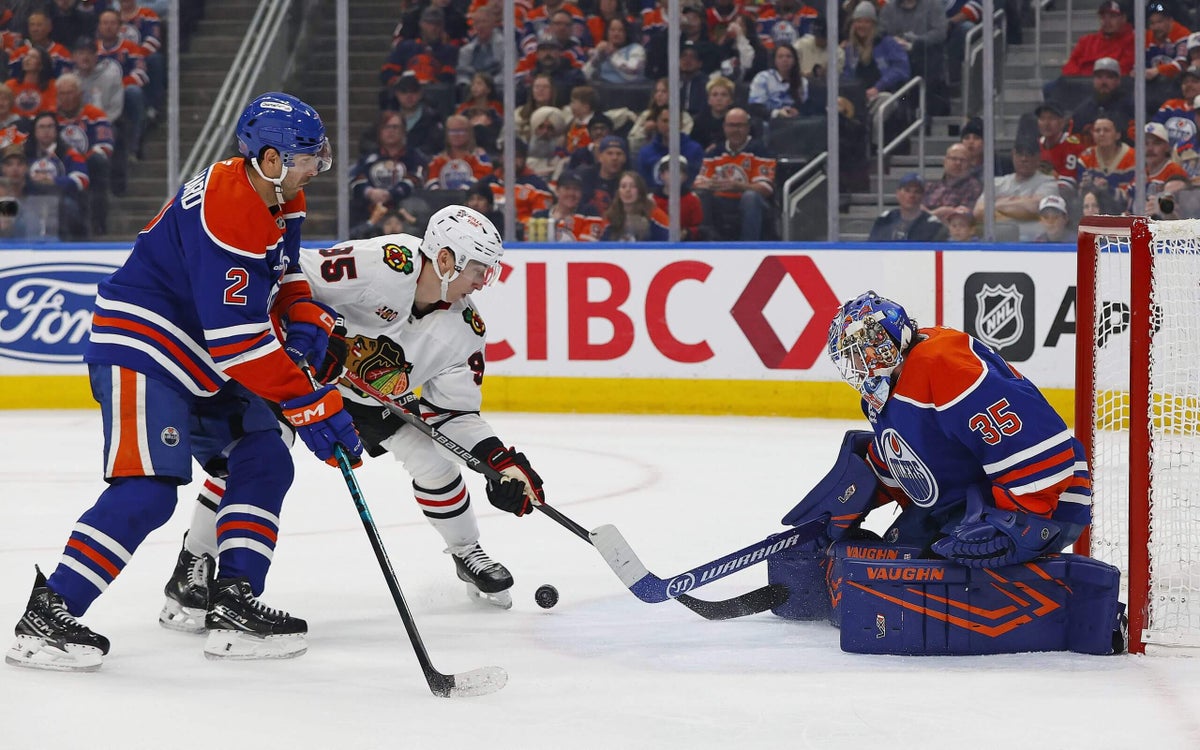
In the end, the Oilers won 3-1 and extended the winning streak to five games. Jarry posted a .944 save percentage, the fourth line (Adam Henrique) scored the opening goal, while both Murphy and Dickinson picked up assists on Vasily Podkolzin’s empty-net goal that put things to bed.
The Oilers have two goalies who are playing well, three effective pairings and four lines that are outscoring opponents. The penalty kill has been effective lately, and even the power play (struggling since Draisaitl’s injury) scored a goal Thursday. It took exactly forever, but the Oilers have reached Easter weekend looking like a Stanley Cup contender. Again.