
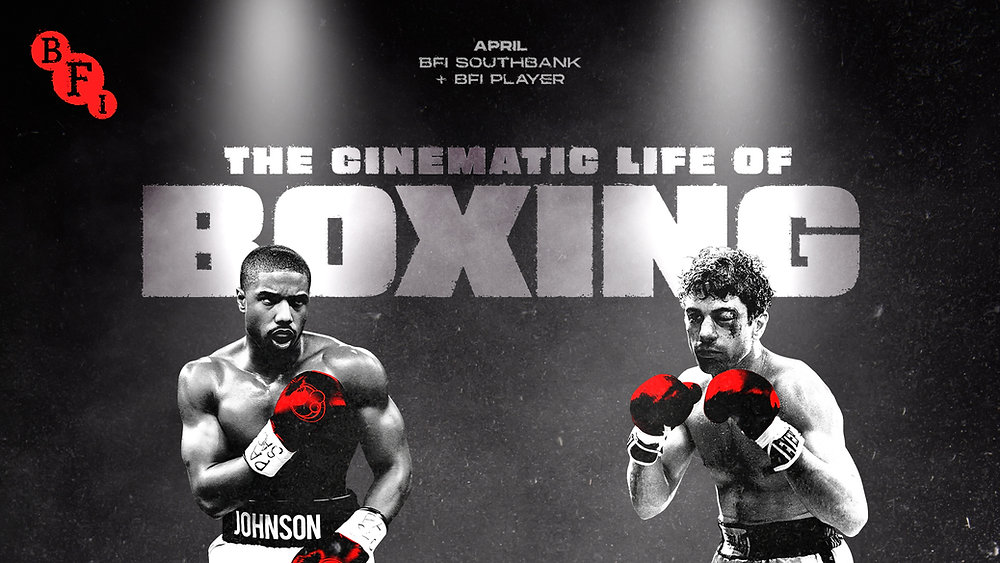
This April, BFI Southbank turns its attention to the ring as a new curated season of boxing films promises to be, no pun intended, a knockout at one of London’s most celebrated cultural venues. Building the programme around a simple but ambitious premise, season curator and Professor of Film, Culture and Society at UCL, Dr. Clive Chijioke Nwonka implores eager viewers to look both in and beyond boxing cinema’s well-worn canon and reckon with a relationship between sport and screen that has always run both ways, as both continue to shape the other.

Image Credit: BFI Southbank
What this season uniquely highlights is that the cinematic life of boxing has always encompassed something far greater than the sport itself, with filmmakers consistently returning to the ring to tell stories about the world outside it. It’s perhaps no coincidence that the season is titled The Cinematic Life of Boxing, because life in all its complexity is precisely what these films are about. Take the canonical titles that anchor our definition of boxing films. Screening on Friday 3 April, Rocky (1976) uses Stallone’s Philadelphia underdog and his shot at the World Heavyweight Championship to tap into a universal feeling, namely that those who nobody believes in deserve a chance too.
For those seeking a grittier story of determination, Raging Bull (1980), screening Monday 20 April with an introduction by Dr Nwonka himself, borrows the rugged tropes of film noir to craft a much darker film. Scorsese’s portrait of middleweight legend Jake LaMotta, anchored by De Niro’s Oscar-winning performance, asks you to reckon with how thoroughly a man can undo himself in his pursuit of greatness. Seen together and seen now, the two films capture something that has always made boxing so loaded as a subject, that the same sport that produces heroes produces monsters, often from the same material.

Sylvester Stallone in Rocky (1976). Image Credit: BFI Southbank
Beyond the titles audiences might arrive already knowing, the season makes an equally strong case for those they may not. Body and Soul (1947), screening Saturday 11 April, is in many ways the film that established the traditions that the canon of boxing cinema has adapted over the decades. Directed by Robert Rossen, it is a noir that uses the world of boxing to examine the price of money and success, as its young fighter climbs through the ranks into the orbit of men who see talent only as something to be bought.
Where Body and Soul asks what happens when success corrupts, Huston’s Fat City (1972), screening on Monday 6 April, asks what happens to those who never really get close enough to find out. Set against the worn backdrop of Stockton, California, it paints a devastating portrait of a town and its characters who seem all but past their prime. Fat City also offers what may be the season’s best hidden gem in Susan Tyrrell’s performance as the volatile, alcoholic Oma, an outcast and a woman surviving on the world’s fringes whose presence reminds viewers that boxing is not exclusively a man’s world. This deliberate thread weaves powerfully into Clint Eastwood’s Million Dollar Baby (2004), showing later that week on Wednesday 8 April, which tells the tragic story of boxer Maggie Fitzgerald, a woman whose relentless determination is the cause of her success and ultimate downfall.
These stories and their visionary breadth were ones which New Wave were lucky enough to explore further, when we sat down with Dr Nwonka himself to get a behind the scenes look into the BFI’s boxing season.
How did you first come to love boxing films, and what made you want to dedicate an entire programme to the genre at the BFI Southbank?
The season may definitely appear as a departure of sorts from my more well-known academic research, which has been concerned with questions of cultural identity through different forms of cultural practices (film, art, cultural institutions etc). However, I have always been fascinated by boxing from a young age, and combined with my academic existence as a professor of film, culture and society at UCL, the programme allowed me to combine both.
When it comes to the earliest films in the programme, how did you decide where to draw the line chronologically, given that boxing scenes appear quite memorably in some capacity in 1920s Hollywood films e.g. Battling Butler with Buster Keaton, what did you define as ‘the cinematic life of boxing’ rather than a film which featured boxing in it?
The programmatic approach was less chronological and more about breadth and ultimately, taste. The cinematic life of boxing essentially means how has cinema approached the rendering of a fascinating sport in various ways across the medium’s history. This allowed for a wide, although extremely time consuming, selection approach where I wanted to balance the more recognisable works that have inspired and are memorable with the more delicate and underpraised films that deserve revisitation.
Boxing cinema has a well-worn canon e.g. Rocky, Raging Bull, The Fighter, and Creed. How consciously were you trying to push beyond that, and are there titles in this programme you’re hoping will surprise even dedicated film fans?
Yes, its certainly true that there is an established popular canon of boxing films, but the is much more alterity and variation to the depiction of boxing themes in films if we really expand what we mean by this. For example, generically and tonally, boxing themed films differ, and capture elements of comedy, drama, romance and film noir. Some films follow the classic hero’s journey where the final fight is the climatic moment, others use boxing as a metaphorical backdrop for stories about the human existence. I wanted to allow room for these varied films to cohabit.
Is there a film in the programme that you feel has been genuinely overlooked or undervalued, one you’re most determined audiences should discover?
I’d of course encourage audiences to watch as many as they can, give that for many, our experiences of the boxing film is generally through the lens of television, and the season gives an opportunity to watch some of the classics on the big screen for the first time. However, The Featherweight is a fantastic take on the boxing biopic, and Wild Foxes is a really poetic variation of the boxing themed drama,
What does boxing offer filmmakers that other sports don’t? Is there something about the intimacy and brutality of two people in a ring that makes it such a rich subject for cinema?
Visually, boxing certainty offers an easier pathway for capturing the nature of dramatic sport than say football or rugby, for at its essence, its two people in a ring, rather than 22 or 30 in a stadium. More importantly, it’s an individual sport, possibly the loneliest sport of all. This makes it prime for extracting universal stories that appeal to the human experience and spirit beyond the sport. Its the ultimate metaphor for life.
What do you hope people take away from the programme as a whole, is there a bigger argument about boxing, or about cinema itself, that you’re trying to make?
I think the season gives an opportunity for audiences to reconsider the boxing film, or boxing themed film, as a valuable and rich contribution to film culture. I think storytellers will always remain fascinated by the sport, how it speaks to questions of identity, desire, the human psyche. Its inextricable from the everyday human experience. Perhaps the less sophisticated films in the field have maybe tainted the credibility of a genre that from its earliest examples, were highly acclaimed. As a cultural studies academic, my research has always been concerned with the impact of culture on society. The boxing film has and will always produce engaging accounts of life both inside and outside the ring.

Will Smith in Ali (2001). Image Credit: BFI Southbank
What the season ultimately makes clear is that cinema has never really been finished with boxing, and judging by the richness of what Nwonka has assembled here, it is easy to understand why. The sport has always given filmmakers a way into something larger about the rest of us, and more than a century into that relationship, neither side looks ready to throw in the towel.
‘The Cinematic Life of Boxing’ runs throughout April at BFI Southbank, and with BFI Membership including two complimentary tickets to standard screenings and priority booking for the 70th BFI London Film Festival this October, there has never been a better reason for viewers to secure their ringside seats than right now.