
What to knowNASA’s Artemis II mission is still en route to the moon as planned after four astronauts launched into space Wednesday, aiming to become the first humans in decades to make a trip around the moon and back.NASA officials provided an update on the mission today, saying a planned trajectory correction was not needed because systems were working well.The crew executed a translunar injection burn Thursday that sent their Orion capsule out of Earth’s orbit.Canadian astronaut Jeremy Hansen will speak to reporters live tonight at 1:10 a.m. ET.The Orion spacecraft is due to make its closest approach to the moon on Monday.Meanwhile, the White House announced it is proposing cuts to NASA — but not to the Artemis program.
Watch Jeremy Hansen take questions live from space tonight
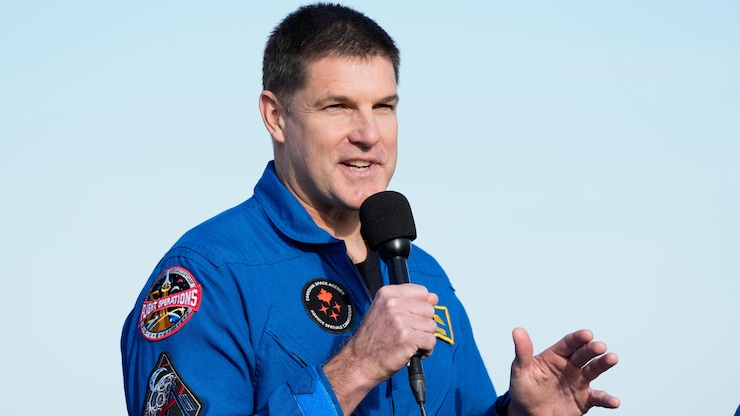
Canadian astronaut Jeremy Hansen is pictured in Houston ahead of the Artemis II launch.
Photo: Associated Press / John Raoux
Hansen is planning to speak to reporters live from the Orion spacecraft at 1:10 a.m. ET Saturday.
The broadcast is expected to last about 20 minutes, according to the Canadian Space Agency.
Hansen will share his impressions of the Artemis II mission and … answer questions from Canadian journalists, the agency said.
CBC will be livestreaming that news conference here (new window).
We’re wrapping up live updates on this page for now as the Orion capsule continues its journey to the moon.
If you can’t get enough updates of this historic journey, NASA has a livestream (new window) providing 24/7 coverage of Artemis II mission activities.
Real-time Orion tracker
For space fanatics following along with the mission from home, NASA has a real-time tracker (new window)that shows where the Orion capsule and its crew are.
The tracker lets you visualize where the capsule is in relation to the Earth and the moon, and track the mission’s path. It also tracks the capsule’s velocity and the distance in miles between the capsule and the Earth or the moon.
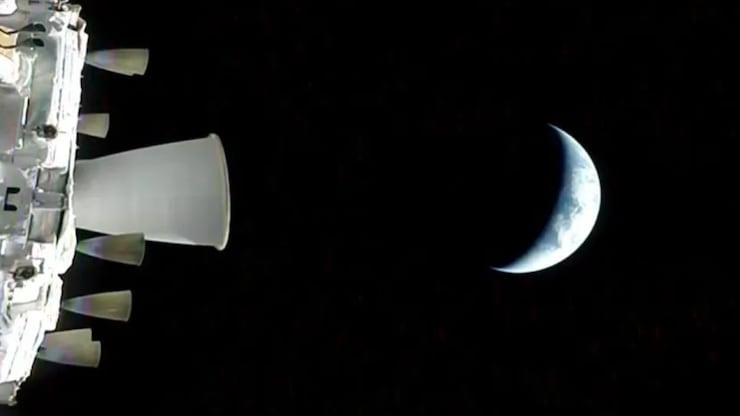
The Orion spacecraft in high Earth orbit on Thursday. (NASA/The Associated Press)
Photo: NASA
‘Proud just doesn’t capture it,’ Glover’s dad says
For some family members of the astronauts waiting back here on Earth, it’s hard to find the words to describe how they’re feeling.
Proud just doesn’t capture it for me. It’s so much more than that, Victor Glover Sr., father of the mission’s pilot, told CNN yesterday. I walk around with my chest poked out … to the moon where they’re headed.
He said he shed some tears of happiness while watching the spacecraft climb into the sky during launch.
Glover is set to make history on the Artemis II mission as the first Black man to travel around the moon.
His dad says he can’t wait for the astronauts to return safely to Earth so he can hug his son.
Astronauts will lose contact with Earth during moon flyby
When the astronauts swing around to the far side of the moon on Monday, they’ll lose signal and communication with NASA teams in Houston for about 40 minutes.
Responding to a reporter’s question, NASA officials said there are plenty of capabilities they hope to add in the future so they can keep in constant contact, including relays on the surface of the moon.
When do the astronauts fly past the moon?
We’re still a few days away from the moon flyby.
On Day 5 of the mission, the Orion capsule is slated to enter the lunar sphere of influence — when the moon’s gravitational pull becomes stronger than the Earth’s.
The astronauts get closest to the moon — and farthest from Earth — on Day 6. The crew will come within around 6,500 to 10,000 kilometres of the lunar surface and will spend the day photographing and taking video of the far side of the moon.
They’ll be able to view some parts of the lunar surface never before seen by human eyes. Previous Apollo missions travelled closer to the moon, limiting how much of it astronauts could actually see.
WATCH | Visualizing Orion’s lunar flyby:
Début du widget . Passer le widget?
Fin du widget . Retour au début du widget?