
Breadcrumb Trail Links
It is inexplicable that Saskatchewan Premier Scott Moe is the lone leader refusing to hit his province with a costly, job-killing carbon tax.
Published Apr 04, 2026 • Last updated 5 hours ago • 3 minute read
You can save this article by registering for free here. Or sign-in if you have an account.
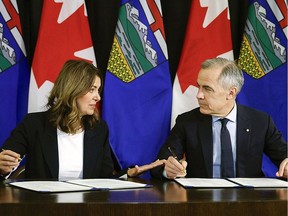 Alberta Premier Danielle Smith and Prime Minister Mark Carney sign a pipeline MOU in Calgary on Nov. 27, 2025. Postmedia archiveArticle content
Alberta should be the last place to impose a carbon tax, yet here we are.
Advertisement 2
This advertisement has not loaded yet, but your article continues below.

THIS CONTENT IS RESERVED FOR SUBSCRIBERS ONLY
Subscribe now to read the latest news in your city and across Canada.
Unlimited online access to articles from across Canada with one account and fewer ads.Get exclusive access to the Calgary Sun ePaper, an electronic replica of the print edition that you can share, download and comment on.Enjoy insights and behind-the-scenes analysis from our award-winning journalists.Support local journalists and the next generation of journalists.Daily puzzles including the New York Times Crossword.
SUBSCRIBE TO UNLOCK MORE ARTICLES
Subscribe now to read the latest news in your city and across Canada.
Unlimited online access to articles from across Canada with one account.Get exclusive access to the Calgary Sun ePaper, an electronic replica of the print edition that you can share, download and comment on.Enjoy insights and behind-the-scenes analysis from our award-winning journalists.Support local journalists and the next generation of journalists.Daily puzzles including the New York Times Crossword.
REGISTER / SIGN IN TO UNLOCK MORE ARTICLES
Create an account or sign in to continue with your reading experience.
Access articles from across Canada with one account.Share your thoughts and join the conversation in the comments.Enjoy additional articles per month.Get email updates from your favourite authors.
THIS ARTICLE IS FREE TO READ REGISTER TO UNLOCK.
Create an account or sign in to continue with your reading experience.
Access articles from across Canada with one accountShare your thoughts and join the conversation in the commentsEnjoy additional articles per monthGet email updates from your favourite authorsSign In or Create an Account
or
Article content
Premier Danielle Smith said she and Prime Minister Mark Carney are “close” to an agreement on the cost of the industrial carbon tax they’ll impose on Albertans.
Article content
Recommended Videos
Article content
It is inexplicable that Saskatchewan Premier Scott Moe is the lone leader refusing to hit his province with a costly, job-killing carbon tax.
Here’s what’s happening:
Smith and Carney signed a memorandum of understanding, known as an MOU.
‘Raw deal’
In that tentative agreement, the feds said they’d consider approving infrastructure such as pipelines and lift the federal production cap on Alberta’s oil and gas.
In exchange, Alberta agreed to obey Ottawa and impose a higher industrial carbon tax.
The catch: the industrial carbon tax will immediately cost Albertans more money and there’s no concrete plan to build a pipeline out of Alberta.
This is a raw deal so far and the MOU was due to be finalized this week.
After signing the MOU, Carney told the media Alberta’s industrial carbon tax would be “six times” higher.

Calgary Sun Headline News
Thanks for signing up!
Article content
Advertisement 3
This advertisement has not loaded yet, but your article continues below.
Article content
The industrial carbon tax is similar to the repealed consumer carbon tax, the main difference is this version is hidden and politicians can deny knowledge of it.
The hidden industrial carbon tax on fuel refineries will make gasoline and diesel cost more at the pump. The tax on utilities companies will make heating our homes and keeping the lights on cost more. The tax on fertilizer plants will increase costs for farmers and will make our food cost more.
The hidden industrial carbon tax won’t just make driving, eating and living cost more.
As CTF Federal Director Franco Terrazzano told a parliamentary committee, the hidden industrial carbon tax will also chase jobs out of Canada, because the U.S. doesn’t have any national carbon tax, no matter what president is in the White House.
“If you chase a fertilizer plant out of Manitoba, it doesn’t reduce emissions, it just means Canadian jobs go to North Dakota,” Terrazzano said.
The Canadian Piping Trades Union Local 67 in Hamilton warned the hidden industrial carbon tax will “decimate” the steel industry.
Advertisement 4
This advertisement has not loaded yet, but your article continues below.
Article content
Meanwhile, Canadian Natural Resources Ltd. just paused its $8-billion oilsands mining operation in Alberta a few weeks ago, citing the costly uncertainty of industrial carbon tax as the key reason.
Trade unionists and a big corporation are singing together from the same song sheet.
Pigs are flying over the frozen plains of Hades.
A majority of Canadians say the costs of a hidden industrial carbon tax will be passed down to regular working people.
Economist Jack Mintz says this MOU’s requirements and the industrial carbon tax will add about US$10 to the cost of a barrel of oil.
The federal government’s plan to raise the industrial carbon tax to $170 per tonne by 2030 will cost the average worker $1,160 in lost yearly income and cost 50,000 jobs, according to a new study by the Fraser Institute.
Carbon tax cheerleaders at the committee on Parliament hill claimed Carney’s industrial carbon tax won’t cost much.
Costly endeavour
As one of the writers of the original federal carbon tax legislation explained years ago, carbon taxes are meant to “punish the poor behaviour of using fossil fuels.”
Advertisement 5
This advertisement has not loaded yet, but your article continues below.
Article content
But, if the hidden industrial carbon tax won’t cost much, then how is the deterrent of the carbon tax working?
Would a major Canadian energy company really freeze a multi-billion-dollar project over a minor expense?
Before the Trudeau government’s retail carbon tax was finally scrapped, it took more than $40 billion from Canadians.
Read More

SIMS: Ratings and spending show why CBC should be defunded

SIMS: Provincial government hikes taxes on Albertans
Carbon taxes cost people a lot of money, they don’t reduce emissions and they chase Canadian jobs away to the U.S.
It’s wrong to punish people for driving, eating and living.
All premiers should tell Carney to stop all carbon taxes in Canada.
Kris Sims is the Alberta Director for the Canadian Taxpayers Federation.
Article content
Share this article in your social network