
Get the best of Vancouver in your inbox, every Tuesday and Thursday. Sign up for our free newsletter.
This year, the Powell Street Festival celebrates its 50th anniversary, an impressive milestone by any measure. It is the longest-running festival in Vancouver and one of the largest annual cultural or community events across Canada.
But perhaps even more impressive than any milestone to Emiko Morita, who served as festival executive director from 2015 to 2024, is that many of the people who founded the event in 1977 are still around and involved.
“I realize how remarkable it is to have this long history,” Morita tells the Straight. “It is a complex story from different people’s perspectives. It can be interpreted in so many ways. While we still have the founding volunteers and their lived experiences and they can clarify things or express their points of view, it’s a great moment to document what is known.”
The Powell Street Festival debuted June 12-13, 1977, at Oppenheimer Park in Vancouver’s historic Japanese neighbourhood Paueru Gai (Powell Street), now part of the Downtown Eastside. A celebration of Japanese Canadian art and culture, the first festival coincided with the centennial year of what was considered to be the start of Japanese migration to Canada in 1877. (That year is in question after a claim that migration actually began in 1884.)
Morita has steered two new anniversary projects for this year, both sharing the same name.
The first, Return to Paueru Gai: Fifty Years of Powell Street Festival is a retrospective
exhibit including archival photos and video and immersive installations. The exhibit, which Morita curated, will run until September 5 at the Nikkei National Museum and Cultural Centre in Burnaby.
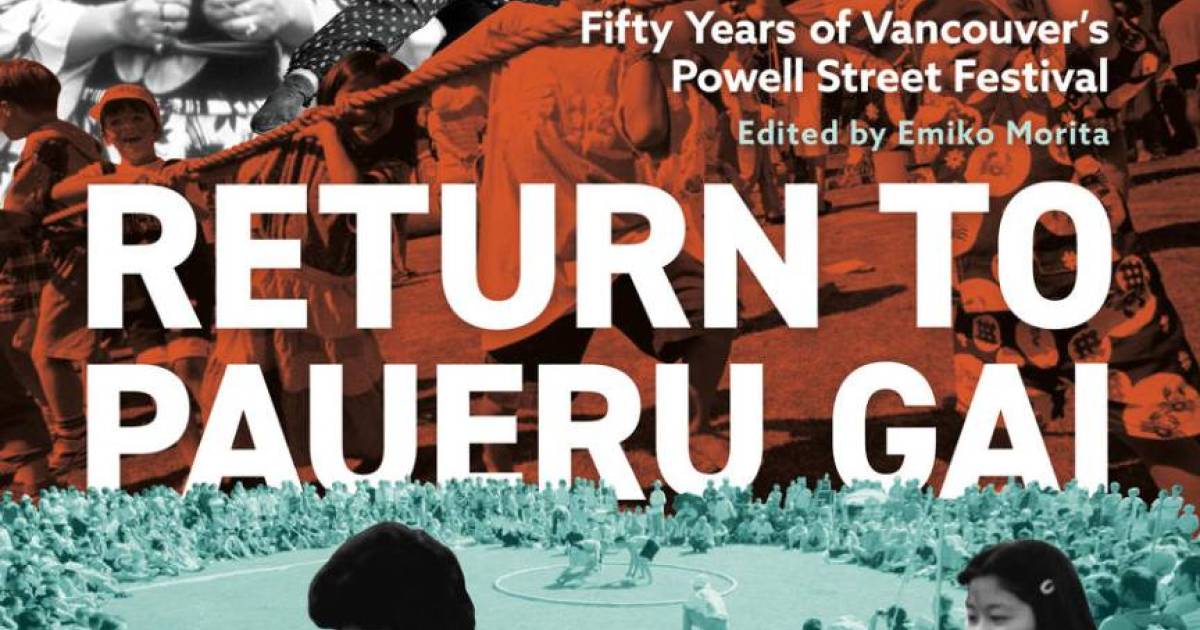
The second anniversary project is a companion book, Return to Paueru Gai: Fifty Years of Powell Street Festival, which offers a respectfully documented history of the festival with engaging essays, archival photos and documents, a gallery of festival posters, and a detailed chronology.
Author Emiko Morita. Henry Tsang
The book’s essays provide a compelling and lived history of the moments and people that have given the festival life. Taiko drumming, sumo wrestling, community food vendors, and human rights advocacy all feature notably in retrospectives written by the likes of Musqueam Elder Mary Point, the seniors of Tonari Gumi (the Japanese Community Volunteers Association), cultural worker Julia Aoki, former Straight editor Charlie Smith, and members of the Japanese Canadian Art and Activism Project, among others.
Like any anniversary, it is a time to celebrate success and to reflect on the past. In part, it’s an occasion to recognize the contributions the Powell Street Festival made to redress the terrible injustice done to Japanese Canadians before, during, and after the Second World War.
Once a vibrant cultural and economic hub for Japanese Canadians, the residents of Paueru Gai were forcibly expelled and relocated following Japan’s attack on the U.S. naval base in Pearl Harbour, Hawaii, in 1941. Beginning in early 1942, some 22,000 Japanese Canadians were exiled from their West Coast communities, lost homes and possessions, and were relocated to remote areas of British Columbia during what came to be known as internment.
These people were not afforded due process, nor were they ever charged with crimes. It was not until 1949 that the restrictions imposed under Canada’s War Measures Act were lifted and Japanese Canadians gained full citizenship.
“The first festival was a quiet political act,” Morita says. “It was the first time Japanese Canadians gathered in a very specific geographic place, a place where they’d been forcibly removed. To actually have the courage to come together and politically declare and express a cultural identity was very meaningful.”
That act of gathering had an important impact.
“Powell Street Festival played a key role in creating the momentum, the relationships, and the situation where people could start talking about the history that led to the creation of the redress communities,” Morita says.
The redress committee of the National Association of Japanese Canadians secured a formal apology from the Canadian government in 1988, along with redress payments to survivors. In 2012, the British Columbia Legislature apologized for the forced relocation and internment of Japanese Canadians during the war, and in 2022, the provincial government committed $100 million to fund health and wellness programs, restore heritage sites, and other initiatives to provide lasting recognition of the historical wrongs committed by the Province of B.C. against Japanese Canadians.
“You have intergenerational trauma. The impact of that forced relocation is evident in my generation,” says Morita, who is a third-generation Japanese Canadian. “The fourth and fifth generations (of Japanese Canadians) ask the same questions. They are on the same journey.”
But when people arrive at Oppenheimer Park this summer—the 50th annual festival runs August 1-2—they will also celebrate the arts and culture, the music and the food, the sense of fun, and the feeling of community.
“Hopefully people will come to the festival because it’s a festival,” Morita says. “It will be for some the beginning of a discovery of their history and a way to connect to their culture. The other thing is that Japanese-Canadian identity is not Japanese identity. It’s very unique. And the festival itself is the re-defining or re-affirming of Japanese-Canadian identity.’’
For Morita, returning to the festival every year has a deeply personal meaning.
“To annually go back to that site where my grandparents first settled and touch the ground. To honour my ancestors and to reflect on that history and what it means and how it informs me and how I engage as a citizen today, is utmost. It is the heart of the festival. It’s an act of social justice.” GS
Return to Paueru Gai: Fifty Years of Powell Street Festival is published by Arsenal Pulp Press and available on April 7.