
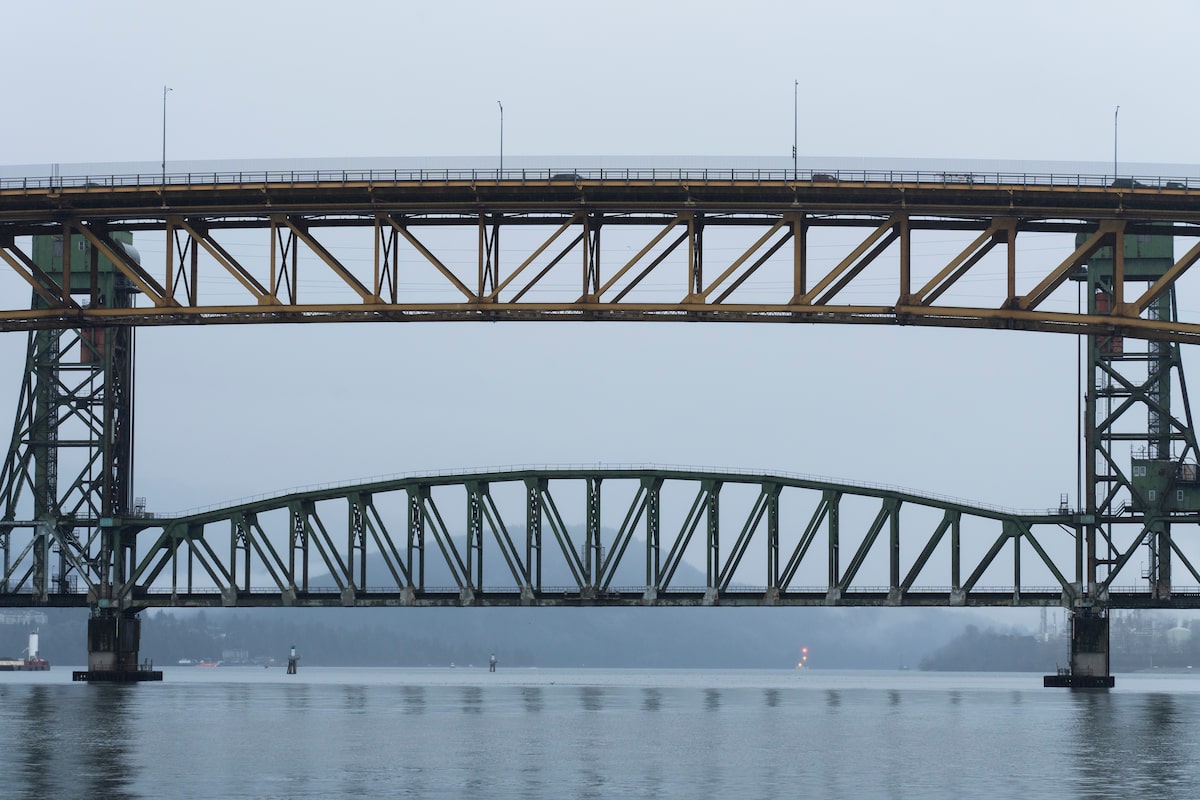
CN’s Second Narrows rail bridge sits next to and underneath the Ironworkers Memorial Bridge that connects North Vancouver to Burnaby B.C. The shutdown of Second Narrows bridge, which is raised to allow ships to enter the Port of Vancouver, caused a ‘colossal bottleneck’ that disrupted a host of commodity exports.Paige Taylor White/The Globe and Mail
Canada’s ambition to be an energy superpower is being undermined by a 57-year-old railway bridge over Vancouver’s harbour, which broke down in February and halted traffic in the country’s busiest port – including oil shipments to Asian customers, who are now searching for new fuel suppliers as war rocks the Middle East.
When Canadian National Railway Co.’s Second Narrows Rail Bridge, which is raised to allow ships to enter the port, got locked in its lowered position on Feb. 22, it took four days to fix the malfunction.
The bridge shutdown caused a “colossal bottleneck” that affected much of the Port of Vancouver, said Robert Terpstra, shipping agent for Colley West Shipping Ltd.
The Second Narrows bridge is the only rail link between several bulk export terminals on Burrard Inlet’s North Shore and the rest of Canada.
Vancouver’s harbour handles more traffic than the country’s next five largest ports combined. It moved a record 170.4 million tonnes of goods last year through 29 terminals, to 170 international markets. Each day, roughly $1-billion worth of goods travel through the port.
Port of Vancouver handles record amount of cargo, bolstered by China
Oil, grain, coal, potash, lumber and a host of other commodity exports were disrupted by the breakdown – an accident long foreseen by industry groups, governments and port executives who have flagged structural problems with the bridge and surrounding infrastructure for years.
The fallout included a dramatic drop in oil exports from pipeline operator Trans Mountain Corp. (TMX). The company hit just over half of its 30-tanker capacity in February, with just 17 ships leaving Vancouver.
Twelve of the tankers went to Chinese refineries, according to a report from RBC Capital Markets. In January, TMX loaded 22 tankers at the terminal.
“As a result of the CN Rail Bridge incident, some of the tankers that were scheduled to load at Westridge Marine terminal were delayed until March,” TMX spokesperson Vanessa De Matteis said in an e-mail. The rail bridge is in the path between the Westridge facility and the Pacific Ocean.
The failure of aging critical infrastructure such as the rail bridge, and its impact on a broad range of exporters, is emblematic of the challenges facing the country as governments and businesses attempt to pivot away from U.S. customers to markets in regions such as Asia and Europe.
In November’s federal budget, Prime Minister Mark Carney projected more than $1-trillion of public- and private-sector spending on infrastructure, including housing, will be needed over the next five years to boost the Canadian economy.
The port’s leaders acknowledge their facilities are essential to the country’s economic growth.
“As Prime Minister Carney looks to double exports to non-U.S. markets in the next decade, the Port of Vancouver is playing an outsized role in delivering more made-in-Canada products to more customers globally,” Peter Xotta, chief executive officer of the Vancouver Fraser Port Authority, said in a press release last month.
Transport Canada, the B.C. Transportation Ministry, the Port of Vancouver and various industry groups have long identified CN’s rail bridge as vital infrastructure that is susceptible to bottlenecks and shutdowns.
A container ship docked at the Port of Vancouver, Oct. 20, 2025.Jennifer Gauthier/The Globe and Mail
A spokesperson for Montreal-based CN Rail, Ashley Michnowski, said in an e-mail that the company recognizes the Second Narrows rail bridge is essential infrastructure.
“The incident in late February was the result of an unforeseen mechanical issue that could not have been predicted or planned for in advance,” she said.
The bridge undergoes “rigorous, ongoing maintenance,” she added, and when it broke down, “CN crews responded immediately, working safely around the clock to resolve the issue.”
Vancouver is expected to see even more tanker and container ship traffic as Canada deepens ties to Asian economies and increases commodity exports.
TMX plans to boost its pipeline’s capacity by 40 per cent, an expansion plan that is central to the federal and Alberta governments’ plan to increase oil shipments to Asian refiners and lessen the oil patch’s dependence on U.S. markets.
Why the Strait of Hormuz has been a global commerce chokepoint for centuries
The U.S. and Israel’s war with Iran and the subsequent closing of the Strait of Hormuz, a waterway travelled by 20 per cent of global oil traffic, has refiners in China, Japan and Korea scrambling to find new suppliers.
“The geopolitical environment is shifting rapidly,” Ms. De Matteis said. “Trans Mountain remains available to receive any increased capacity that may become available through our shippers as a result of market conditions.”
Analysts say there is surging Asian demand for Canadian oil.
“With geopolitics on the front burner and significant disruptions occurring in the physical market, we would expect Canadian crude exports from the Trans Mountain pipeline to ramp back up in the coming months,” a team of RBC analysts led by Greg Pardy said in a recent report.
“If anything, recent events in the Middle East have put a spotlight on the advantaged characteristics of Canadian oil on the global stage, standing as a low-risk, reliable export source with world-leading resource depth,” the RBC analysts said.
The aging rail bridge is also a challenge for Saskatchewan’s key exports, which account for 50 per cent of the port’s trade.
“We need to see significant investment in efficiencies in Vancouver,” Saskatchewan Minister of Trade and Export Development Warren Kaeding said in an interview earlier this month. “Whether that’s building a new Second Narrows bridge or it’s dredging the channel … We need to see investment there.”
Why Canada’s energy superpower status can’t fully protect us from the oil crisis
Last August, the chair of the Canadian Wheat Growers Association wrote an open letter calling on CN Rail to replace the bridge in order to address safety and reliability concerns. Daryl Fransoo, who owns a wheat farm near Glaslyn, Sask., about 200 kilometres northwest of Saskatoon, said the bridge is critical.
“For farmers in Saskatchewan, Alberta, and Manitoba, this bridge is not just a piece of infrastructure, it’s the conduit that connects our fields to the world,” Mr. Fransoo said. “The bridge’s age and design pose significant risks to this critical supply chain.”
In 1979, a freighter ran into the rail bridge during heavy fog and knocked a section into Burrard Inlet. It took five months to repair.
Much of Canada’s fifth largest export by dollar value – potash – is shipped to markets overseas through the Neptune Terminals on the North Shore, which are connected to the mainland via the Second Narrows bridge. The terminals receive cargo from an average of two trains per day, and ship that cargo out on about 330 vessels a year.
Saskatoon-based fertilizer giant Nutrien Ltd. is part owner of the Neptune Terminals.
In November, the company decided to build a new export terminal in Longview, Wash., instead of in Canada. Port capacity constraints and challenges with Canadian transportation infrastructure factored into Nutrien’s decision, the company told The Globe and Mail at the time.
The $1-billion facility, scheduled to open in 2031, will ship potash to fast-growing markets in the Indo-Pacific, including China, India and Japan.
Last year, the B.C. government approved the Vancouver Fraser Port Authority’s plan to dredge the Second Narrows waterway, which would allow tankers to be fully loaded with oil from the TMX terminal in Burnaby, and then pass under the rail bridge to reach the ocean. To navigate the relatively shallow channel, large tankers currently leave the terminal at 70 per cent of their capacity.
When the Second Narrows rail bridge shut down, tugboats used to move ships throughout the port were stranded on the east side of the bridge. That contributed to the bottleneck, Mr. Terpstra said.
A bridge shutdown is exceptionally rare, Mr. Terpstra said, adding that he can think of only one similar example from his more than two decades of working at the port.
“This is an absolute perfect example of how reliant we are locally on that bridge traffic,” he said.