

Listen to this article
Estimated 3 minutes
The audio version of this article is generated by AI-based technology. Mispronunciations can occur. We are working with our partners to continually review and improve the results.
The Artemis II mission is expected to complete a record-breaking lunar flyby today.
The Canadian Space Agency says astronaut Jeremy Hansen and his three American crewmates are set to become the space explorers who will have ventured farther into space than anyone before, surpassing a record set by Apollo 13 in 1970.
NASA says the estimated maximum distance from Earth during today’s flyby by the Orion spacecraft will exceed 406,000 kilometres, beating the 400,171 kilometres set by Apollo 13.
When Orion passes behind the moon, the spacecraft will enter a communications blackout of about 40 minutes as the lunar surface blocks radio signals.
Later, it will come as close as about 6,500 km to the moon’s surface, and from that vantage point Hansen has said the moon will look like a basketball held at arm’s length.
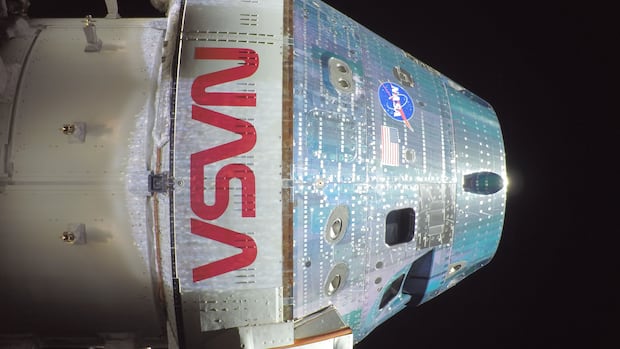
WATCH | Artemis II nearing the moon’s gravitational sphere :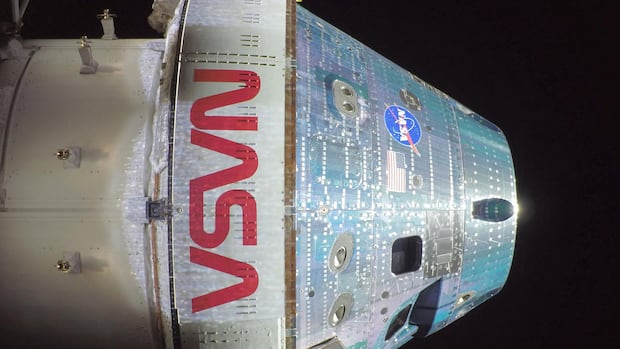
Artemis II mission Day 5: Nearing the moon’s gravitational sphere
The Artemis II mission has passed the halfway point with the Orion spacecraft entering the moon’s gravitational sphere ahead of a lunar flyby.
For a little over five hours, the crew is expected to take turns observing and photographing geological features on the moon, like impact craters and ancient lava flows.
“The crew will make their lunar observations with real-time data analysis, guidance provided by a team of scientists and the knowledge acquired through their geology training in Labrador, Iceland and in class to describe surface textures, shapes, and colours, providing valuable data for future exploration of the moon,” reads a news release from the Canadian Space Agency.
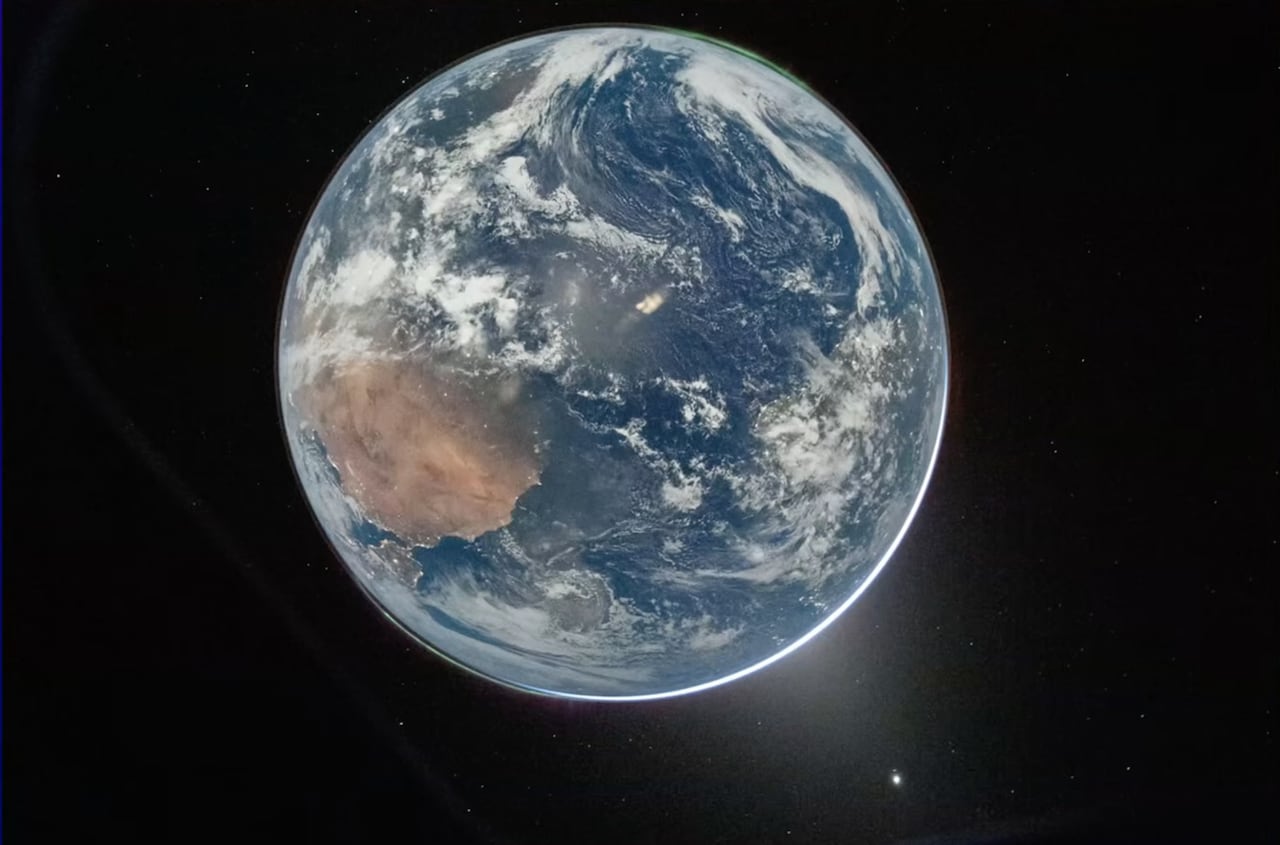 This image provided by NASA shows a downlink image of Earth taken by NASA’s Artemis II astronaut commander Reid Wiseman inside the Orion capsule on Friday, April 3, 2026. ( NASA via The Associated Press)
The flyby promises views of the moon’s far side that were too dark or too difficult to see by the 24 Apollo astronauts who preceded them.
NASA says the Orientale basin, a 3.8-billion-year-old crater that formed when a large object struck the lunar surface, will be fully illuminated and visible as Orion approaches.
WATCH | NASA officials asked about Artemis II toilet troubles :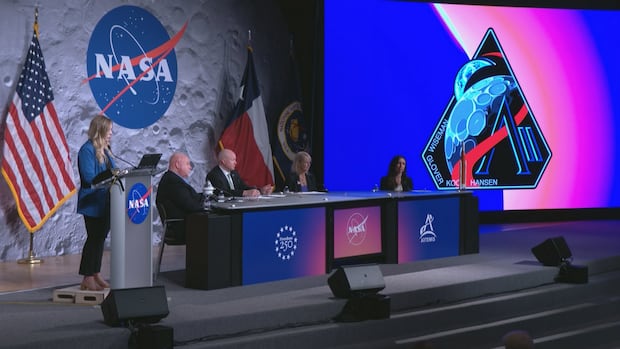
NASA officials asked about Artemis II toilet troubles
At a NASA news conference on Saturday, Judd Frieling, Artemis II ascent flight director, and Debbie Korth, Orion deputy program manager, spoke on the status of the spacecraft’s toilet, which has repeatedly encountered issues since Wednesday’s liftoff.
On Tuesday, Orion will leave the lunar sphere of influence en route back to Earth.
Apollo 13’s astronauts missed out on a moon landing when one of their oxygen tanks ruptured on the way there. Mission Control pivoted to a free-return lunar trajectory to get them home as fast and efficiently as possible. This routing relies on the gravity of Earth and the moon, and minimal fuel.
Artemis II’s astronauts are following the same figure-eight path since they are neither orbiting the moon nor landing on it.
The capsule will aim for a splashdown in the Pacific near San Diego on April 10, nine days after its Florida launch.