
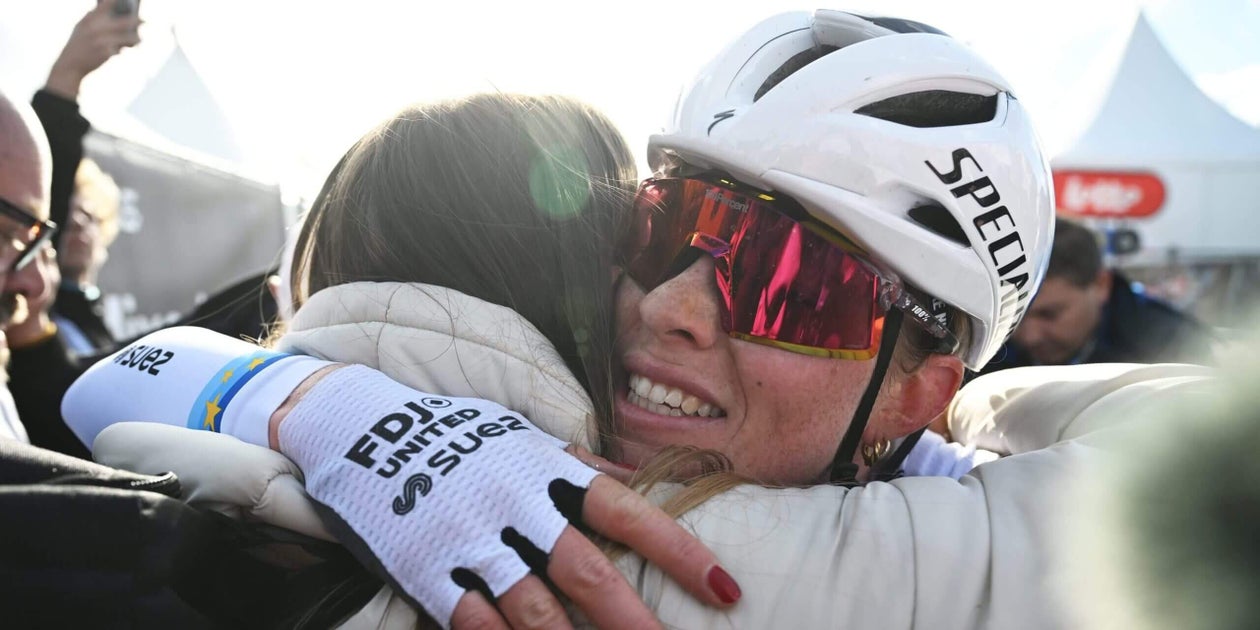
Oudenaarde, Belgium — Sunday, April 5
Demi Vollering’s bike weaves from left to right and back again, fluttering forward with the haste of falling blossom.
She is not riding this way from exhaustion — though her legs have been shutting down for a good few kilometres now. Nor is she navigating her way through cobbles. The pavé is some twenty minutes behind.
No. The flamme rouge is behind her, the finish line a few pedal strokes ahead, and the only thing compelling her to sway towards the line is all-absorbing joy.
“I’m really suffering,” she had told her FDJ–Suez team car moments earlier.
“Demi, the others have gone,” came the response from the rolled-down window. “You’re about to win Flanders.”
Vollering has won almost every race that matters in the sport — the Tour de France, the three Ardennes classics, Strade Bianche and the Amstel Gold Race — but never this. Her childhood home, in south-western Netherlands, is just over an hour’s drive from the race start in Antwerp.
Now, the 29-year-old’s wait is over. Clad in the white jersey of the European champion, a smile spliced with a grimace from five kilometres out, she punches the air three times before crossing the finish and placing her hands together in a meditative prayer.
Vollering has won the Ronde van Vlaanderen, Belgium’s biggest race, and, for many, the most prestigious Monument of them all. Across the weekend, The Athletic was embedded for the ride.
“Sport is really an emotion,” she had said on Friday evening, reflective during a lengthy interview at the team hotel. “When you’re chasing a win, actually what you’re chasing is the emotion of the winning feeling.”
That emotion on Sunday? “Today was crazy,” she responds late that night. “I still need to believe that this happened.”
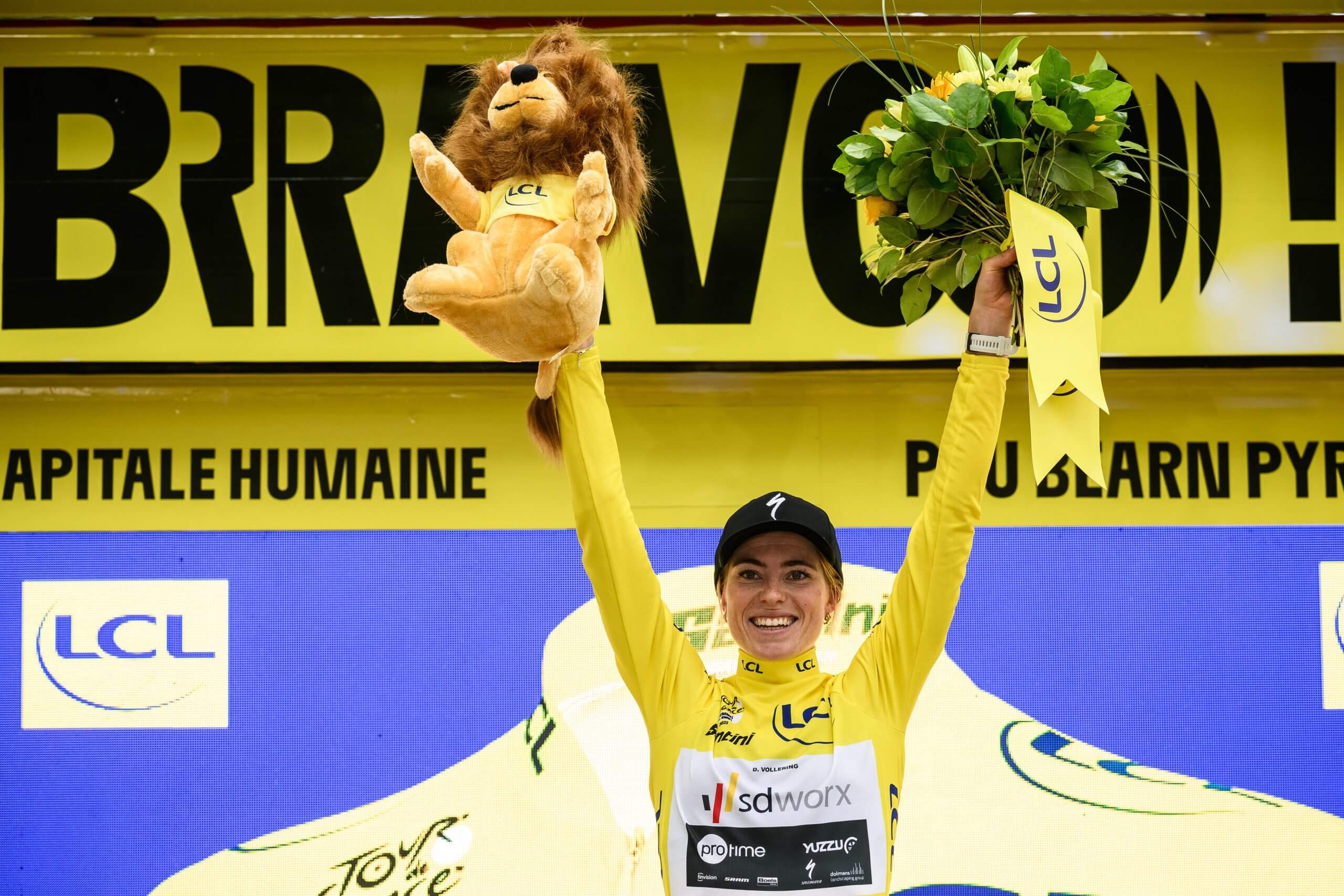
Demi Vollering celebrates after winning the 2023 Tour de France Femmes. (Jeff Pachoud / AFP via Getty Images)
Kortrijk — Saturday, 12.15pm
FDJ–Suez directeur sportif Lars Boom has pulled out his phone and decided. Saturday’s shakeout ride is just finishing, there are just over 24 hours until the race starts, and the temperature is 15C (59F). It is warm enough for his squad to stop for coffee.
“The other day we had a lot of sick people in the team last week, it was three degrees, and then we are going for coffee,” he grumbles. “I told them: ‘What are we doing, three f*****g months to be in good shape and you drink a coffee, get sick, and f*** up your whole race. I did it once, my second year at Astana: went for a coffee with the team, got a cold, two days later, had a fever, didn’t finish Paris–Roubaix, my most important race. Is that worth the coffee? No.”
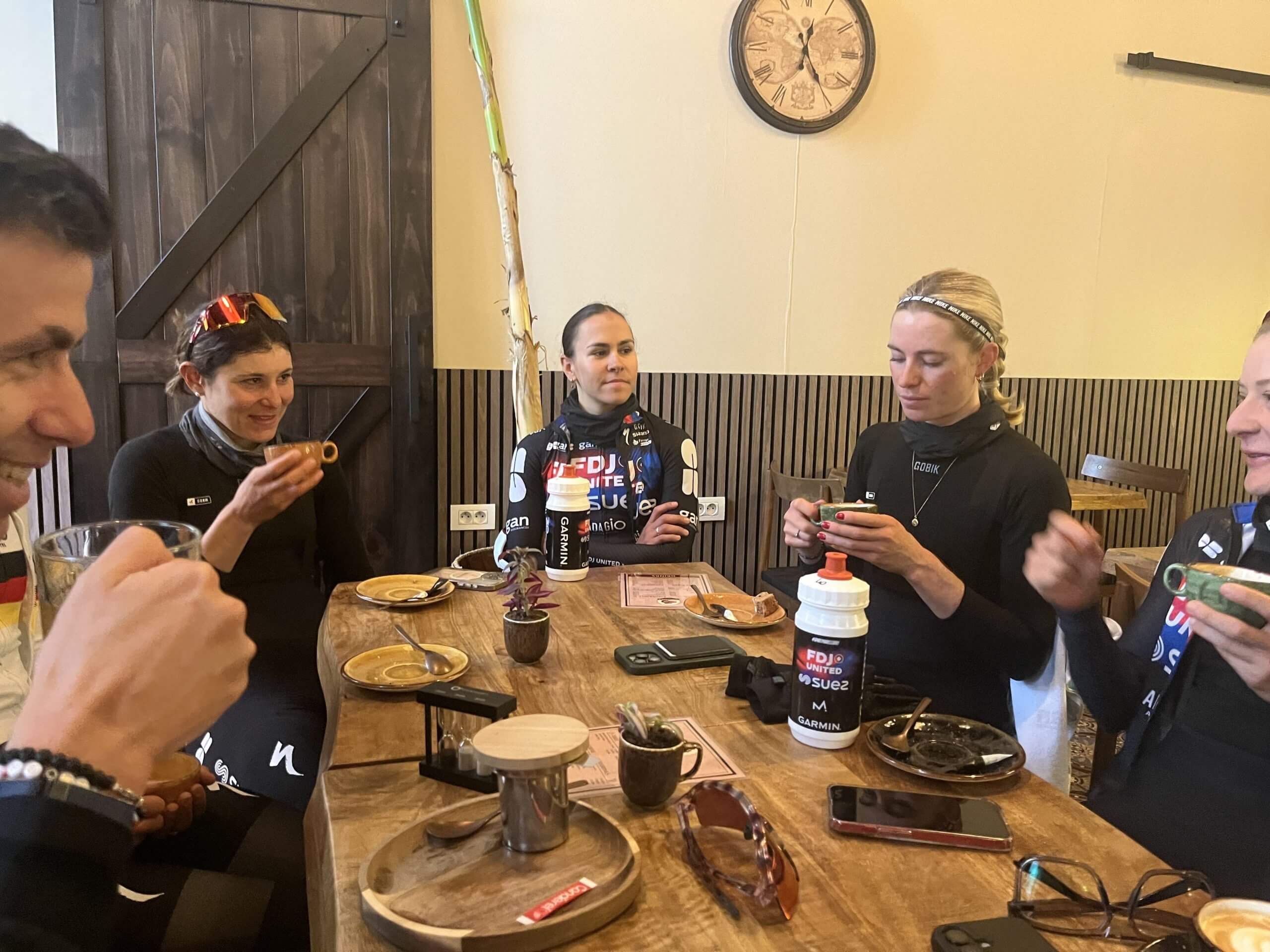
The team enjoy some downtime on Saturday. (Jacob Whitehead / The Athletic)
Boom is a tall and imposing former Classics specialist who possesses the sort of handshake you would expect. A former Tour of France stage winner and 2008 cyclocross world champion, he retired in 2019 after a 16-year professional career. But he knows these moments are important for the team to relax and bond, especially when the collective will need to work for the race chances of one. The research on where to go has been done. This Kortrijk cafe, for instance, specialises in Indonesian coffee beans.
As Boom sits down, he is gently ribbed by the FDJ–Suez team. Vollering steals his new sunglasses and tries them on. An hour earlier, she caused him to swear — not, in itself, a difficult task — and grip the wheel by almost crashing into the gutter within minutes of starting the training ride.
But there is no talk of cycling over coffee. Instead, amid wood-panelling, expensive lamplight, and a half-dozen flat whites, the team talk about the ethics of flying versus driving, how inheritance tax compares across countries, and ask team manager Stéphen Delcourt how many companies he has.
Vollering is not the loudest voice at the table. In her second year at the team, she is FDJ–Suez’s star rider, though there is a lot of talent here. Franziska Koch is the German champion. Elise Chabbey, a former Olympian in canoe slalom, won Strade Bianche last month. Twenty-year-old Célia Gery is the under-23 world champion. As well as leading the team on the road, she plays something of the older sister role.
The day before, on the team bus after their recon ride of Flanders’ climbs, while the majority of the team were having coffee shakes, one rider had only eaten an apple. Vollering raised her eyebrows.
“You’ve only had an apple?” she said. “Don’t you need protein?”
The other rider laughed. “Yes, mum,” she replied. They drank the coffee shake.
“Because also it’s important they take care of themselves because I need them in the race,” Vollering explains. “I just want them to be completely ready for Sunday.”
This Sunday is Easter Sunday, a date that underscores the Tour of Flanders’ importance to Belgium’s Holy Week.
The race is a foundation of modern Flemish identity. It is special because it ignores the cities to race through the villages and roads of the workers, mounting dozens of short but punishingly steep climbs, known as bergs, that typify the Vlaamse Ardennen — the Flemish Ardennes. The peloton will jolt over tiny roads used for daily work, sometimes forced to dismount, old cart ruts rendered into tactical equations.
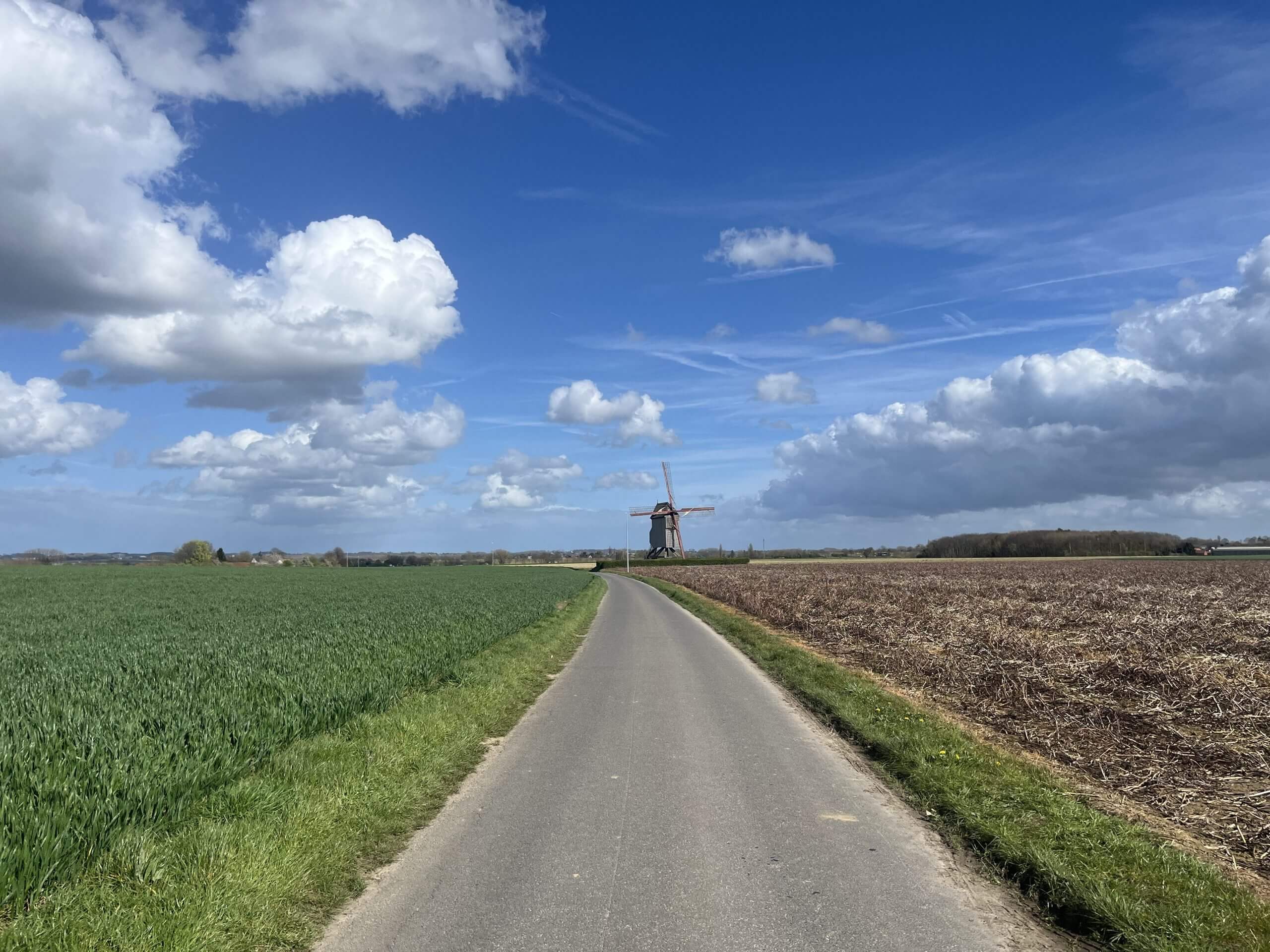
In Flanders, the roads are narrow and the wind is frequently strong. (Jacob Whitehead / The Athletic)
And then there are the cobbles — known as pavé in France and kasseien here — that animate the racing. If the landscape is the Flandrien body, to the local imagination, these are the wrinkles, smile lines, dimples and pockmarks that gives a lifelong love its expression.
“It’s really unique,” says Vollering on Friday evening. “The number of people always coming to watch and cheer, you can really feel this, you can feel this race is really lifting. It gives people all over the world such a special feeling.”
Perhaps that makes the rare gap in Vollering’s palmares more conspicuous. “It’s not like a matter of box-ticking,” she says. “But I really want to win it.”
Vollering is a climber rather than a one-day specialist, unlike, for example, Sunday’s big favourite, three-time winner and Flandrien Lotte Kopecky, yet won at the Omloop Het Nieuwsblad in February, having not ridden on cobbles all offseason. Despite being lighter than almost all her rivals, she believes the cobbles suit her.
“If you have bad legs, then it’s really not fun to ride over the cobbles,” she explains. “But if you have good legs, you can make a difference there. You cannot ride easy over them; you really feel like it’s easier when you have speed. You have to go fast, and that hurts. But it suits me when a race is hard. It’s special, it’s like this here.”
Oudenaarde — Sunday, 11.30am
“Welcome to the most important day of the year in Belgium,” comes the welcome at the FDJ–Suez team bus. It is followed by a warning. “All of Flanders is now in a state of war.”
A few metres away, Boom drinks coffee while watching his riders prepare, catching each of them for a quick final word, and a pat on the shoulder. He raced here nine times, finishing sixth in 2015, and is something of an expert in the most tactically complex of all the Monuments. With its climbs narrow, steep, and slippery, making passing extremely difficult, the roads on the lead-ins are also far tighter, making it far harder for riders to move up. You have to anticipate the bend of the road to hug the inside, to know the wind direction to save the legs.
“This race is about survival,” says Boom. “When I raced, it was about positioning at the beginning of the race, not spending too many moments in the wind. Those can have a big effect on your legs in the finale. It comes down to small details.”
And Boom is in a good mood. He has checked his weather apps again. The forecast is for wind. With possibly the strongest team in the race, he is confident it will allow them to create gaps in the peloton.
“There’s a lot of headwind early in the race,” he says. “If you try to make a move, you will kill yourself by doing so. Our movement is going to be on the Eikenberg, to race it really hard. On top, there are crosswinds, so we can make the group smaller by pulling an echelon at the top.
“Then, we want to create a high tempo over the Koppenberg with Franziska, Elise, Célia, and Demi to be together. Then we’ll adapt, but the goal must be to have a hard race from then on. It’s about riding a consistently high pace. If it’s a small group, it’s a really difficult moment, for example. Demi will try to attack there.”
The team’s tactical meeting was held at their hotel in Wevelgem at 6:45 pm the previous evening. Boom doesn’t just want to show his team a long slideshow presentation, but to make them participants in the race plan, choosing one rider each day. Sunday is Vollering’s turn.
She tells the squad that she never wants to sit five rows back, but to create “a small ball” at the front of the peloton where FDJ–Suez can ride en masse, safe with teammates around her. Then she asks them to pull for her.
“I like it when efforts are as long as possible,” she explains. “I’m a rider who needs a hard race. Every uphill, that’s what we need to do.”
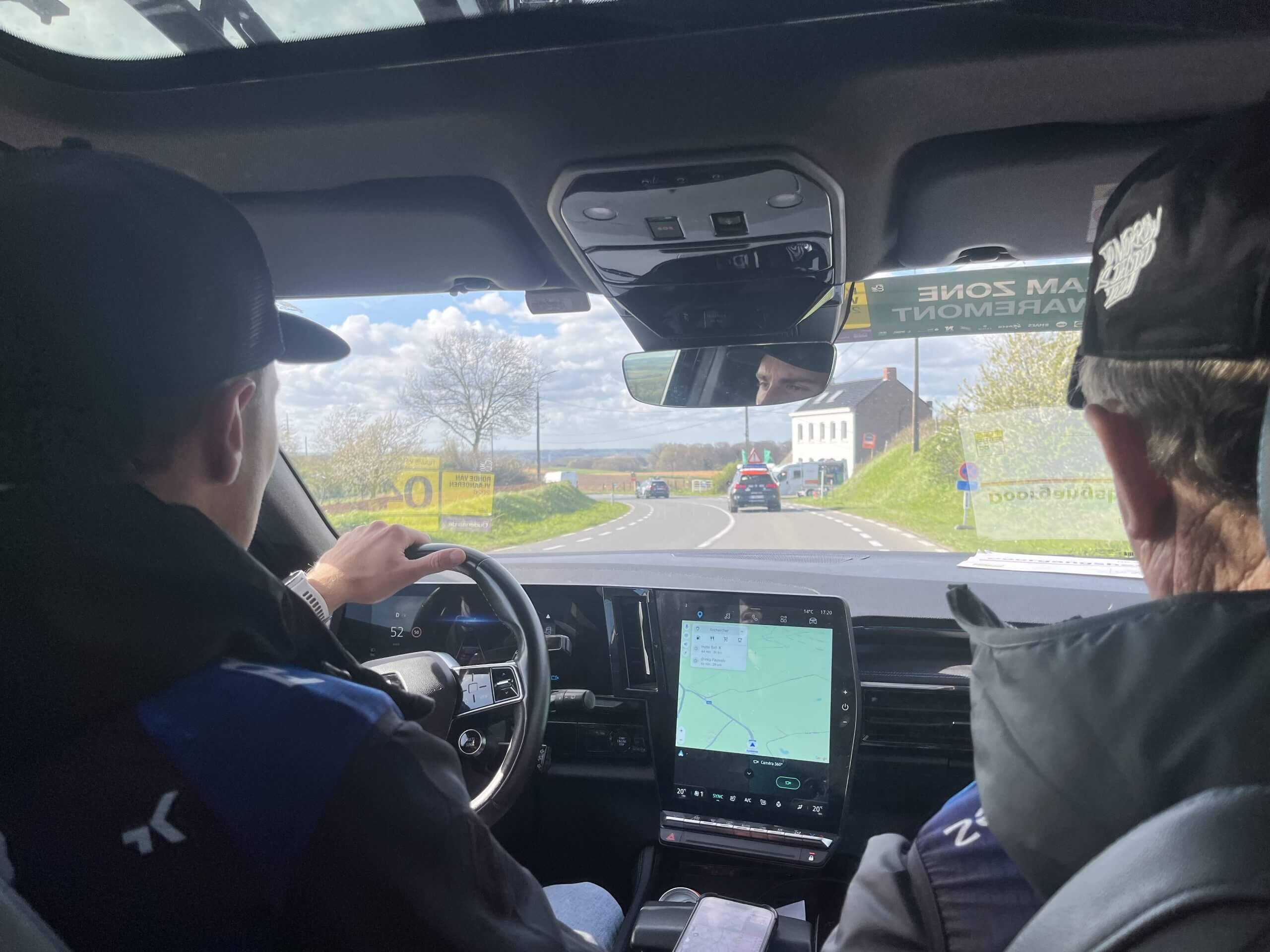
Inside the FDJ–Suez team car on race day (Jacob Whitehead / The Athletic)
Herzele — Sunday, 2.45pm
Jules slams the door of FDJ’s team car and speeds into the hills of the Flemish Ardennes, aiming to escape Oudenaarde before the race starts and roads close. He is one of the team’s mechanics; next to him is veteran soigneur Christian, known as Kiki. They hold the primary responsibility for feeding FDJ–Suez during the race, carrying bidons filled with a carbohydrate mix.
The race begins; at the first feed zone, Vollering grabs two bottles, holding one in her teeth as she undoes the other.
By the time the leaders reach the next, some 50 kilometres into the race, it has begun to spit with rain, the droplets flying horizontally across the sky. A landscape of ditches and hills, on the rare occasion that the crosswind drops, the scent of fertilising manure fills the air. Fortunately, this is the sort of wind that could furrow fields without a plough.
Vollering is surprisingly far back at the next feedzone, anonymous in the middle of the bunch. It makes her vulnerable to crashes and sudden attacks. This was not the plan. There is frustration in the team car — and it means it is difficult for her to reach Jules on the side of the road to grab her bidon. Between the pair, and amidst the melee, the bidon hits the pavé.
“I saw her at the last minute,” Jules exhales to Kiki as he runs back to the car. “She’s in a white kit.”
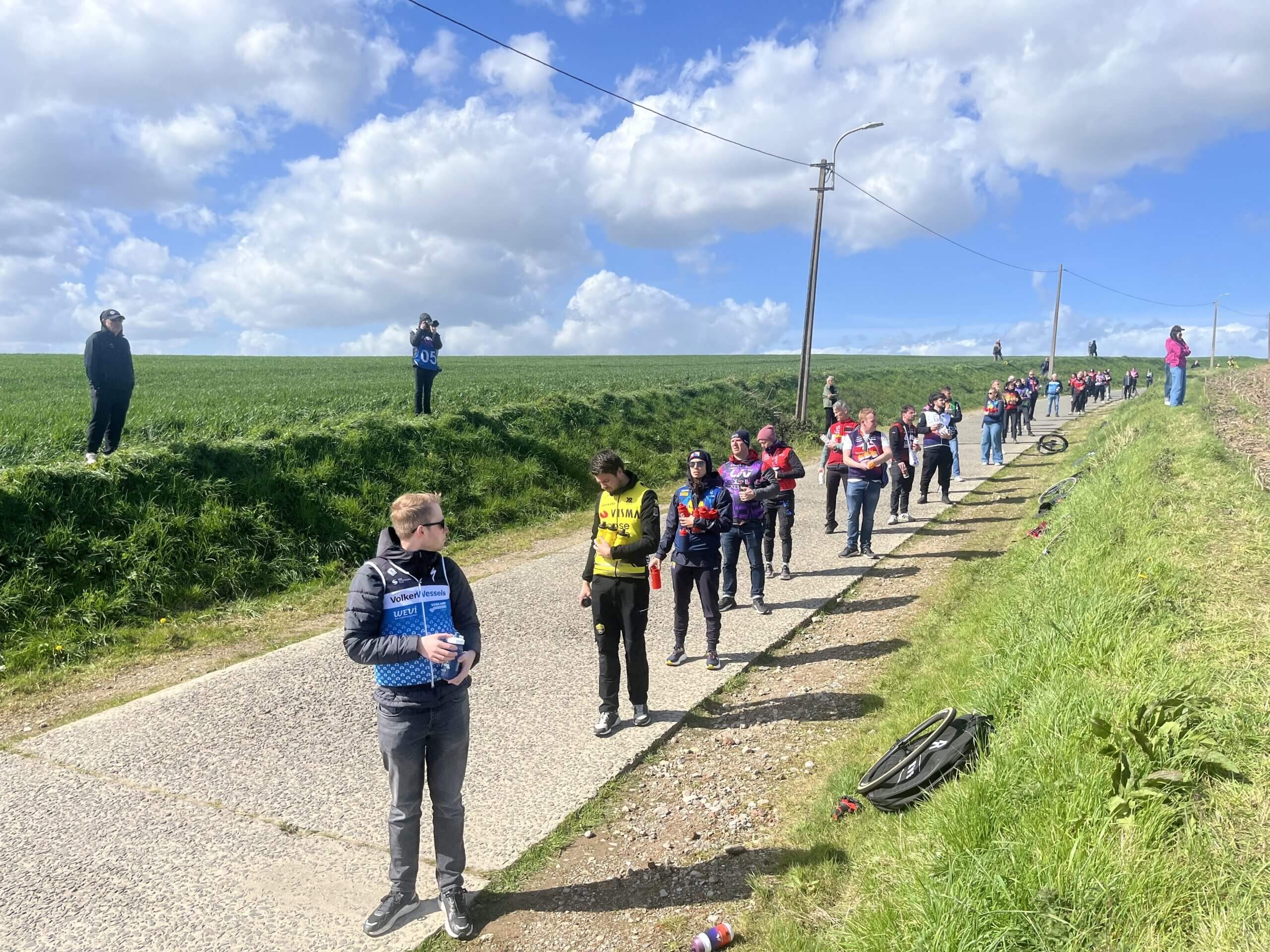
For team staff, a race is a complicated jigsaw of tasks (Jacob Whitehead / The Athletic)
These landscapes are not unfamiliar to Vollering. Now 29, she grew up helping out on the family flower farm, one of the largest producers of hydrangeas in the Netherlands. Suitably, the flowers are known for their adaptability, their ability to flourish in all soil types.
As well as winning multiple junior ‘fat tire’ races when at school, Vollering was a talented speed-skater. The focus and repetition appealed to her meditative nature. But the moment she felt she was no longer improving, she decided to stop.
“I had a season where I felt like I was standing still,” she says. “I couldn’t improve myself, I couldn’t set any personal records, and the fun disappeared faster than I thought it should have started to go. So it was a natural step to focus more on cycling.”
Vollering was a relative latecomer to elite cycling, only signing her first professional contract in 2019, aged 22. Previous years had seen her shuffle between internships, spending time at a hair and nail studio, a daycare nursery, as a gym teacher, and at garden centres. The repetitiveness frustrated her — except in gardening.
She developed her own fascination with flowers, co-founding a business and pushing through an advanced course, beating herself up if she forgot a single question on the test — the colour varieties, their families, the Latin names, how to take care of them. The focus had been a recurring theme.
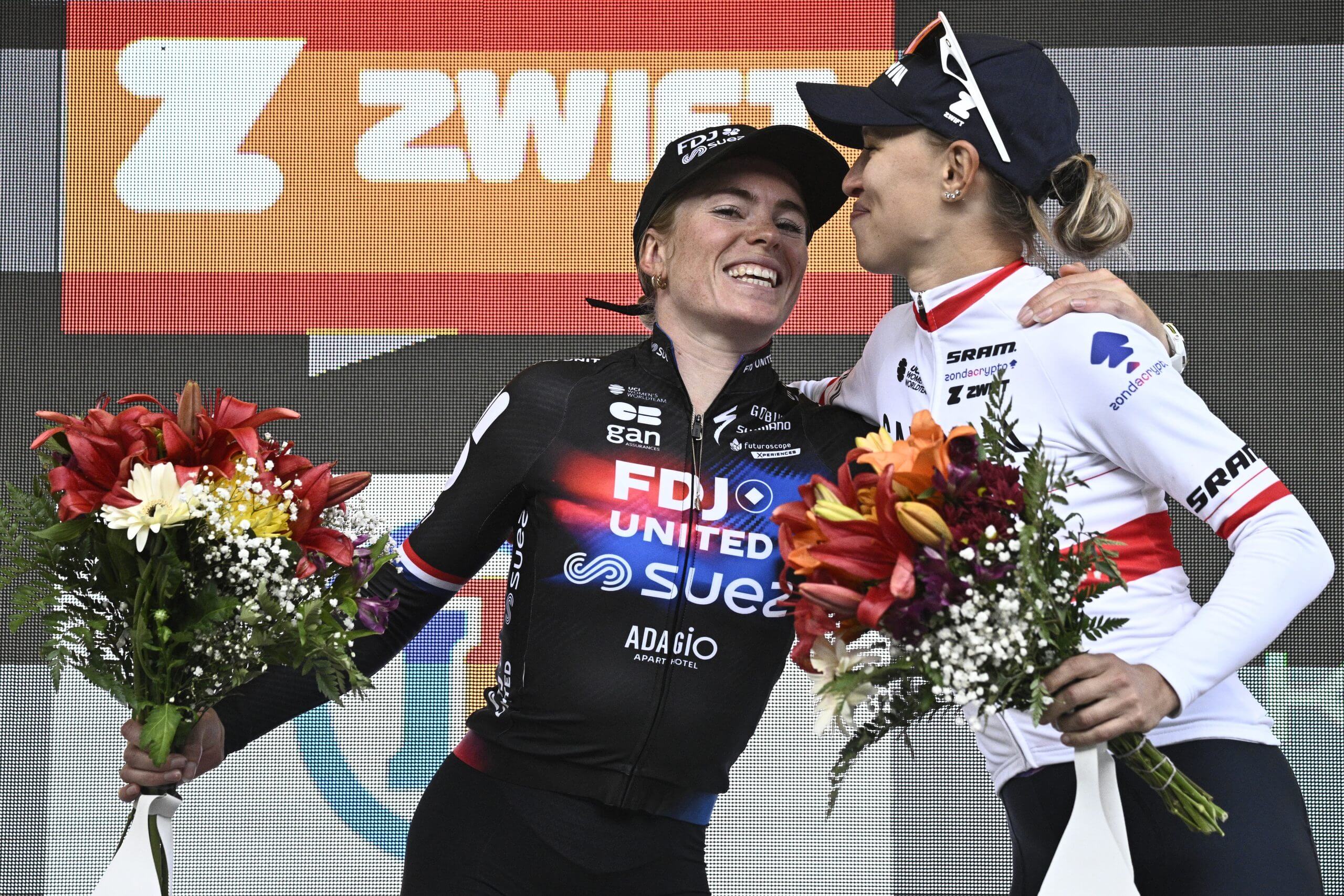
Vollering’s experience of flowers does not just come from podiums (Julien de Rosa / AFP via Getty Images)
“My mum tells a story about how, as a baby, I was walking around a low coffee table with a glass of water on it,” she says. “I was struggling to hold myself up and to walk around this table. And by trying so hard, I hit the glass of water and it fell off.
“And then I got furious because I made the big mistake of knocking over the glass of water. Like, ‘This is not how it should be’. I can be so focused on what I am doing and if something goes wrong, I can be super angry with myself. I really want to do everything perfectly.”
That extends to her time off the bike. Vollering has built a reputation for being willing to speak out on taboos — bringing up, often unprompted, the relationship between cycling and issues such as periods, unhealthy weight loss, and mental health. Another initiative she founded, Move to Dream, connects exercise and mental wellbeing.
Being a professional cyclist can be a selfish existence — unrelenting focus on your own performance, the need to sacrifice things that are not important, the inability to always see people. How does she balance the two?
“It’s true,” she says. “But it helps me to do this. I really take care of my own career to race as fast as possible, to train, eat, and sleep in a perfect, perfect way. But at the same time, I get energy by sharing what I can. I had this podium, so why not use it? And sometimes I don’t realise that’s what I’m doing. I’m quite an open book.”
Kruisberg — Sunday, 5.15pm
The wind is still up as the route threads itself through the Flemish Ardennes as if lacing a bow, the steeples of dozens of dotted village churches rattling in its stead. The climbs are beginning to intensify, both in frequency and gradient.
“We really worked on getting them to stay close to each other with the wind,” says Delcourt, FDJ–Suez’s team manager. “But then we really had to motivate them. Sometimes they’d get on the radio and say: ‘We don’t really have a good feeling now.’
“‘You are the best,’” we were saying back. “‘Please trust us. You are the best, you are the best.’ We repeated that a lot, that we are a good collective. We need to push each other at the limit.”
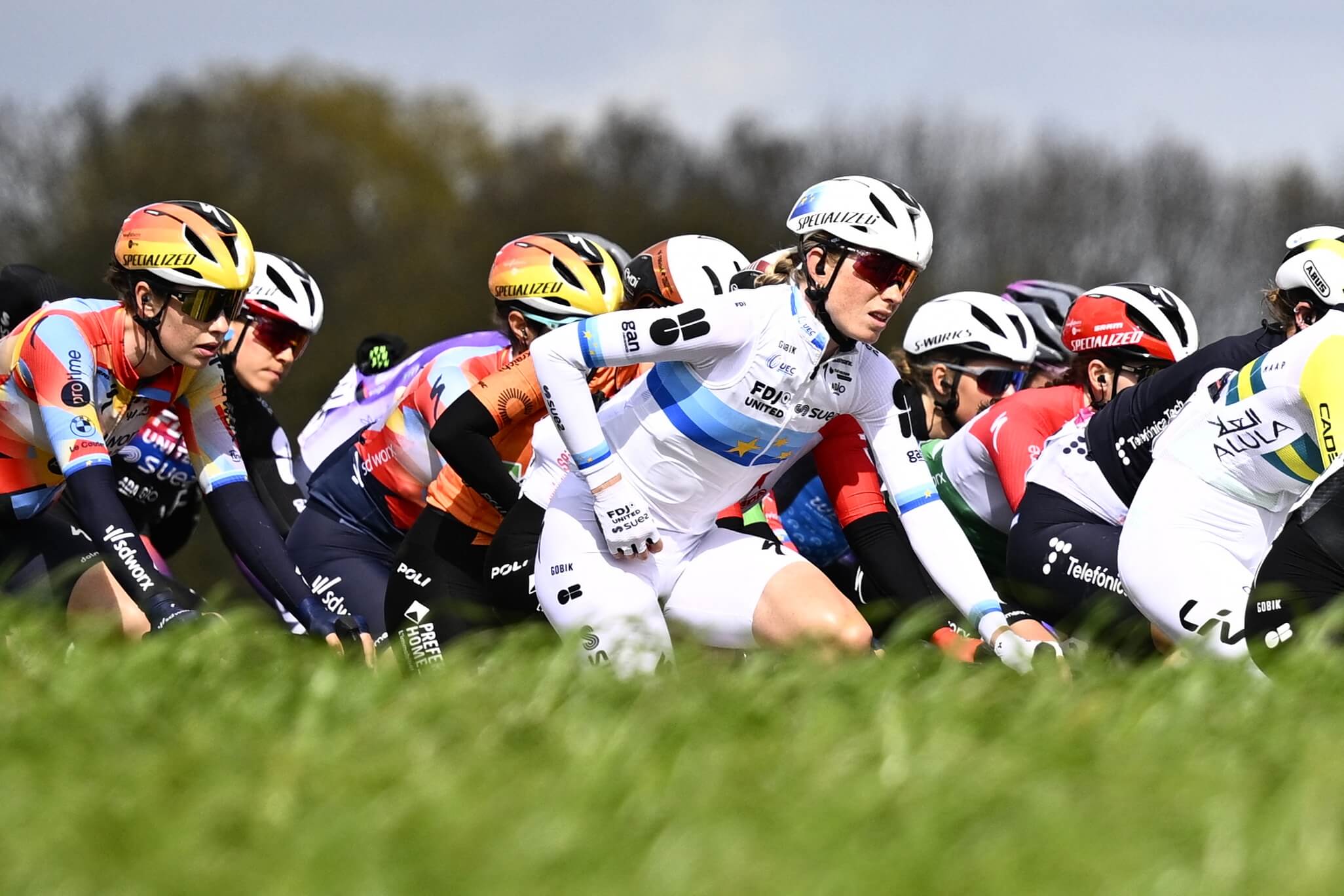
Vollering in peloton on Sunday (Jasper Jacobs / Belga / AFP via Getty Images)
Vollering sits strongly in second wheel as the peloton makes its way over the Molenberg, marking the start of the Ronde’s true brutality. The next major climb is the Eikenberg.
“The plan was to make it really hard here,” says Chabbey, who has fought her way to the front before driving the pace on with a grim relish. Instantly, the peloton begins to thin.
At the back, as the bunch descends towards the infamous Koppenberg, two of Vollering’s rivals crash badly: reigning time-trial world champion Marlen Reusser and 2025 Liège–Bastogne–Liège winner Kim Le Court. Reusser is later diagnosed with a fractured vertebra, Le Court with a broken wrist. It is a reminder of Flanders’ ever-present dangers.
FDJ–Suez riders dominate the remainder of the field. German champion Koch, in particular, is having a superb day in support of Vollering. By the Kruisberg, with 27km remaining, there are just five riders alone at the front — Vollering, Koch, reigning Tour champion Pauline Ferrand-Prévot, three-time Flanders winner Lotte Kopecky, and the ultra-attacking Puck Pieterse.
Vollering launches, not going all in yet, but leaving the saddle and accelerating strongly. She gains a few bike lengths, but is hauled in by Pieterse. From the back of the quintet, Koch gets on the radio.
“Take my wheel,” she tells Vollering. “Don’t waste your energy. We’re going full gas from the bottom of the Kwaremont.”
The beauty and brutality of cycling is this: a rider can be perfect for 99 per cent of the race, but at the end of it all, the race might come down to a final sprint, an all-important launch uphill. Other sports reward that 99 per cent perfection with goals, birdies, money in the bank, and unassailable leads. In cycling, the 99 per cent is nothing. It is over when the rider crosses the line.
Four days before the Ronde, in the Dwars van Vlaanderen race, Vollering had a golden chance to take victory — but was beaten in the sprint by Reusser. “I really believe that if she waited a bit later, she would have won,” said Boom.
Watching from the car, the directeur sportives have imperfect knowledge — their stream is usually delayed, while they cannot see everything that goes on within the chaos of the peloton. It means the burden — and the pressure — is on the rider. As the team leader, five others behind her, there will be a point where Vollering has to put their work on the line — and go.
She meditates to help her visualise these moments, obeying her golden rule — she is allowed to skip one day, but never two.
“When you’re going into the finale and you’re already fatigued, you cannot think straight anymore, then it’s automatic. You just do it. And that’s how it should be, you should always be in the moment because if you think, it is already gone. The race is too fast for you to have doubt.”
Oude Kwaremont — Sunday, 5.30pm
Vollering’s bike swings to the right, she pops out from behind Koch’s wheel, and she is away, climbing up the Oude Kwaremont with a fully seated attack, the sort of acceleration that breaks chasing riders both physically and psychologically.
The Oude Kwaremont, at 2.2km, is both the Ronde’s longest, noisiest, and most famous ascent. Feeling good after the Kruisberg, knowing she still had matches to burn, Vollering had resolved to attack from its very base.
“That was key,” says Boom. “We needed the largest gap we could get.”
She appeared to float over the cobbles in her white jersey, Ferrand-Prévot and Pieterse trailing behind her. Kopecky, the greatest classics rider of her generation, was out of shot. In the men’s race, an hour or so earlier, only 16 men did their final ascent (they ride it three times) faster than Vollering. She was two seconds faster than Remco Evenepoel.
By the time Vollering summits, the only part of her form betraying effort was her expression, but the lead, by now, was 20 seconds.
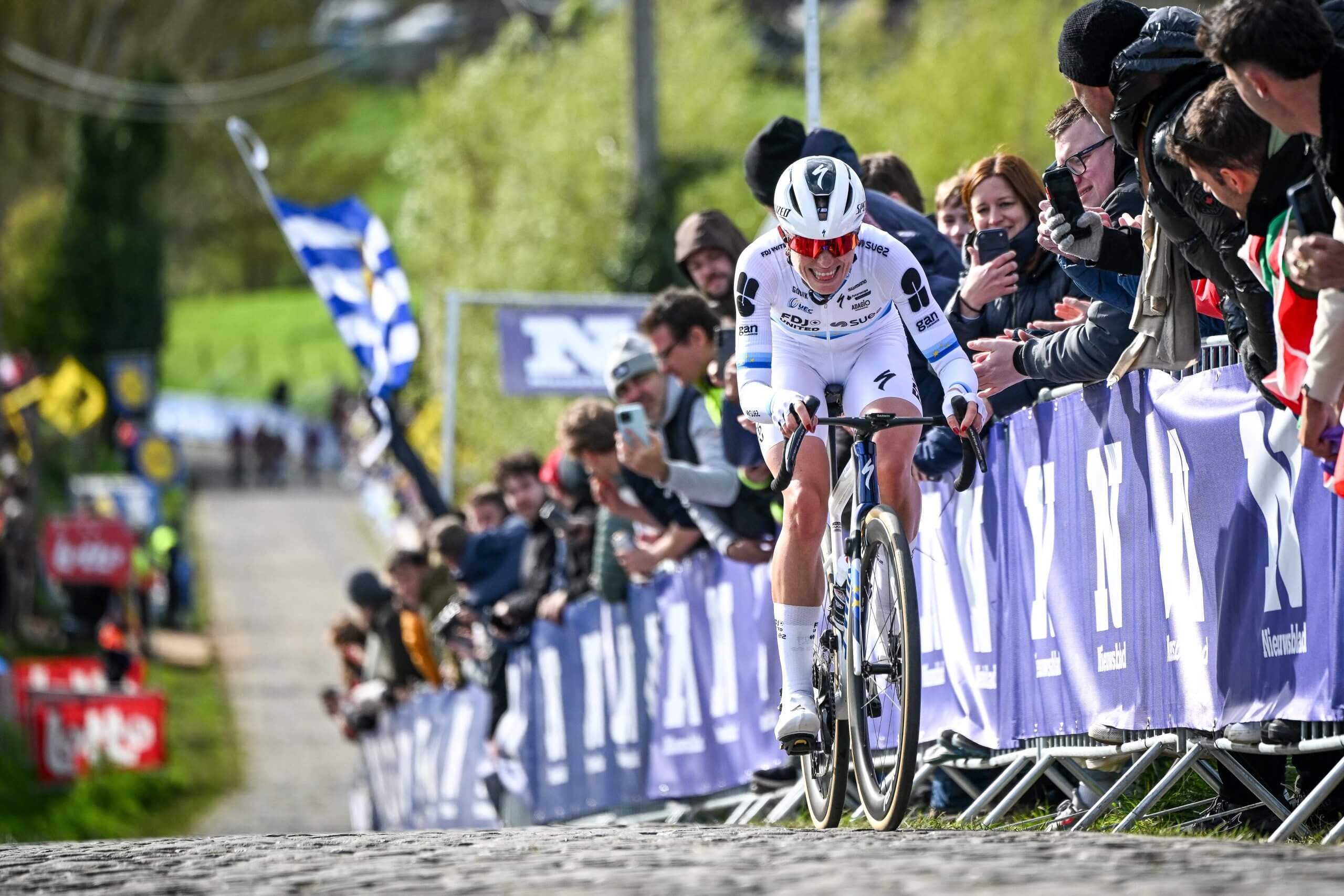
No one could live with Vollering when Sunday’s race reached its most demanding stage. (Elias Rom / Belga / AFP via Getty Images)
Vollering considered Sunday to be her first true opportunity to win the Ronde. Races in Flanders, during her time at SD–Worx, were all about Kopecky — with Vollering, at best, in a co-leadership role. On deciding to leave, she opted to sign for FDJ–Suez — then at the start of their team-building project.
“I’m willing to take risks,” she says. “I’ve always seen it with everyone around me. My family are entrepreneurs. I’m not afraid to fail. I moved to Switzerland so I’m not stuck in my habits, I’m always willing to move to the scary side, to get uncomfortable to grow again.”
Moving teams, quitting speed-skating, swapping countries — is the trying something new less scary than the prospect of being stuck?
“It’s true,” she says, looking into the distance. “I never thought about it like that.”
Oudenaarde — Sunday, 5.50pm
Now, Vollering is free to fly down the Kwaremont in golden light; the only rival near is her own ever-lengthening shadow. She ignores the bidon, she is solo and gone, Pieterse and Ferrand-Prévot are well back. Another effort up the Paterberg adds more seconds to her advantage, as does a near-perfect descent down the other side.
From the descent of the Paterberg to the final meters. Congrats, @demivollering! 👏👏 #RVV26 #FLCS pic.twitter.com/77SJjr7udo
— Ronde van Vlaanderen (@RondeVlaanderen) April 5, 2026
With 10km remaining, the gap has grown to 43 seconds, with tailwinds to come. She is in time-trial mode now, with an emerging smile doing nothing to harm her aerodynamics. In the feedzone car, Jules turns to his right and bangs the steering wheel. “Hey Kiki, we are going to win, Kiki!”
Up ahead, in the race car, Boom is keeping his focus, but even he cannot ignore what is about to happen.
“We had to keep pushing her because it was only 40 seconds and you never know what’s going to happen,” he says. “But she’s a really strong time-triallist. With two kilometres left, you just have to tell her to enjoy it because they’re not coming back. It’s not often that you finish alone in a Monument and that you win Flanders.”
She got the message. “They told me to enjoy it like five times,” Vollering laughs afterwards. The Dutchwoman whips up the crowd as she enters Oudenaarde; there is no animosity from the Belgians here. She has charmed Flanders.
On stopping the bike, her partner Jan sprints over with the couples’ dog, Flo. “To be honest, I was needing to cry in the van,” he says. “You see what she does, what she puts into it, she can never go to a party, ski with her family, she misses so many special moments, she misses being home.” Later, Vollering too will burst into tears.
Quand Demi Vollering retrouve son chien après sa victoire sur le Tour des Flandres 🐶 pic.twitter.com/wnVSW1crVZ
— Eurosport France (@Eurosport_FR) April 5, 2026
There have been images like this before, in different circumstances. Two years ago, she lost the Tour de France by just four seconds to Kasia Niewiadoma.
“But it’s not like when you lose a race you can just cry and sit in a corner,” she had said on Friday. “That’s not going to help you. So the next day you have to wake up, go train again, and just focus on the next thing. It’s important to just move on.
“Sometimes, it’s a little sad, because if you win a race I’m the same. The next day I do the same as if I had lost. It’s not that I start to behave or feel different.”
These habits do not even change for a race like the Ronde van Vlaanderen. On Monday, Vollering travels to Dijon to recon the time trial for this summer’s Tour de France, the season’s key remaining goal. It is three years since she last won the yellow jersey.
That is tomorrow, but this Sunday evening is still the evening of Flanders’ Holy Day, and Vollering stands its champion. The meditation, the sacrifice, and the team have brought her here. She is going to stay in its glow for a few hours at least.
“I’m still really on a high,” she says at 10 pm. “I’m super full of adrenaline still. I just called my family and still cannot really believe it. Maybe that will also never come. Or maybe it will come when I’m lining up on the start line, trying to do it again. Maybe that’s when you feel quite how special this has been.”