
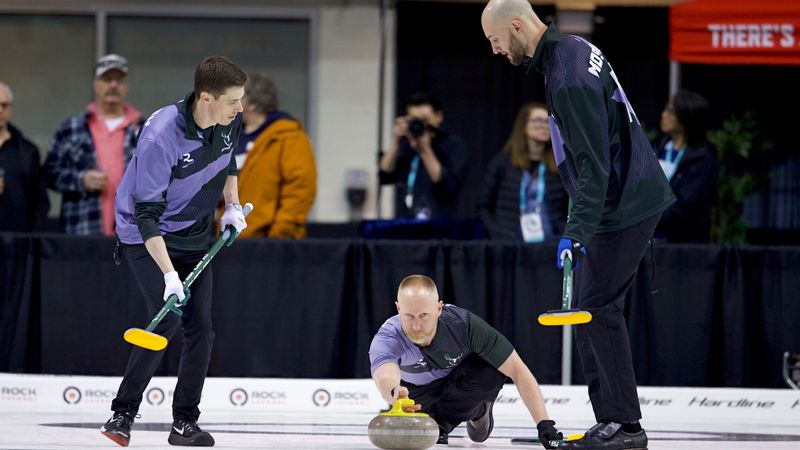
Curling is consistently one of the most-watched Winter Olympic sports, pulling in millions of viewers worldwide. But when the athletes return home—and curlers return to their day jobs—audiences don’t have much opportunity to keep up with the sport, even if they wanted to.
Nic Sulsky wants to change that. This week, the Toronto-based entrepreneuer is debuting Rock League, the world’s first professional curling league, launching out of the Mattamy Athletic Centre (formerly Maple Leaf Gardens) in downtown Toronto. With broadcast deals across Canada, the United States, the United Kingdom and South Korea, Sulsky is hoping to capitalize on the momentum garnered by some of the top curling teams from the recent Milano Cortina Olympics—while keeping Canada at the centre of it all.
One of Sulsky’s star players is Korey Dropkin, a 2026 silver medalist with Team USA, who’s travelling up to Toronto to play—and, like Sulsky, happens to be Jewish. Both Sulsky and Dropkin join the Menschwarmers to talk about how they got this league off the ground, why the sport is appealing to watch, and what is was like coming in second place at the 2026 Olympics.
But before that, hosts Gabe and James recap a major couple weeks in Jewish sports news, including the start of baseball season (with disappointingly few Jewish players) and Amar’e Stoudemire’s induction into the Naismith Basketball Hall of Fame.
Transcript
Note: Transcripts are AI-generated and may contain errors.
James Hirsh: Very excited to be joined today by Korey Dropkin and Nick Sulsky. Korey, let’s start with you just by saying congratulations and you know, how did it feel to win an Olympic medal? What an accomplishment.
Korey Dropkin: Yeah, thank you. Thanks for having me. Man, it feels great. It’s a dream come true. I had an absolute blast over in Italy. Just had the time of my life, to be honest. It was the most fun week of curling I’ve ever experienced. And to have it be at the Olympics is pretty special. But yeah, happy to be here. Thanks so much for having me and looking forward to the conversation.
James Hirsh: This is, you know, maybe a sort of sad way to start, but I want to ask you about time because the nature of team sports or certain Olympic competitions where you compete, you know, head to head is that if you are the silver medalist, which you are, it does mean that you lost your last game. What was that like? What was that like? I mean, you go into the game knowing that you’re going to win either gold or silver. Did it, was it a devastating loss? Does it feel tempered by virtue of having this? Again, I’m not at all criticizing a silver medal. It’s an amazing accomplishment. And it’s the nature of the curling round robin that you’re going to lose a few games here or there, but you happen to lose the last one. So what does it feel like to go into that last one, knowing you’re coming away with it and ultimately not being able to win?
Korey Dropkin: Yeah, great question. the best way to answer that is that there’s a little bit less stress in terms of there’s a bit weight off of your shoulders, you know, it’s, I’m not really in the business of complaining about being an Olympic medalist, right? I don’t think you have anything to complain about or anything to be. It’s a lot of, it’s a lot of years of hard work and, and dedication that’s, that’s, you know, really been, just such a battle to get to and so much sacrifice and, you know, so many years of just passionate focus on my craft and on our craft with Korey. And, you know, it is heartbreaking though. You know, you dream about being in that gold medal Olympic game. You dream about winning that game. You know, yes, you dream about being on that podium, but you dream about being on top of that podium and listening to your own national anthem. And so there was a lot of bittersweetness that went with the loss of that game. And going into that game, we knew we were going to be on the podium. We knew we were going to be at least silver medalists. And so that definitely made it a little bit easier to play. I think that bronze medal game, you’re probably still stressing a little bit, you know, trying to hide it, tuck that away and just focus on playing your game like you did all week. And that gold medal game was a great game too. It did feel like we were just, 1/2 inch off here and there. And man, Isabella, she was just, she was game. She was queen. She played really well that game too. And Rasmus too. At the end of the day, those are two great people and two well-deserved gold medalists right there.
Nic Sulsky: And James, for a bit of background, I’ll give Korey a little bit of a rope here, a little bit of a life preserver.
Gabe Pulver: This is Nick joining us, by the way.
Nic Sulsky: Oh, hi, everybody. I’ve spoken to a lot of curlers and they all say, and Korey can kind of qualify. by this, that the most stressful game at the Olympics is actually the semifinal game. Right. That is when curlers are the most stressed because, you know, at the Olympics, there’s ten teams, you know, battling all week, you know, full round robin, all that kind of thing. That semifinal game is so stressful because if you win your semifinal game, you’re guaranteed a medal. If you don’t win your semifinal game, then the stress of finishing fourth at the Olympics is It’s a challenge. So, you know, the fact that Korey and Korey were able to win their semi was great. And let’s face it, the Swedish national anthem is way nicer than the Star Spangled Banner anyway. So, you know, Korey, thank you for saving all of us to, you know, from hearing that, you know, I appreciate that.
Korey Dropkin: Wow. That was quite big, dude.
Gabe Pulver: It was.
Korey Dropkin: Nobody even knew who was talking at first, too.
Gabe Pulver: So I want to take it back a little bit, Korey. You, you know, there aren’t, you don’t hear a lot about the legends of Jewish curling. Where are you from? How did you get into the sport? And, you know, I read you’re somewhere in the Midwest now, like, take us through your journey from young child to Olympic medalist, the best you can.
Korey Dropkin: Yeah, just to give you a quick summary, you know, born in Boston, raised in Southborough, Massachusetts. Grew up curling out of Broomstones Curling Club. You know, I really follow the love and passion that my parents and my brother had for the sport of curling. Older brother, five years older, and he was kind of my hero growing up. And I just followed his footsteps, kind of had my nose to the glass watching him kind of, you know, come up through juniors. in curling and just traveled around following him. 20 years ago, I actually watched him compete in junior nationals in Duluth, Minnesota. And that was the first experience I had in Duluth. You know, that was also the year of the 06 Winter Olympics. And watching Pete Fenson’s team win the bronze medal and stand on that podium in Torino, Italy was the birth of my Olympic dream. And that was when I was like, this is what I want to do. a US team can go to the Olympics for the sport of curling and win a medal. I want to do that. And I have to be an Olympian. Like that’s, this is the coolest thing ever. And so that’s kind of when my, like my, mindset began, my dreams began for you know, continuing my pursuits and curling and I gave up everything, you know, pretty much sport wise when I was a junior in high school. Um, I knew that I was going to move to Minnesota after high school. Um, the destination was Duluth. And, uh, and so I’ve been here for 13 years, you know, just continuously in that pursuit. Um, you know, I work as well outside just to help, uh, be able to make a living. Um, you know, I used to be a landscaper and now I’m a realtor. Um, And so that’s been great. But the focus has really always been curling. And I’ve been so close a couple of times, losing the Olympic trials final to John Schuster on the men’s side in 2017 and 21 to go to the 18 and 22 Olympics.
Gabe Pulver: And that was that was in the four-man, whatever the is that the term is—the four-man?
Korey Dropkin: Men’s team, four-man curling, you know, all that jazz. And in 2021, my mixed doubles team also lost the semi-final of the Olympic trials. so I’ve been so close so many times and there’s been so much heartbreak, so much like defeat and disappointment, frustration, kind of all those feelings of, minor depression that, one has to kind of live and learn from and find a way to kick themselves out of. and try to also use that as more fuel for the fire and, you know, keep on keeping on because, you know, when you just, when you have your mind set on something and you just keep working hard towards it and keep taking those necessary steps, you know, it’s not really a miracle. It’s just a matter of time. Just keep plugging away.
James Hirsh: You know, the Olympics, the Olympics really seems like such a, such a slog. You know, you’re throwing pretty much every day, sometimes twice a day. You and Korey TC, your teammate, seem to have a great connection. It seems like many of the other teams are either married or brother and sister pairs. Can you talk a little bit about your friendship and how much that contributed, how much you have to be of one mind with your mixed doubles partner when you’re out there? What’s your communication like? What’s your strategy like working together?
Korey Dropkin: Totally, yeah. You know, we’ve been we’ve been we’re great friends. We’ve been friends since, you know, 2011. We met, you know, 2012. We, you know, represented the country at Junior Worlds together, you know, moving to you to Duluth to go to UMD. She also went to UMD. So that’s really in better friends. And, you know, honestly, we’ve all just we both kind of just respected each other so much for, you know, not just our craft, but, you know, who we are as people off the ice. And that’s kind of really helped in terms of, our chemistry on and off the ice. And it’s important to be good teammates and we’re great teammates to each other. She’s definitely, we’re definitely different, right? We have a different complexity. different mindset. You know, she brings that cool, calm confidence. You know, she’s kind of the ice to my fire. And I bring that energy and, you know, really all that emotion because I like to display my my my emotions on my sleeve when I’m on the ice, you know, especially in mixed doubles, you know, in four person men’s I’ve skipped for so long and I feel like I’ve always been so contained. And then being able to kind of be in that, you know, sweepers, sweepers system or sweepers mindset, it kind of allows me to break out of my, break out of, the closet a little bit and be able to just show my emotions and express, how I feel about this sport, how much I love the sport, and also be able to show my fitness. I put so much of my time and effort into, my my pursuits and, being stronger and also being mentally sharper. And it’s nice to be able to show everyone around this world that, this sport, we are athletes. The sport of curling is a sport of athletes.
Gabe Pulver: So that’s a really good segue, and your answer there and your answer before into talking a little bit about the Rock League, this new project. Curling is one of the few Olympic sports, or not few, but one of the Olympic sports that gets really popular during the Olympics. And then a lot of people go back to their day jobs. Similarly, you mentioned you made the switch to from, I guess, competing at the highest of the highest level in from a foreperson, as you said, skipping to mixed doubles. So the Rock League seems like it sort of answers both those questions, or at least attempts to. Maybe you and Nick could tell us a little bit about what the project is.
Nic Sulsky: Yeah, I mean, I’ll jump in and I’ll let Korey add some handsomeness to the answer and some youth. That’s easy. It should be. Rock League is the first professional curling league ever to, you know, ever to hit the sport. What’s exciting about Rock League, it launches April 6th to 12th, all in Toronto, Mattamy Centre, Three games every day going from Monday to going Monday through Sunday What’s exciting about rock league unlike some of or unlike every other big curling event around the world is it’s a It’s a game that mixes all of the Olympic formats So basically there’s for the first time in curling there are actually like team names and logos and designs and And each team has five men and five women on it. It’s actually the first mixed gender professional sports league on earth. We have teams representing Asia, 2 from Europe, two from Canada, one from the United States. And during the event, one team plays another team on three sheets of ice. So there’s three games going on to determine the winner of the match. And there’s a men’s fours game, a women’s fours game, and a mixed doubles game. all happening at the same time. So teams are going to be competing to win two of the three matches and they’re going to be kind of playing together. Each team has a GM and a coach. You know, it’s different than a lot of these other, a lot of the other, all of the other curling event series is around the world. Like I got into the sport. I’m not a curler. I put together a group and we acquired a property called the Grand Slam of Curling, which is the biggest curling event series in the world. It’s been around for 25 years. 16 of the best men’s teams and 16 of the best women’s teams come to each of our five events that we have each year. Each event is six days long. It was owned by Rogers SportsNet, the biggest sports media company in Canada. We bought it from Rogers SportsNet. Primarily because to your point, curling has a massive blow up every four years because of the Olympics. It’s literally quantitatively the most watched Winter Olympic sport. Really? Wow. But then, yeah, which is because there’s so much curling on, right? It starts before the opening ceremonies, it goes all the way to the closing ceremonies.
Gabe Pulver: And it televises so well. It’s such a good TV sport.
Nic Sulsky: Exactly. And it’s funny that you say that, but up until two years ago when we bought the Grand Slam of Curling, Roger Sportsnet never distributed any of that content outside of the country. It was just a Canadian sport, which is why curling is bigger here than anywhere else. So part of the thesis of what we’re trying to do with Rock League and what we’re trying to do with the entire sport of curling is… We need to get the sport in front of eyeballs of the fans all around the world. You can’t build a sport without actually being able to distribute that content and allowing fans to watch it, right? So the slams now are broadcast and distributed all over the world, as will Rock League. Like we have a great partnership in Canada with CBC. It’s going to be on main linear and on gem throughout the entire week, which is really exciting. And we have a bunch of other international broadcast partners. So yeah, the project is Quite literally, let’s wrap this incredible sport that everybody falls in love with every four years around the world with a professional sport wrapping an ecosystem. So real money and real growth and real team IP logos, jerseys, so people can root for Korey Dropkin or root against Korey Dropkin when he’s playing, you know, Oh, who’s going to be doing that, really?
Gabe Pulver: Hopefully not the listeners of this podcast. Although Korey, it’s an audio medium, but Korey is currently doing a bring it on, like a Morpheus style bring it on.
Korey Dropkin: It’s all a hand talk I got. Nick’s got enough for everybody here.
Gabe Pulver: Yeah, you guys have been, you know, there’s a question, back to Korey for a second. You guys have sort of been, the term would be chirping at each other, which we were talking about before we started recording as a very, very much part of curling culture. which I learned, you know, 10 minutes ago. To both of you, you know, we hear about chirping a lot in hockey culture. What’s it like in curling culture? Korey, what are some of the best chirps you’ve either said or heard before? And we consider that to be Canadian. Why is it, is it becoming American in curling at least?
Korey Dropkin: Yeah, it’s, you know, chirps are definitely a little bit part of the sport. I will be fully candid with you. I’m not a big chirper. You know, Nick and I have kind of gone back and forth a little bit on this, but I’m definitely not a big chirper. I know Danny Casper, Chris Plies, is pretty good. Hamilton, a lot of the Canadian boys, especially you get the sheriff, Matty D going and he’ll bow back for sure.
James Hirsh: Well, we saw that, we saw that this Olympics for sure with the touch gate, I guess. the Canadian Canadian.
Korey Dropkin: Oh yeah, Mark. Hey, Mark. Yeah, Mark Kennedy. He’s a he can he can chirp. But yeah, I know it’s
Nic Sulsky: Korey doesn’t — Korey doesn’t really chirp. He flexes. He really enjoys making sure that other people know how strong the old the old John Morris.
Korey Dropkin: Yeah, John Morris has, he’s been one of my heroes of the sport. And that man, I’ll tell you what, he was always good showing off his biceps. And I’ll just, I’ll take a little bit of, I’ll take a little bit of taste of that because I was definitely showing my biceps off a little bit at the Olympics. So there you go.
Nic Sulsky: That’s so was on purpose.
Gabe Pulver: Now we know it was on purpose. That’s good to know.
Nic Sulsky: Yeah, but Gabe, what I will say is that one of the exciting things about curling is that all the players are miked. All the players are miked every game. There’s no masks, no helmets. And I think with from a rock league perspective, one of the things that’s really interesting is the teams, they’re brand new teams, right? So you’re going to have teammates that have been playing together for a decade, sometimes for more than a decade, playing against each other. So I think you’re going to see that the chirping is going to increase to a point that I don’t think the sport has ever seen or heard because you’re going to have best friends who have been playing together literally since they’ve been teenagers chirping each other. I guarantee you, Rachel Homan and Emma Miskue, who are two of the greatest curlers of all time, who won a bronze medal for Canada, they’ve been best friends, I think, since they’re like 12 years old. They have never played on different teams. Emma is on Alpine, which is one of the European teams, and Rachel’s the captain of Maple United. When Maple and Alpine play with one another, play each other, I predict that Rachel and Emma, there’s going to be some chirps. There’s going to be a lot of that because teammates and best friends are going to be on different teams for the first time.
Korey Dropkin: That’s definitely what you see too commonly, like even on tour with your regular teams. We’ve just in general, the community made a lot of friends. You know, everyone’s got so many great relationships around the world and with all the other teams. And so that’s typically where you see the chirps coming in is when people are tight, you know, that they want to see They want to see if they can get in your head a little bit and they’re going to give a little bit. So it’s a give and take. It’s a give and take for sure.
James Hirsh: I think speaking speaking for the viewers, I mean, I think we want to see it. We want to see it in Rock League as you know, this is a team format and you know, whatever, whatever friendship goes out the door, goes out the door when you get on the ice. And there’s no gloves to drop. I don’t think it needs to go that far.
Nic Sulsky: But James, one of the other things that’s going to be pretty exciting about Rock League is, you know, when you watch Olympic curling, there’s four sheets on the ice, right? Four games, in fact, they’re going on. Rock League, there’s only three. But what we’re doing with Rock League is we’re introducing something called sheet side seating, where we’re putting a bar and seats and standing right down the middle of the arena. So fans, fans are going to have a built beverage in their hand and Korey’s going to slide by. and they’re going to be able to interact, let’s just say. So that will be a very interesting new twist on a curling event. That’s a great question.
Gabe Pulver: Do you ever hear particular heckles from fans, or are curling fans generally well-behaved, or maybe do they get deep in? Is there something that will freak you out and you’ll miss a shot, or are you too locked in to notice?
Korey Dropkin: I think most curlers are going to be locked in. But there are some curlers that really like to interact and engage with the fans. And I think that’s part of the nature of the sport. And I think that’s where the fans especially want to see the sport going towards. I’d say in Italy, I had a good time interacting and just kind of, helping build some energy with the crowd, because whenever the crowds get energy, it’s kind of, it kind of circulates through the building for me. So I enjoy that for sure. I know for sure playing in Canada, though, most respectful, but you always got the ones every once in a while that are going to chirp you and be like, go home, you don’t belong here, you know, something like that.
Gabe Pulver: There’s the famous picture from, I think it was the 2018 Olympics of Rachel Homan’s husband double-fisting beers at like 7:30 in the morning. I hope that’s the crowd you get at the Rock League, just for the excitement of it all.
Korey Dropkin: Oh yeah, oh yeah. And then there’s the famous picture too of Brad Jacobs, you know, kind of spinning his finger, like let’s hear it, give me some more booze.
Gabe Pulver: Yeah. So that’s, I mean, is there a big camaraderie said everyone’s on tour? Does the whole league go out for a beer after the match? Is that how it works generally? Or is there a little more love lost?
Nic Sulsky: Well, you know what? Before Korey, I’ll tell you, the thing that made me fall in love with the sport, I mean, the sport’s great. I remember going to my very first curling event. And after the game, I went to a bar across the street and I was having a pint with a buddy. And I saw the curlers that I just watched on the ice. They were in the bar, they were hanging out with each other and they were hanging out with the fans. And I was like, ’cause I grew up playing rugby. I was like, oh, there’s a real community here. And so, I mean, the reality is these are elite athletes. So I think that the proper answer and the true answer is if a team has an early morning game, they’re sleeping. But if a team isn’t playing until two or four in the afternoon, six in the afternoon, is the likelihood of them being out for drinks possible? Absolutely. And certain people on tour tend to partake a little bit more than others. But I mean, Korey, like, Korey’s a very friendly fella, right?
James Hirsh: Yeah. We should mention, you know, obviously we’re a Jews in Sports podcast. Korey, glad to have you for that reason, and we understand your dad works at the Hebrew College in Newton, Massachusetts is great. Nick, we understand you had some Maccabia participation in rugby in your youth. What’s the prospects for getting curling in as a Maccabia sport? I mean, there’s been some winter games in the Maccabia, you know, hockey’s been in for a while and now women’s hockey as well. How do we get more Jews into curling, Jewish kids into curling and get curling in the Maccabia?
Nic Sulsky: That is a great question, and it’s funny, I’ve been talking to the folks at the JCC here in Toronto, because as you guys probably know, the junior Maccabea is coming August 2nd. Yeah, this summer, August 2nd to 7th. And and it’s funny, I played senior Maccabea in 97 for Canada in rugby. I also played junior in Detroit, I think in 94 or something to that degree in softball and fast pitch. I’ve experienced it. It’s such an incredible experience. And it’s funny, the the folks you know, some of our some of the folks that we know, we were talking about doing an exhibition for curling for the kids here in Toronto in August, bringing some of the, you know, medalist curlers in and doing a learn to curl, doing a bit of an exhibition. Because to your point, we’d love we’d love to see it. Right. And Israeli curling is starting to grow. We’ll the Israeli wheelchair curling team won a bronze medal at the Invictus Games in 2025 and wheelchair curling has become really, really big. The Israeli curling team actually played in the tier, kind of in the B tier of the European Championships this year. So yeah, I mean, at the end of the day, like we want to see the sport grow everywhere. And just because of my personal experiences, like McAfee, it was such an incredible, such an incredible moment. Like I will never forget those two times I got to play for Canada. And yeah, I just hope, I think, Again, no promises, but we are hard at work trying to figure out how to bring the sport to the young Jewish athletes. ‘Cause let’s face it, that’s how you grow a sport. You can get the older ones playing, but really to facilitate true grassroots expansion and growth, it’s about the kids. So we got to expose them to the sport first.
Gabe Pulver: We’re seeing right now a very big boom in Jewish hockey. And I feel like you guys are immediately adjacent to that in terms of like an athletic community-based winter sport. there’s Jewish hockey leagues all over the world and we’re seeing that sort of benefit in to the community and the NHL with players like Zach Hyman or fellow Olympic medalists Jack and Quinn Hughes. Korey, who are from the East, grew up all over America, but also Jewish. But your question leads me to wonder, do you know of any other top tier Jewish curlers? There was an internal debate we had about Danny Kasper. We couldn’t figure it out. We’re not sure if, Korey, you might be the only one that we know of, but have you made the connection with anybody else? I assume the Swedish brother and sister are probably not Jewish.
Korey Dropkin: I don’t think so. I don’t think so. No, but what I would say is, I mean, I love sharing my passion for the sport with others that want to get into it. So anyone that’s interested, feel free to reach out and happy to get involved with the growth, especially in the Jewish community. I’d be happy to just be there to help promote the opportunities and the growth of the sport.
James Hirsh: Yeah. Well, why don’t we leave it there? I think we’re all really excited to see how Rock League goes. We wish you guys really well. And I would say for Jews in Toronto, especially people with young kids, if you’re off for Passover, there’s often a school break. Go check out Rock League. What a great thing to do. You know, it’s right downtown. I love the Madame.
Gabe Pulver: The arena’s fantastic.
James Hirsh: For people who aren’t in the know, it’s what Maple Garden, Maple Leaf Gardens used to, what used to be Maple Leaf Gardens.
Korey Dropkin: And really to circle it back to a previous question is, if you’re wondering whether those athletes are gonna be out having a couple or not, maybe go across the street to Mickey Finn’s, ’cause I think she’s gonna get hit hard that week.
Show Notes
Credits
Support The CJN