
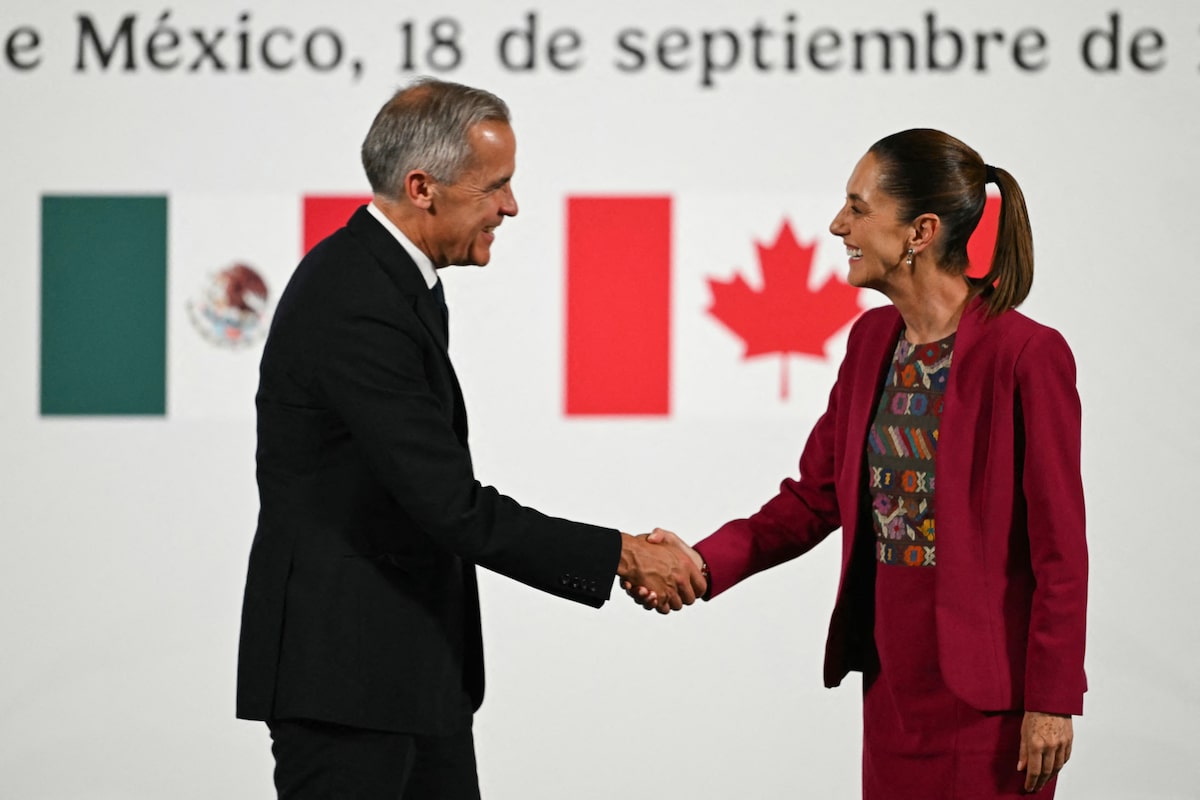
Prime Minister Mark Carney shakes hands with Mexico’s President Claudia Sheinbaum at the National Palace in Mexico City in September, 2025.YURI CORTEZ/AFP/Getty Images
Andrei Sulzenko was a principal negotiator of the Canada-U.S. Free Trade Agreement
Last month, a biannual ministerial-level World Trade Organization meeting took place in Cameroon. The ostensible objective of the meeting was to restart WTO reform.
Progress stalled on a deadlock on renewing the just-ended two-year moratorium on digital commerce tariffs, with the United States pushing for a lengthy extension in return for co-operation on other issues. With more than 160 members at the WTO, consensus on anything is a challenge.
The meeting ended by punting all the issues to the never-ending squabbling at WTO headquarters in Geneva.
But there is a silver lining in the ongoing drift of WTO irrelevancy: The discussions among a “coalition of the willing,” spearheaded by the almost 40 countries in the Comprehensive and Progressive Agreement for Trans-Pacific Partnership trading alliance and the European Union, to establish intensive collaboration on an ambitious liberalizing agenda.
Canada and Mexico on different paths heading into USMCA crunch time
This goes back to Prime Minister Mark Carney’s oft-cited speech at Davos in January, which can be characterized as both an eloquent summary of evolving global economic relations as well as a catalytic call to arms of like-minded “middle power” countries. His speech gave intellectual permission to an already flourishing set of initiatives in the absence of historical U.S. international leadership.
For some years, successive U.S. administrations have been on the outside, only occasionally looking in, with respect to global institutions. The second Trump administration has served mainly to reinforce this disdain – IN ALL CAPS.
For example, the U.S. has consistently been lukewarm about the United Nations and its various specialized bodies, as well as the WTO, the keeper of international trade rules. These institutions are badly in need of reform, as they have delivered a lot of talk and little action; but the U.S. has over the years aided the sclerosis with either passivity or deliberate undermining.
American skepticism about, if not outright hostility toward, multilateralism has been largely bipartisan politically. A major point of convergence came in the 2015 electoral campaign when candidate Hillary Clinton joined candidate Donald Trump in rebuking the Trans-Pacific Partnership, with signatories including Canada and the U.S., that then-president Barack Obama had championed as a way of isolating China regionally for its systematic commercial transgressions.
President Trump formally withdrew from the TPP in 2017, and President Biden chose not to rejoin what had then morphed into a 11-country pact called the CPTPP. The U.K., although not a Pacific nation, joined in 2024.
After Davos, trade liberalizing engagement among like-minded countries has shifted from a sedate pace of discussions over decades to almost frenetic activity taking place over mere months. For example, the EU quickly finalized long-negotiated trade agreements with Mercosur – the Argentina, Bolivia, Brazil, Paraguay and Uruguay bloc – and then with India. It is fair to say that the worldwide trade “rupture” instigated by the U.S. hastened those deliberations.
For its part, Canada has been very active in mending fences bilaterally and in resurrecting languishing negotiations. Prime Minister Carney has established the basis for ongoing rapprochement with China. He has also kick-started moribund trade negotiations with India and with Mercosur. Canada has also pursued many specific bilateral and plurilateral economic and security-related agreements.
The pace of middle-power collaboration appears to be strengthening. But the “coalition of the willing” behind the ambitious liberalizing agenda represent two big trading blocs and almost a third of global GDP, and any new agreements would still be compatible with existing WTO rules so long as they did not result in more restrictive actions.
If that core group (including Canada) were to move forward expeditiously, their collective ties through various agreements with other countries could result in a rapidly snowballing consensus on new trade rules, all without the U.S.
Such middle-power collaboration puts Canada in a delicate situation in advance of pending negotiations with the U.S. and Mexico on the future of the United States-Mexico-Canada Agreement (USMCA). Arguably it provides Canada with more leverage or at least reduces U.S. leverage. But it also makes tricky forthcoming discussions about issues such as increasing North American content requirements to promote continental consolidation in manufacturing – a likely high priority for the U.S.
The important tactic for Canada, then, will be to keep all possibilities in play until potentially tough decisions need to be made. Better yet, there could be a scenario where we bake our cakes and eat them too. After all, in the near term, maintaining access to the U.S. market is essential while, in the medium term, Canada is able to further diversify through global partnerships. That’s just good risk management.