
Published April 6, 2026 11:40AM
Tadej Pogačar destroyed his rivals one by one to win his third Tour of Flanders. First, he rode Wout van Aert off his wheel on the ascent of the Oude Kwaremont. Second, he put in a dig to prevent Remco Evenepoel from catching back onto the front group. Finally, he dispatched Mathieu van der Poel on the final ascent of the Kwaremont before driving the nail into the coffin on the Paterberg.
It was a dominant display that we’ve become accustomed to as witness to Tadej Pogačar. But every time we see it, it remains impressive. Every year, Pogačar sets a climbing record, wins a record number of races, or breaks a 100-year-old curse.
On Sunday, he became a three-time champion of the Tour of Flanders, and we will soon see if this is the season where he can win all five monuments. Tadej Pogačar is better than ever, and we have his power data to back it up. This is how he won the 110th edition of the Tour of Flanders.
The Four-Hour Warmup
In any monument, there is a multi-hour warmup period that is often forgotten. These are the kilometers that occur before most of us turn on the TV. But when it comes to performance and data analysis, these periods must not be forgotten.
The average rider at the Tour of Flanders burned 3,500-4,500 kJs in the first four hours of racing. This was the “easy” part, by the way. As we get into the numbers below, remember that these are fatigued performances, not fresh numbers.
Why am I setting the cut-off at four hours of racing when there was still 100 kilometers to go? Because that’s when Pogačar started attacking.
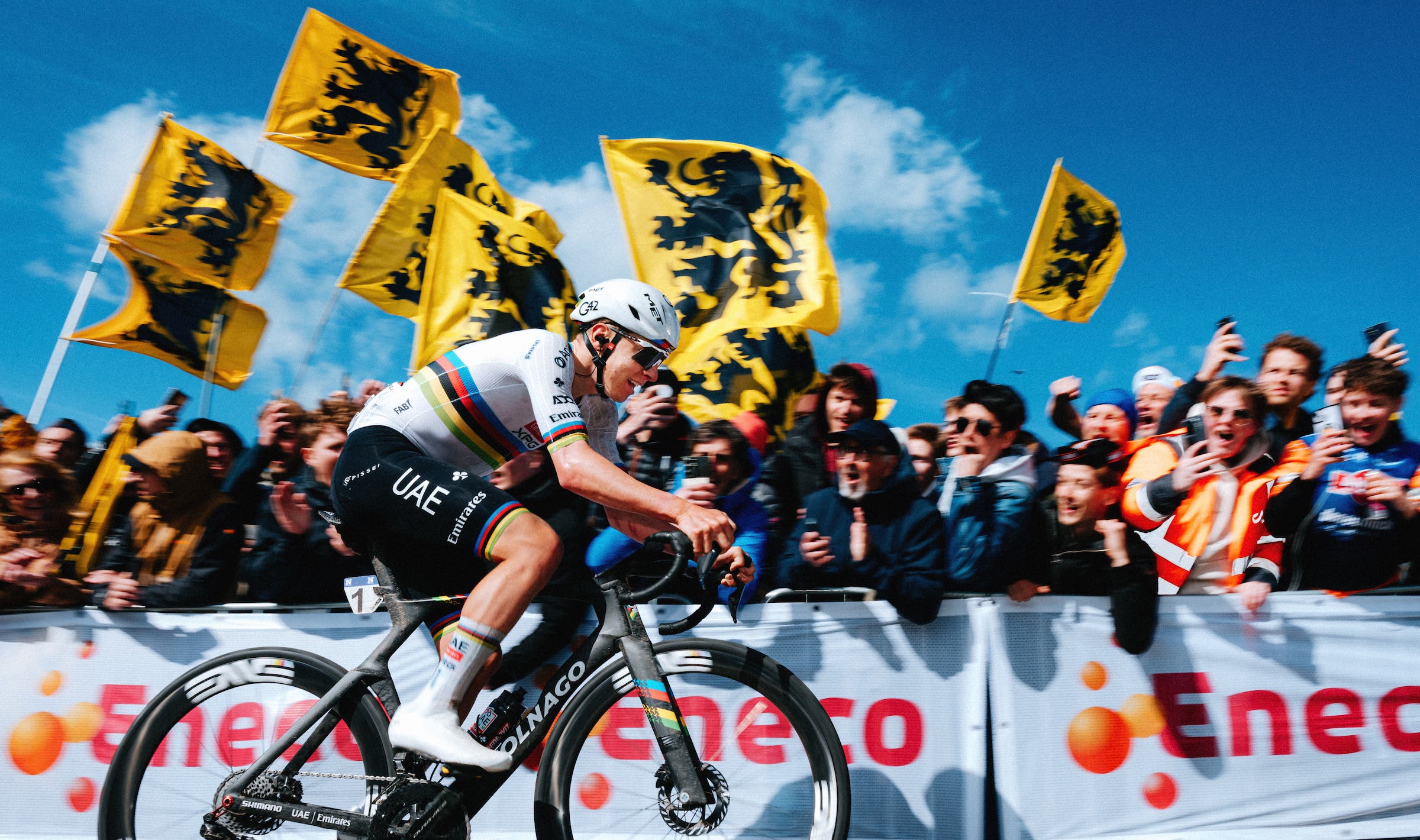 (Photo: Gruber Images)
Pogačar’s Countless Attacks
Just before the Molenberg, UAE Team Emirates-XRG surprised the peloton with a full leadout into the base of the climb. Nils Politt and Florian Vermeesch went to the front and started pulling like freight trains with Pogačar tucked in their wheels. Van der Poel was in good position whereas Van Aert was floundering. It took a few teammates sacrificing their races for him, but the Belgian made it back to the front just in time.
Vermeesch smashed up the Molenberg with such pace that only 10-15 riders were left at the front of the race. Pogačar was there of course, along with Van der Poel, Van Aert, and Mads Pedersen. Also among the group was a Tour of Flanders debutant, a 63kg Belgian named Remco Evenepoel. If there was ever a race situation perfect for Evenepoel, it was this. With a group of about 15 riders going clear, there wouldn’t be major battles for position. Rather, it would become a survival of the fittest.
At this point of the race, UAE Team Emirates-XRG’s strategy was clear: death by a thousand cuts.
Instead of one big move on the Kwaremont, Paterberg, or Koppenberg, Pogačar started launching attacks on every climb. With 57km to go, Pogačar launched his telegraphed attack on the second ascent of the Oude Kwaremont. He launched from the front of the group, so everyone could see it coming, but only Van Aert managed to immediately close the gap to his wheel.
Over the next three minutes, the entire race is flipped on its head.
First, Van der Poel started coming back to the lead group. Pedersen was dropping the wheel, Pogačar and Van Aert were riding away, and Evenepoel was stuck in the middle. Nearing the top of the Kwaremont, Van Aert was starting to get dropped, while Van der Poel and Evenepoel had managed to catch Pogačar’s wheel. This is the moment where the elastic snapped for Van Aert. He was only three seconds behind the leaders at the top of the climb, but that gap would explode over the next few kilometers. One thing was now clear: the podium at this year’s Tour of Flanders would be Evenepoel, Pogačar, and Van der Poel — but in what order?
Pogačar – Attack on the Second Oude Kwaremont
Time: 2:50
Estimated Average Power: 530w (8.1w/kg)
Attack on the steepest section: 1:13 at 640w (9.8w/kg)
The next climb was the infamous Paterberg, a sharp and steep ascent lasting just over a minute. After all the brilliant work to make the lead group, Evenepoel ruined his race here by pulling with Pogačar. The Belgian even took the lead partway up the Paterberg, half-wheeling Pogačar before the Slovenian put in another acceleration. Just as Van Aert had been gapped on the Kwaremont, Evenepoel was now in the same position atop the Paterberg.
Pogačar and Van der Poel climbed the Paterberg in 58 seconds, while Evenepoel was four seconds slower at 1:02. Those four seconds soon turned to five, then six, then eight…The Belgian could almost reach out and touch the leading duo, but one final acceleration from Pogačar blew open the gap for good. The winner of the Tour of Flanders would be either Van der Poel or Pogačar.
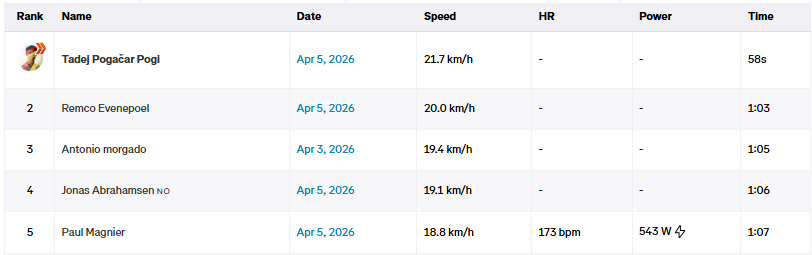 Pogacar – First Paterberg
Pogačar – Dropping Evenepoel on the First Paterberg
Time: 58 seconds
Estimated Average Power: 650w (9.9w/kg)
Before the final attacks from Pogačar, one could argue that the race was won and lost just after Evenepoel was dropped. This is the moment that Van der Poel started working with Pogačar. For as strong as he is, Pogačar is slower than Evenepoel on flat roads. The Belgian is a world and Olympic time trial champion, arguably the fastest rider ever in an aero position. Pogačar could put a few seconds into Evenepoel on each climb, but then the Red Bull-Bora-Hansgrohe rider would take back that time and more on the flats.
But the race changed when Van der Poel started to pull. That’s when the gap on the flats stopped coming down. Instead, the gap started expanding, and Evenepoel lost sight of the leaders. Now it was down to two: Pogačar and Van der Poel. The Dutchman looked stronger than ever, but so did Pogačar.
Pogačar Deals the Knockout Blow
On the final ascent of the Kwaremont, Pogačar gapped Van der Poel almost immediately. The Alpecin-Premier Tech rider held the gap initially, but then it exploded after the Kwaremont’s crest. Six seconds at the top turned to 13 on the descent, and 16 seconds by the top of the Paterberg. Tadej Pogačar was simply too strong.
UAE Team Emirates-XRG’s strategy is revealed in the climbing times. Pogačar went 12 seconds slower on the final Kwaremont ascent compared to the second, but he still dropped Van der Poel. The Slovenian’s greatest strength isn’t his explosive power; it’s his fatigue resistance. There are plenty of riders in the world who can match Pogačar’s 2:50 ascent of the Kwaremont. But after nearly six hours of racing, five full gas attacks, and two hours of swapping turns with Van der Poel and holding off Evenepoel, that’s what makes Pogačar the best rider in the world.
Pogačar – Dropping Van der Poel
Kwaremont: 3:02 at 480w (7.4w/kg)
Paterberg: 1:04 at ~610w (9.3w/kg)
The world champion won solo with a 34-second gap over Van der Poel and one minute 11 seconds over Evenepoel. Van Aert was fourth at more than two minutes down, with Pedersen finishing fifth, another 44 seconds behind.
For as dominant as his performance was, Pogačar winning Paris-Roubaix is far from a certainty. Pogačar didn’t win the Tour of Flanders by a million miles, and his rivals made a number of key mistakes that directly contributed to their downfalls. If Van Aert had made the front group on the second Kwaremont, if Evenepoel hadn’t overextended on the Paterberg, and if Van der Poel hadn’t wasted precious energy pulling with Pogačar, who knows that could have happened in the Tour of Flanders.
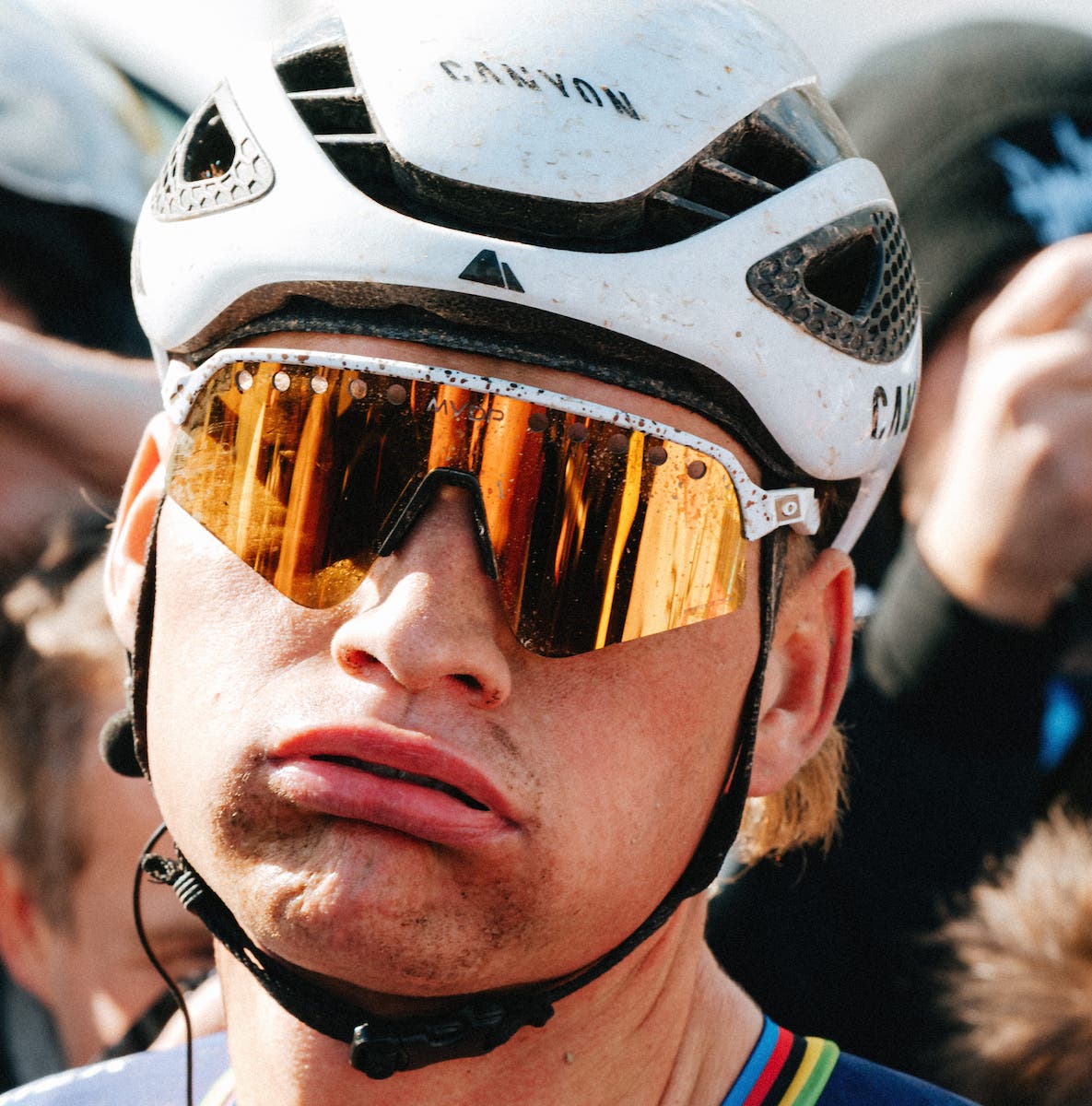 Tough day at the office. (Photo: Gruber Images)
Power Analysis data courtesy of Strava
Strava sauce extension
Riders: