
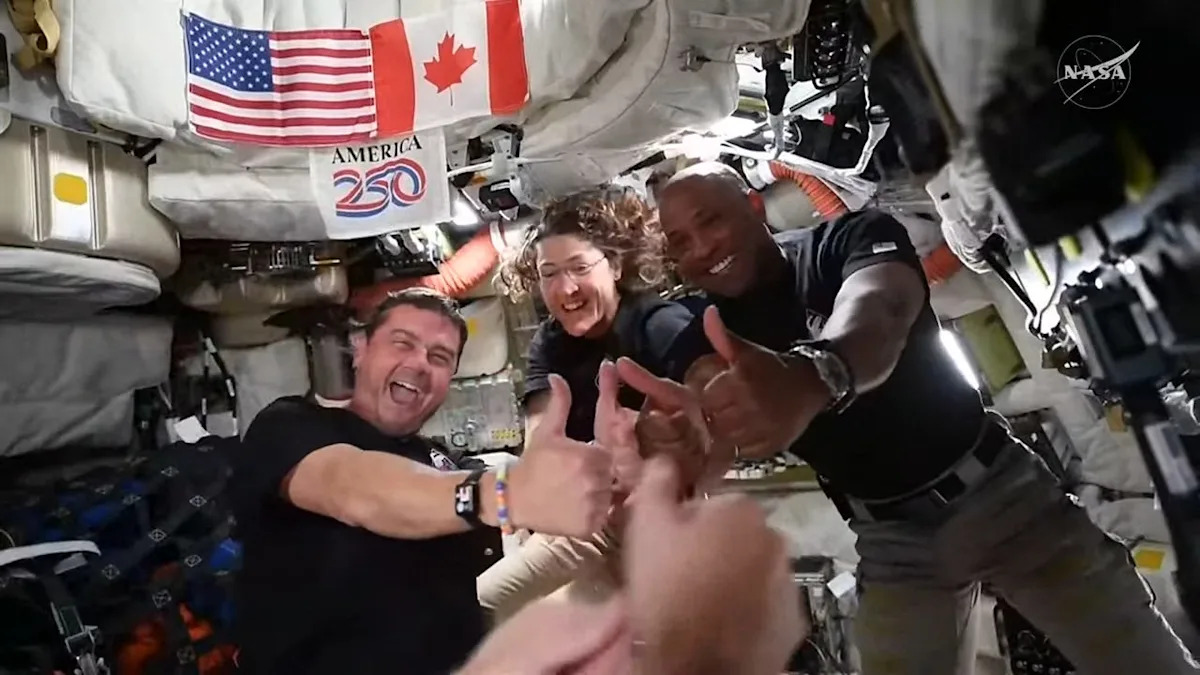
Before etching their names in spaceflight history, the four Artemis II astronauts received some posthumous words of encouragement from one of NASA’s greats.
Jim Lovell, who flew on two Apollo-era missions in 1968 and 1970, recorded a message for the astronauts before his death in 2025. They heard it before they became the first humans to fly near the moon in more than 50 years.
On Monday, April 6, astronauts Reid Wiseman, Christina Koch and Victor Glover of NASA, as well as Jeremy Hansen of the Canadian Space Agency, flew by the moon in a mission similar to the Apollo 8 flyby, of which Lovell was a part. And in a bit of serendipity, it wasn’t long before a nearly seven-hour period of lunar observations began that the Artemis II crew broke one of Lovell’s own records: surpassing the distance from Earth that the ill-fated Apollo 13 mission reached under Lovell’s command.
Artemis II is the first human spaceflight under NASA’s Artemis program, the main objective of which is to return humanity to the surface of the moon for the first time since the Apollo 17 mission in 1972.
But the Artemis campaign is far from a reprise of the Apollo era. This time, NASA is aiming for humans not to simply leave, but to remain to set up a moon base toward the lunar south pole ahead of the first crewed expeditions to Mars.
A look at Artemis around the far side of the moon
1 of 9
This handout image released by NASA shows a fully illuminated Moon, with the near side at top, dark lava plains, and the Orientale basin, with parts of the far side visible, on April 6, 2026. The four astronauts embarking on NASA’s lunar flyby became on April 6 the humans to travel furthest from our planet, as they get set to view areas of the Moon never before seen by the naked eye. The Artemis II team broke the previous record set by 1970’s Apollo 13 mission, which they are expected to surpass by approximately 4,105 miles (6,606 kilometers) when they reach this journey’s anticipated furthest distance from Earth — 252,760 miles — later today.
Here’s what to know about Jim Lovell’s message to the Artemis II astronauts.
Who is Jim Lovell? Astronaut was part of 2 Apollo missions
A native of Cleveland, Ohio, Jim Lovell was selected for two moon missions during NASA’s Apollo era.
The first was Apollo 8, which in 1968 sent Lovell, Frank Borman and Williams Anders on a six-day trip orbiting the moon. Just as Artemis II, the mission served as an important prelude to a moon landing, helping test systems, hardware and procedures before astronauts stepped foot on the surface during Apollo 11 in 1969.
Lovell also was the commander of the nearly disastrous Apollo 13 mission, which in 1970 was meant to be the third human moon landing under the program.
But an oxygen tank that exploded on the service module transformed the spaceflight into a life-or-death situation. Relying on backup life-support systems on the Apollo Lunar Module meant to transport them to the moon’s surface from orbit, the astronauts used primitive methods of celestial navigation to make their way back to Earth.
Lovell was later portrayed by Tom Hanks in the 1995 “Apollo 13” film directed by Ron Howard.
See photos from space during NASA’s Artemis II mission so far
1 of 7
Artemis II crew members Jeremy Hansen, Reid Wiseman, Christina Koch, and Victor Glover answer questions from reporters during the first downlink event of their mission.
Before death, Lovell recorded message for Artemis II mission
Jim Lovell, who died Aug. 7, 2025, at 97 years old, was unable to witness humanity’s return to the moon’s vicinity with the April 1 launch of Artemis II from the Kennedy Space Center in Florida.
But the iconic astronaut did record a message before his death for the four astronauts selected for the mission that they were able to hear Monday, April 6.
“Welcome to my old neighborhood,” Lovell said in a message shared by NASA, which was played aboard NASA’s Orion crew capsule as the astronauts prepared for a historic lunar flyby. Referencing the Apollo 8 mission, Lovell said he and the crew were treated to “a view of the home planet that inspired and united people around the world.”
“I’m proud to pass that torch on to you,” Lovell continued. “It’s a historic day, and I know how busy you’ll be. But don’t forget to enjoy the view.”
Lovell concluded: “Good luck and Godspeed from all of us here on the good Earth.”
See the moment Artemis II lifts off for historic moon mission
1 of 35
Artemis II and it’s crew of four lift off from Kennedy Space Center April 1, 2026 on a 10-day mission around the Moon and back. Craig Bailey, FLORIDA TODAY via USA TODAY NETWORK
Artemis II astronauts make historic flyby of moon
The Artemis II received the message while on the cusp of making spaceflight history April 6 during a trailblazing lunar flyby.
Before a nearly seven-hour observation period even began, the Artemis II astronauts traveled farther from Earth than any humans ever have, surpassing a record set in 1970 during Lovell’s own infamous Apollo 13 mission. That mission, which required an emergency return to Earth, reached a distance of 248,655 miles away.
The Artemis II astronauts passed that milestone before 2 p.m. ET April 6 – and then went thousands of miles farther. By around 7 p.m., the mission reached a maximum distance from Earth at 252,756 miles, setting a new record for human spaceflight, according to NASA.
Swooping around the moon’s far side, the Orion vehicle carrying the Artemis II astronauts came no closer than 4,067 miles above the lunar surface during the historic rendezvous. That altitude allowed the crew to see the full disk of our celestial neighbor as they witnessed lunar sights that no other humans before – not even the Apollo astronauts – have experienced in person.
How long is the Artemis II mission? Here’s when they’ll land on Earth
After launching April 1 from Florida, the astronauts are now making a four-day journey back to Earth, using our planet’s gravity to naturally “slingshot,” or pull Orion back home, negating the need for propulsion or much fuel.
Once Orion blazes through Earth’s atmosphere, a protective heat shield will be cast off to make way for parachutes to deploy and slow the vehicle down.
The capsule is due to make a water landing Friday, April 10, in the Pacific Ocean near California off the coast of San Diego, after which five orange airbags will inflate around the top of the spacecraft and flip the capsule into an upright position. After the landing, the crew would exit the vehicle onto a U.S. Navy recovery vessel within about two hours.
Eric Lagatta is the Space Connect reporter for the USA TODAY Network. Reach him at elagatta@usatodayco.com
This article originally appeared on USA TODAY: Here’s Apollo astronaut Jim Lovell’s message to Artemis II before flyby