
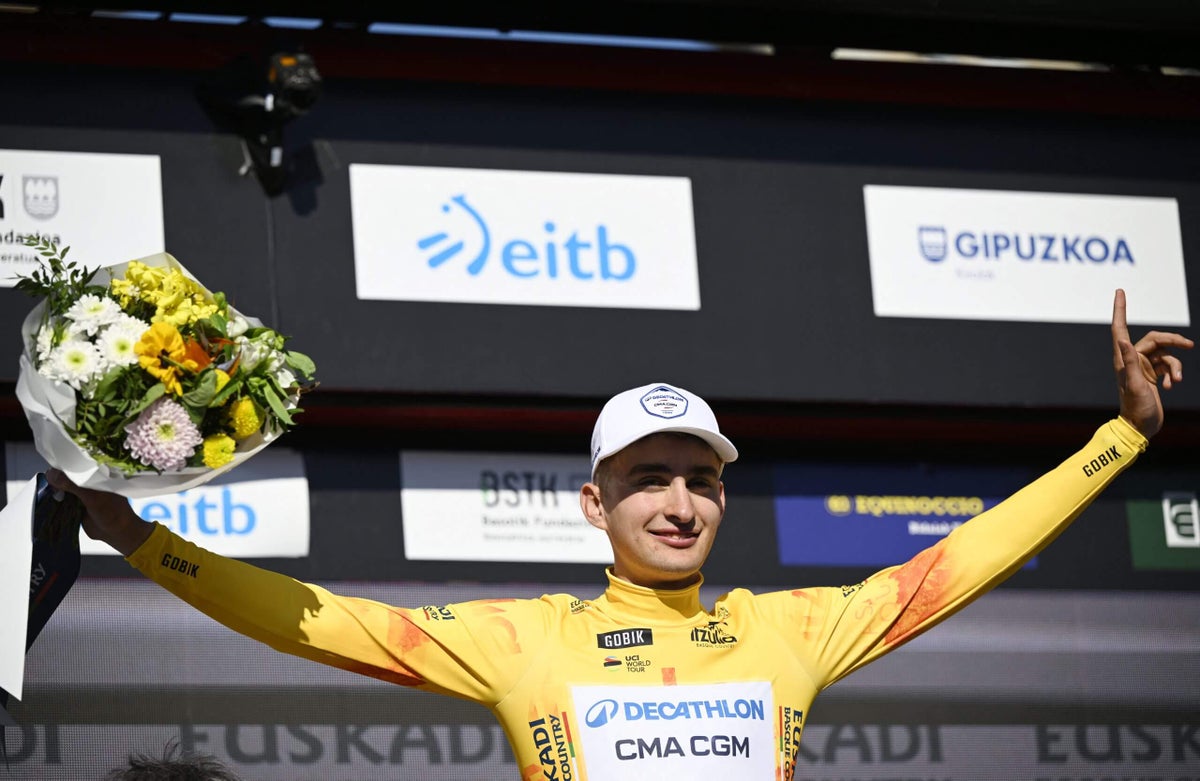
While Tadej Pogacar’s victory at Sunday’s Tour of Flanders underscored his dominance at cycling’s summit, a remarkable performance from 19-year-old Paul Seixas during the opening two stages of the Iztulia Basque Country proved that his next great rival is already here.
It sharpens the debate over whether the teenager’s Decathlon-CMA CGM team will send him to the Tour de France — where Seixas is the nation’s next great hope to end a 41-year wait for a French winner.
The Lyon-native already looks fated to become the first Frenchman to win a World Tour stage race since Christophe Moreau at the 2007 Criterium du Dauphine, one of the most remarkable records in the sport.
On the evidence of the past two days, he is already a superior climber to every rider except Pogacar and Jonas Vingegaard, though he has never ridden a three-week stage race.
Already a bronze medallist at last year’s European championships, Seixas won Monday’s time trial by 23 seconds over Kevin Vauquelin, finishing the 13.8km course with an average speed more than 1kph over any other rider.
The following day, Seixas showed that he already possesses outstanding powers of recovery by destroying a high-class field on the 9.4km climb to San Miguel de Aralar, easing away with 27km of the stage to complete before soloing to a one minute and 25 second victory.
Other riders in the field include Grand Tour podium finishers Juan Ayuso, Isaac del Toro, Matthew Riccitello and Florian Lipowitz — all in their early to mid-twenties — as well as 36-year-old five-time Grand Tour winner Primoz Roglic.
No rider was able to match Seixas’ fierce acceleration on the lower slopes of Tuesday’s 164km stage from Pamplona to the caves of Mendukilo, with only reigning Amstel Gold Race champion Mattias Skjelmose making an attempt to keep up with him.
Seixas then consolidated his advantage on the descent into the valley, before once again sprinting his way up a three kilometre rise to take victory.
“It’s just exceptional,” said fellow Frenchman Kevin Vauquelin after Monday’s time-trial, in which the INEOS Grenadiers rider finished second. “There’s no coincidence. He’s just strong, and he trains hard. He’s been on that level since last year, since becoming (junior) world champion. There’s no coincidence.”
Decathlon have aggressively built up their squad to support Seixas whenever he makes his Grand Tour debut, signing climbers such American rider Riccitello to serve as a super-domestique in the mountains alongside Felix Gall and another young Frenchman, 21-year-old Leo Bisiaux.
They have also recruited top rouleurs and Classics specialists such as Daan Hoole and Tiesj Benoot to offer further support on the flat.
Decathlon are set to decide whether Seixas will enter the Tour de France after Liege-Bastogne-Liege on April 26 — the autumn’s Vuelta a Espana is another option — with the speed of Seixas’ development accelerating any previously held plans for his race schedule.
With his contract at the team expiring in 2027 — amid interest from Pogacar’s UAE Team Emirates, though Decathlon are favourites to secure a renewal after increasing their budget to €40million ($46.3m) for this season — the potential of having just two opportunities to podium at the Tour with Seixas, or better, is likely to be another factor in whether he lines up at Barcelona’s Grand Depart this July.
Seixas already demonstrated his ability to go toe-to-toe with Pogacar at Strade Bianche last month, in which he finished a strong second after only just missing out bridging to the world champion’s back wheel.
The Tour de France, however, is a different and lengthier beast, in which the pressure from an expectant French public will be rampant. First though, Seixas has four stages of the Iztulia Basque Country remaining — and Moreau’s record to break.