
Stay up to speed with stories written by drivers, for drivers.
Get automotive news, DIY tips, market trends, in-depth car profiles, and more right in your email inbox.
What is it about a fast wagon? The concept of a sporting family hauler has a unique appeal—a study in contrasts, in dissonance. Like wearing a tuxedo T-shirt to the Met Gala, or putting black truffles on an otherwise plain cheeseburger. Consider this: Volvo built its reputation first on durability and later on safety. By the mid-1970s, when the Swedish brand really hit its international sales stride, Volvo’s lineup was more frumpy than feisty. And that was part of the formula for success: solid, sober, safe. Sexy? Not so much.
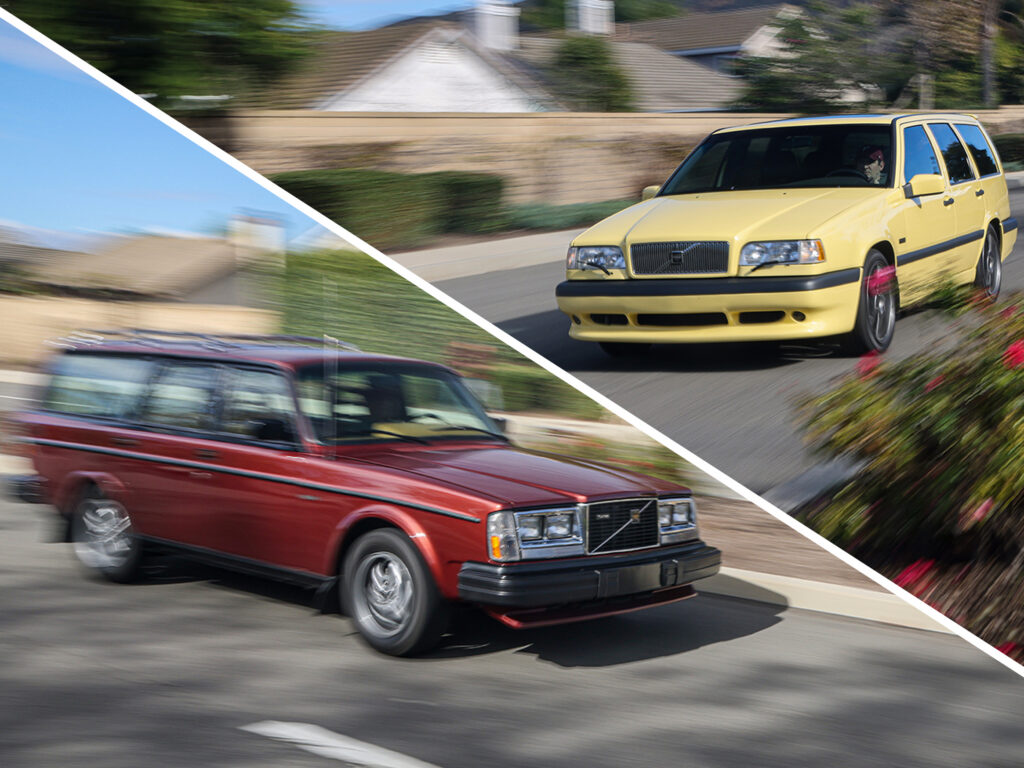
Instances where Volvo actually embraced a bit of verve are rare, and as such, they’ve become magnets for brand enthusiasts. We had the chance to briefly get behind the wheel of two such turbo bricks: the 1995 Volvo 850 T-5R and the 1982 245 GLT Turbo. Both are part of Volvo’s U.S. heritage fleet but do not appear or drive like museum pieces; these cars look and feel like they get semi-regular use, which means they largely represent the kind of examples you’d expect to find out in the wild.
1982 Volvo 245 GLT Turbo
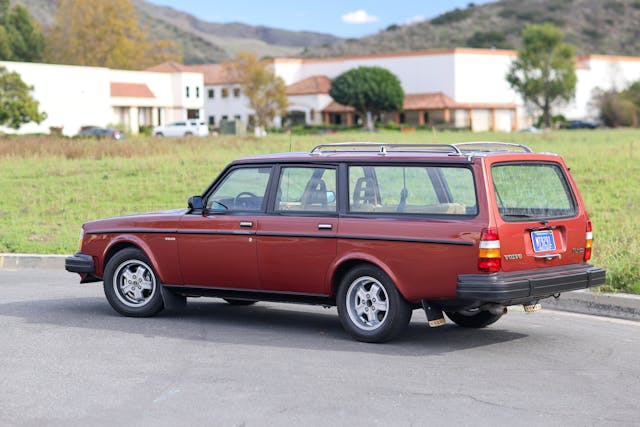
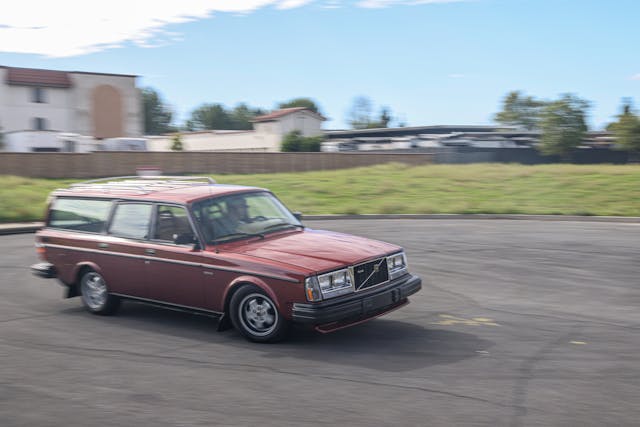
Let’s start with the elder statesman, the 1982 245 GLT Turbo, colloquially known as the 240 Turbo. We have a detailed 240 series Buyer’s Guide if you’d like a complete deep dive going back to the initial 1974 launch, but we’re going to pick up the story in 1980, when Volvo’s rear-wheel-drive 240 series compact got a new, sporty trim: the Grand Luxe Touring. The so-called GLT replaced much of the 240’s chrome trim—on the doors, handles, and taillight sills, for instance—with black. Aluminum-alloy 15-inch “Virgo” wheels were also standard.
For 1981, a new turbocharged version of the fuel-injected B21 “Redblock” engine, known as the B21FT, arrived for 240-series sedans (244) and coupes (242). Known as the B21FT (F = fuel injection, T = turbo), this now-legendary 2.1-liter Redblock appeared in the 245 wagon for 1982, giving Volvo claim to one of the world’s fastest longroofs at the time.

With the benefit of a Garrett AiResearch T3 turbo and its 6 psi of boost, the B21FT made about 130 horsepower and 155 lb-ft of torque. That was a hefty 25 hp or so more than the naturally aspirated B21F, putting this overhead-valve four-cylinder roughly on par with Lincoln’s emissions-choked 302-cubic-inch V-8. (A later intercooled version of this engine cranked output as high as 162 hp and 181 lb-ft!) To handle the extra grunt, Volvo blessed the B21FT with forged connecting rods and redesigned pistons. That durability, combined with the low 7:5:1 compression, turned these engines into tempting platforms for tuning.
“There are probably a lot more turbocharged Redblock 240s now than Volvo ever built,” argues editor-at-large Stefan Lombard, “because it’s a pretty straightforward DIY job with tons of thorough documentation. These engines are so overbuilt and so understressed, that with a few hundred bucks in materials, often sourced from junkyards, you and a couple friends can radically alter the performance of a 240 in a weekend.” Indeed, you don’t have to look hard to find build threads on enthusiast websites like Swedespeed or TurboBricks that boast 300 hp.
Volvo USA’s red-over-tan GLT Turbo offers no wacky aftermarket thrills. The engine and three-speed automatic with overdrive are authentic to 1982. Shifts are smooth and unobjectionable, but the optional four-speed manual would present a dose of extra driver engagement. Boost doesn’t obviously “kick in,” but rather steadily climbs for smooth, even power delivery. The overhead-valve four-cylinder is neither charismatic nor particularly refined where NVH is concerned, but one is left with the sense that, like a cockroach, the hunk of steel will endure a nuclear detonation, if not the heat death of the universe. All to say, it’s not a barn-burner, but the Turbo keeps up with modern traffic. You cannot say that of naturally aspirated 240s, the Galapagos Giant Tortoise of Pacific Northwest traffic.

Suspension is supple, neither stiff nor soft, but sudden side-to-side movements—even with the GLT’s thicker stabilizer bars—expose the 240’s middling athleticism. When it was new and reviewed by MotorWeek, John Davis noted the GLT Turbo’s lack of rear-end grip under lateral load, saying, “Perhaps this car wants to be much more of a sports car than it was ever designed for.”
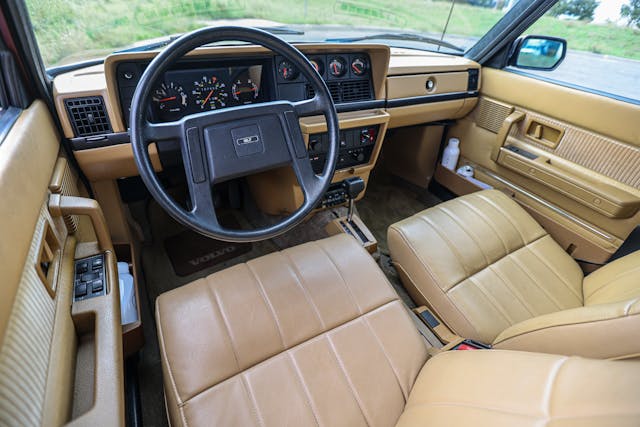
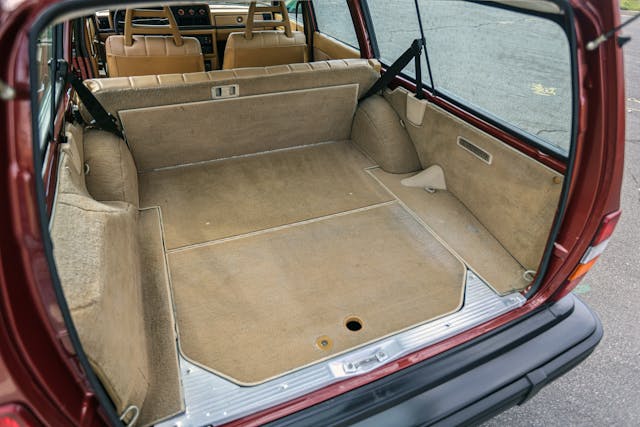
Otherwise, this specimen is typical 240 in its Nordic loveliness and livability. The seats are supportive and comfortable, particularly with the GLT’s added bolstering. Thin pillars and lots of glass lend a feeling of airiness. When an entire college dorm room’s worth of crap needs to be moved, the enormous cargo area is Valhalla.
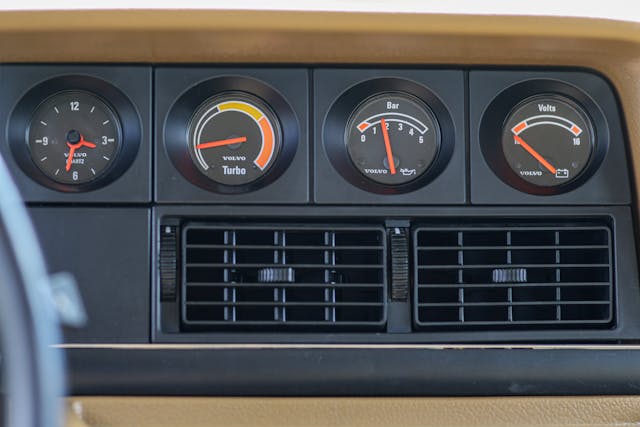
The thin-rimmed steering wheel is pleasant to hold. Visibility through the windshield is outstanding, despite the hood’s prodigious length. There is a Turbo boost gauge on the dashboard, but it functions much like daytime television: It’s there, it’s on, but you can safely ignore it without missing anything of substance. Despite the widespread use of plastic in this interior, which has weathered more than 100,000 miles, all of the switchgear and surfaces hold up well.
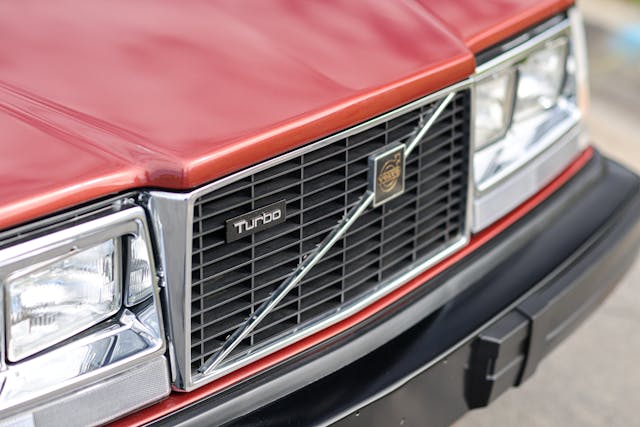
In period, this would have been a lovely car indeed to drive across several states. And at just under $14,000 when new ($47,000 today, or less than the average transaction price of a new car), it melded fantastic value with near-luxury accommodations. This, factored alongside the 240’s reputation for toughness and safety, helps explain why Volvo sold more than 2.6 million of them globally over 19 years. So adored was the 240 that it was sold, for several years, alongside the 700 series that was supposed to supplant it.
1995 Volvo 850 T-5R Wagon
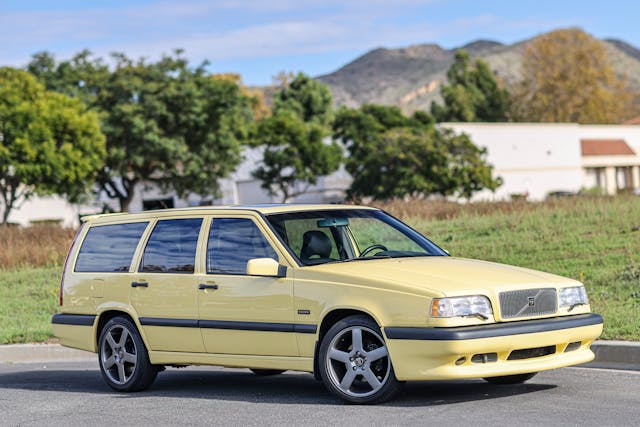
Now, the Cream Yellow young gun, the hallowed 850 T-5R. This model’s story really begins in 1978, three years before the 240’s GLT Turbo engine even arrived. Volvo “aim[ed] for the stars” with a totally new vehicle concept dubbed Project Galaxy. The result was defined by four novel (for the brand) engineering elements: front-wheel drive featuring a transverse five-cylinder engine, a semi-independent and passive steering rear axle (known as the Delta-link), self-adjusting front seat belts, and a side-impact protection system (SIPS). By the time the 850 arrived in 1991, Project Galaxy was among the most—if not the most—expensive industrial engineering investments in Sweden’s history. It entered the U.S. market for the 1993 model year.
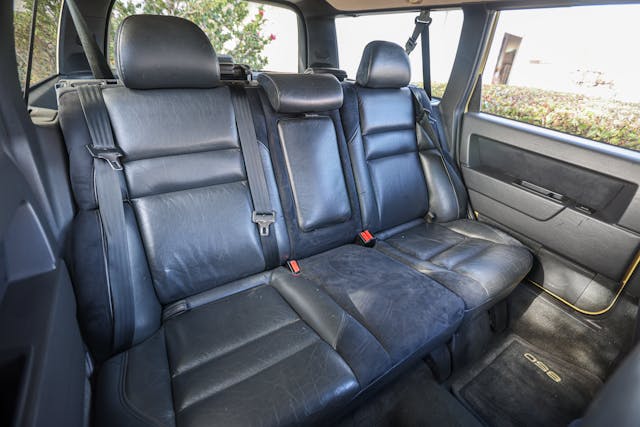
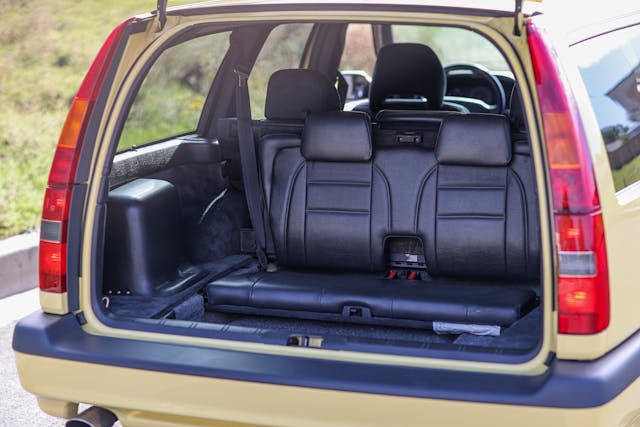
Given the long development gestation, there was a lot riding on the 850’s success. Volvo’s design team opted to minimize further risk by skinning the massive innovation package with a familiar look that didn’t depart much from the outgoing 700 series. The strategy worked; Volvo’s 850 was a hit right out of the gate, racking up enormous sales in the U.S. and Europe while collecting dozens of awards. Naturally, the company was keen to crow about this big win, and that pride took two forms: 1) Volvo entered the 850 wagon into the British Touring Car Championship in 1994, and 2) it developed a limited-run, high-performance variant known as the T-5R.
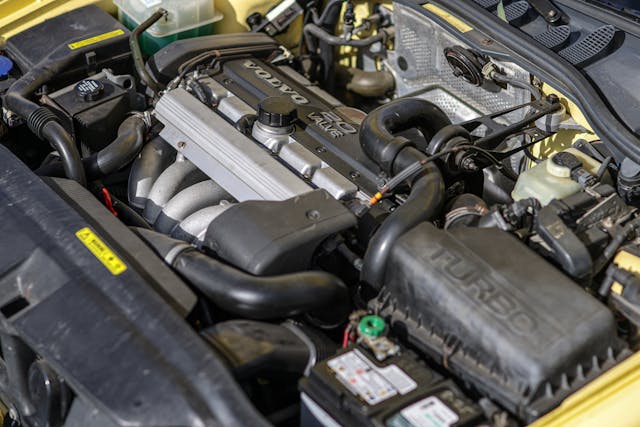
When the 850 first arrived, it contained a 2.4-liter dual-overhead-cam workhorse making 168 hp. Officially known as the Volvo Modular Engine, this all-aluminum (block and head) inline five-cylinder came to be known as the Whiteblock, due to its light-colored appearance in contrast with its red-painted and cast-iron overhead-valve predecessor. The 850 Turbo turned up the brick wick to 222 hp from a 2.3-liter Whiteblock for 1994.
Volvo did not stop there. The limited-run T-5R sedan and wagon arrived for 1995, blowing away the international press with its 240-hp output from the same 2.3-liter turbo-five, beefed-up and lowered suspension, and sporty exterior design details. Porsche helped with tuning the so-called B5234T5 engine, which included an overboost feature to achieve the stated 18-hp bump; above 5100 rpm, the ECU permitted an extra 1.4 psi of boost (totaling 10.9 psi) to be available for 30 seconds. Amid clawing front wheels, the T-5R dispatched zero to 60 mph in 6.8 seconds, making it the quickest production wagon in America.
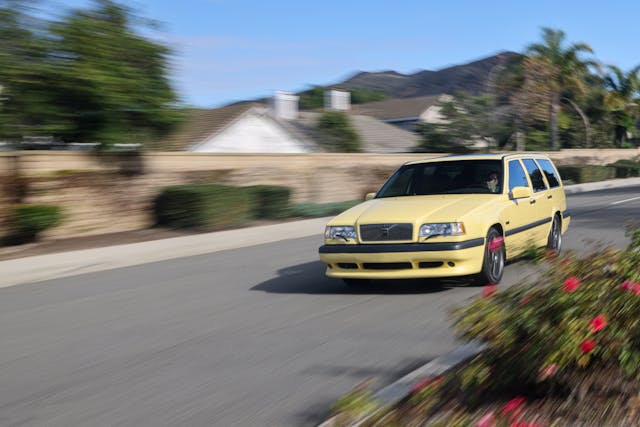
The hot-rod Swede drew comparisons in period car magazines with the 240-hp BMW M3 and 227-hp Audi S4. But even with its 0.86-inch lower stance, thicker antiroll bars, stiffer springs, and 205/45 Pirelli P Zeroes on 17-inch alloy wheels, the T-5R was merely sporty in the most Volvo sense. Think university economics professor… who takes sabbaticals to pursue an avid cross-country skiing hobby. “The T-5R isn’t a high-strung megacar that aims at the performance heavens,” said Car and Driver in 1995. “[Volvo] focused on a few simple, notable tweaks to raise the performance bar of an already fine offering.”


Even today, the T-5R has spunk. The five-cylinder loves to rev, and the resulting intake noise is textured and distinctive; with freer-flowing pipes, the exhaust sound might make a few members of our Volvo-loving editorial staff a bit weak at the knees. Unlike the GLT Turbo, there is a noticeable shove when boost hits, often accompanied by a slight tug of torque steer from the steering wheel—221 lb-ft, if you’re curious. Whereas the 240 keeps up with modern traffic, the 850 does so far more easily. The four-speed automatic—standard on U.S. cars, which never got other markets’ five-speed manual—does a fine job of cog-swapping to keep the engine in its power band. A sport button can tell the automatic to hold gears longer between shifts.
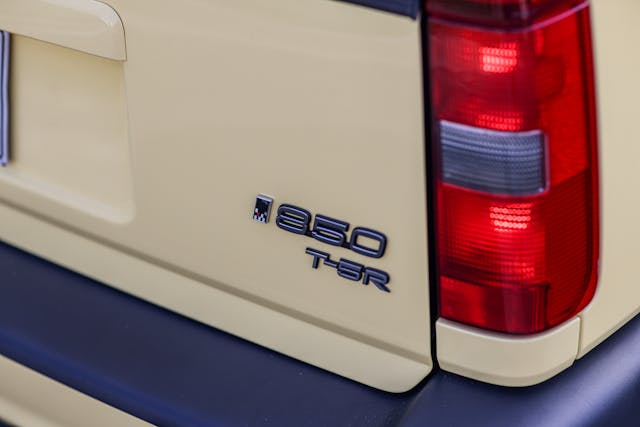
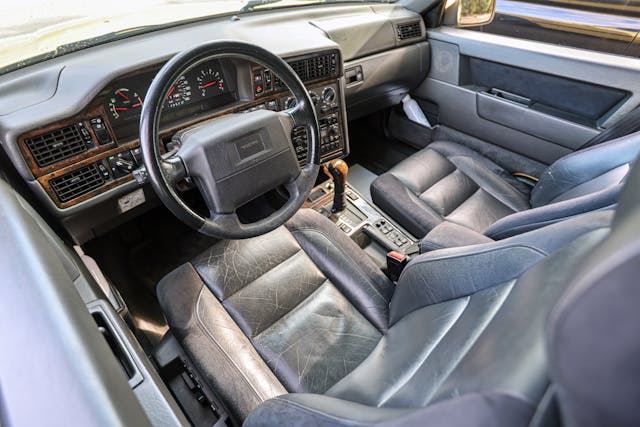
There is a bit of initial push on turn-in, but the T-5R handles confidently, and the steering sends clear, satisfying feedback to your hands. The ride is even decent compared with today’s ultra-stiff performance cars. With wood trim, leather seats, yellow-stitched floormats, and various bits of Alcantara to keep the driver company, the T-5R’s interior is inviting as well as functional, if not as cavernous as the 245 GLT Turbo.
“A big part of the appeal of the 850 for me is just how good Volvo was across the board,” says managing editor Eddy Eckart, who owned and modified an 850 Turbo for over a decade. “It’s an incredibly comfortable long-haul car, could swallow a massive amount of cargo, and genuinely surprised me with how fun and balanced it was. And that sound—the chortling demon of an uncorked Volvo five-cylinder, is one of the best around.”

And whereas the 245 is almost brazenly unstyled, the T-5R is downright handsome. It gets a whole lot of attention. Some of that is due to the roof-mounted wing(!) and more aggressive front bumper lip, but the Cream Yellow launch color does a lot of heavy lifting. It was initially planned as the only T-5R hue for the global run of 2500 vehicles. Immense demand convinced Volvo to expand production, after which point black as well as olive green joined the palette.
So successful was the T-5R that Volvo essentially added it to the portfolio for 1996, naming it the 850 R and eventually introducing all-wheel drive when the 850 became the V70 in 1998. Yet despite that fact, the limited-run T-5R retains a cult-classic status that underscores its collectibility. Production totaled 6964 cars, with only 876 of those earmarked for the United States. The car we drove, from Volvo’s collection, is one of 49 U.S. cars imported in Cream Yellow.
Cost to Buy a Turbo Brick
Not to ignore the 700-series turbo cars, but if it’s between the two cars we drove, the 245 GLT is more affordable. “Our insured values of sedans and wagons reflect the same trend with 245 GLTs averaging around $16,300 and 850 T-5Rs averaging $19,000,” observes Adam Wilcox, Hagerty Senior Information Analyst. “However, the 850 T-5R has seen more growth in recent years, with insured values increasing 65% since 2021 vs. 30% for the 245 GLT.”
In the past five years, the median sale of a 245 GLT is 18% lower than an 850 T-5R. Top sales follow the same hierarchy: $24,407 for a 1983 245 GLT Turbo wagon in early 2023, and $27,300 for a five-speed 850 T-5R wagon in late 2021.

“Both of these wagons are popular among young collectors, a strong indicator of future collectibility, says Wilcox. “Twenty-five percent of 850 T-5Rs are owned by millennial and Gen Z collectors, and that figure is 23 percent for the 245 GLT Turbo. Compare that with Hagerty’s entire book of insurance business, of which those younger demographics account for only 10 percent. Still, the largest owner share for both cars is from older generations: boomers at 39 percent for the 850 T-5R and Gen Xers at 40 percent for the 245 GLT Turbo.”
The best enthusiast cars tend to be the ones people actually use. Thus, these Volvo wagons are a boon: practical, distinctive in their styling, and enjoying plenty of parts and community support. Those itching for more of a classic “old-car” experience cannot go wrong with the infinitely charming 240, a defining car for the brand that anyone who lived through the 1980s remembers. The 850 is far more tractable in 2026 and handles more or less like a modern car, but it still evokes Volvo’s sturdy squareness and ‘90s nostalgia. If you’ve got bricks on the brain, you can’t go wrong; these are (relatively) fast wagons that beg to be driven and enjoyed.