

A new report suggests that Ontarians are falling behind their American neighbours when it comes to living standards.
The study conducted by right-wing think-tank the Fraser Institute finds Ontario ranks near the bottom of the Great Lakes region when it comes to GDP per person, a metric researchers use to evaluate economic prosperity.
The study suggests the gap with nearby U.S. states has widened significantly over the past two decades.
In fact, it said that from 2001 to 2024 the regional average GDP per person grew by 22.5 per cent while Ontario’s only grew by 12.7 per cent.
“Within North America’s Great Lakes region, Ontario is clearly an economic laggard and its living standards are falling behind those of its neighbours,” Jake Fuss, the institute’s director of fiscal studies and a co-author of the report, said in a news release.
Ontario near bottom of region
In 2024, Ontario’s GDP per person stood at $74,143, a number researchers marked as the “second-lowest” among jurisdictions studied, ahead of only Quebec.
By comparison, New York recorded $134,470 per person, while the regional average reached $94,523. That’s roughly 27.5 per cent higher than Ontario.
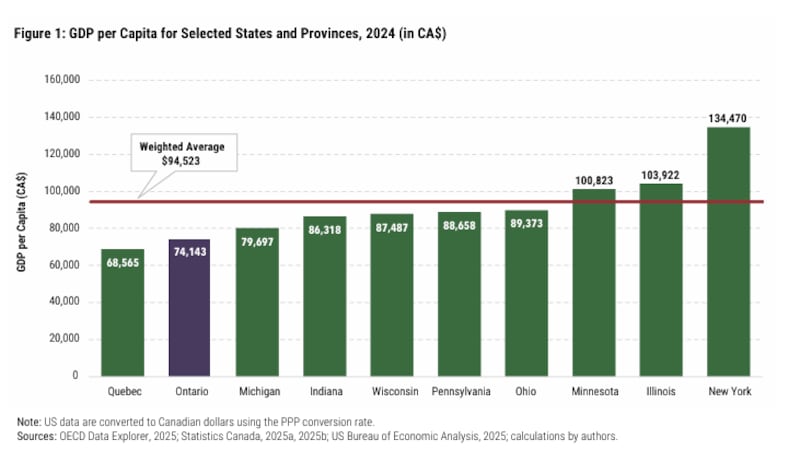 Fraser Institute Figure 1: GDP per Capita for Selected States and Provinces, 2024 (in CA$) – (Fraser Institute graph).
The report examined nine jurisdictions across the Great Lakes region, including several major U.S. states such as Michigan, Ohio, Illinois, Indiana, New York, and Pennsylvania among others.
Researchers say they used GDP per capita as a measure for living standards, noting it reflects “overall per-person economic production” and is closely tied to “job creation and wage growth.”
“GDP growth helps drive job creation and wage growth and is therefore frequently used as a straightforward, if imperfect, measure of prosperity,” the report states.
Gap has widened over time
The study also found the gap between Ontario and its regional peers has grown over time.
As a result, the difference in prosperity has expanded significantly.
In 2001, the regional average GDP per person was 23.7 per cent higher than Ontario’s.
 Toronto people / residents Commuters cross an intersection through traffic outside of Toronto’s Union Station on Tuesday, August 26, 2025.THE CANADIAN PRESS/Chris Young
By 2024, that gap had grown to 34.5 per cent which marks a 10.8 percentage increase.
“This means that the standard of living in Ontario is falling behind that of neighbouring U.S. states,” officials noted in a media release.
Why it matters
The report argues that weaker economic growth has broader implications beyond headline figures.
Ontario’s slower growth “has translated into less job creation, slower wage growth, and more pressure on public finances than would be the case in the presence of more robust growth,” the study notes.
Researchers caution that GDP per capita does not capture everything such as income distribution but say it remains one of the most comprehensive indicators of overall prosperity.
“No single metric captures the whole picture. However, the most comprehensive measure of overall prosperity is real GDP per capita,” the report read.
“It’s important for Ontarians generally—and policymakers specifically—to understand that the province is falling behind its neighbouring jurisdictions,” Fuss concluded.
“The province’s relatively poor economic performance in recent years has real consequences for the economic well-being of Ontarians.”