
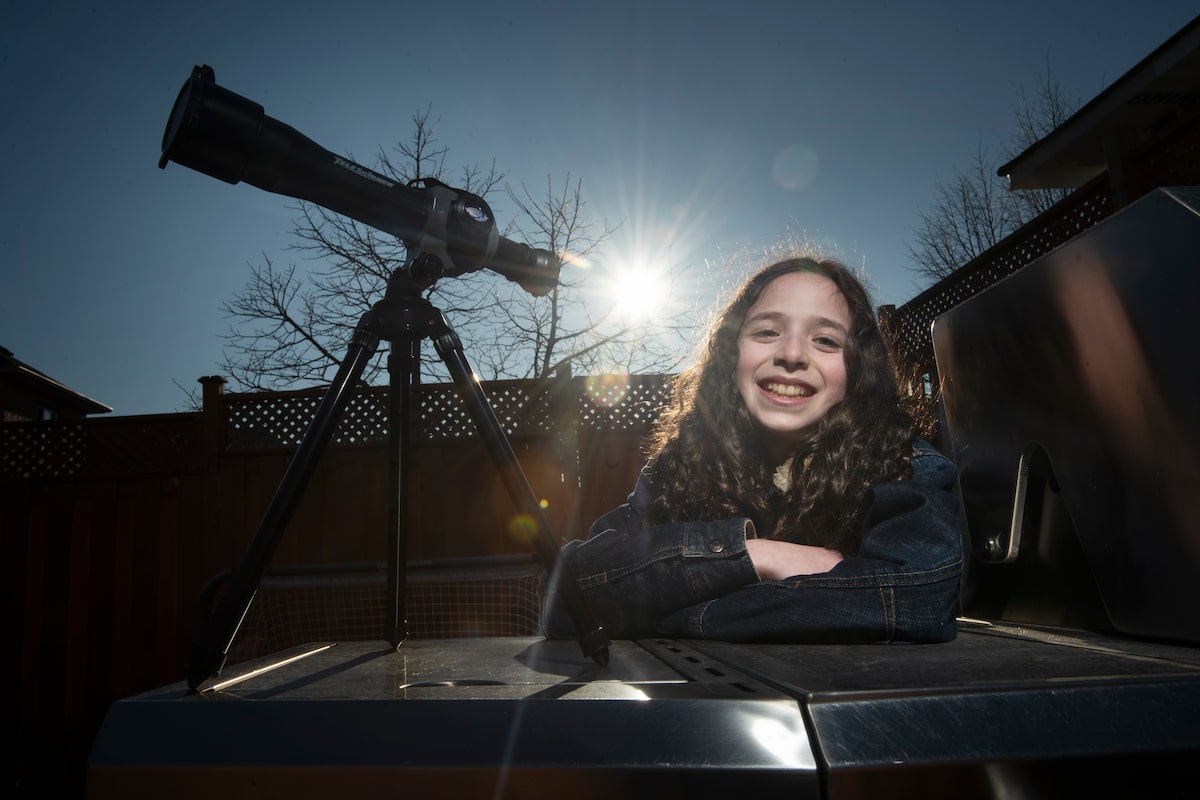
Space enthusiast Gabriella Lamberti with her telescope outside her home in Vaughan, Ont., on Tuesday.Photography by Fred Lum/The Globe and Mail
In the depths of the pandemic, five-year-old Gabriella Lamberti was cooped up with her mom in their Vaughan, Ont., home, searching the internet for boredom-busters, when something on the NASA website caught her eye.
Drawn in by the distinctive blue, red and white insignia, she couldn’t resist the urge to explore. She joined a live video Q&A with an astronaut-in-training: Jeremy Hansen.
For several minutes, she spoke to Mr. Hansen about the moon and the stars, launching an interest in space that has since blossomed into a full-blown obsession. Gabriella, now 10, pores over the NASA website, devours space books and builds rocket ships out of cardboard boxes. Or marshmallows and toothpicks. Or a plastic fort kit.
Last week, as she watched Mr. Hansen board a real rocket as part of the Artemis II mission and become the first Canadian to reach deep space, she felt a personal connection.
Carney talks inspiration and teamwork in call with astronaut Jeremy Hansen
“It was really cool with all the smoke and fire when they go up,” Gabriella said. “He’s breaking records, so obviously, I feel excited.”
That wonder is shared by many Canadians who have been tuning in from coast-to-coast to track Mr. Hansen’s mission since the crew blasted off from NASA’s Kennedy Space Center in Florida on April 1.
American astronauts Victor Glover, Christina Koch and Reid Wiseman round out the crew onboard the mission’s Orion spacecraft. They will spend 10 days observing and photographing the moon before a planned splashdown in the Pacific Ocean on Friday.
The mission marks the first time humans have travelled around the moon since 1972. It serves as a test for future lunar exploration, with the goal of putting boots on the moon as soon as 2028.
After school on Tuesday, the NASA livestream glowed from the TV in the centre of Gabriella’s living room. She’s been obsessively tracking the mission on YouTube and the NASA website.
When Gabriella saw Mr. Hansen on TV before the launch, she recognized him immediately. She told her mom, Vittoria Lamberti, “I think he’s wearing the exact same suit he wore five years ago.”
Vittoria Lamberti shows a photo of Gabriella speaking to astronaut Jeremy Hansen.
Gabriella is contemplating a career as a rocket scientist, aerospace engineer or capsule communicator in NASA’s mission control.
“Right now, I’m scared of being an astronaut … but I think building it would be really cool,” Gabriella said.
Mr. Hansen is inspiring Gabriella to face her fear. “He’s not scared of space,” she said. “If I ever overcome it, I want to go to Mars.”
The red planet’s appeal is in its uncharted territory. Gabriella wants to build robots, such as Mars rovers, and adventure where no earthling has gone before – as long as she doesn’t find aliens. She hopes there isn’t life on Mars, but predicts that humans will be there soon.
What we learned from the Artemis II mission and what comes next
The precocious fifth grader is an astronomical encyclopedia, often spouting tidbits from the NASA website, and teaching her mom more than a thing or two. “I’m more invested than she is,” Gabriella said. “I’m also really happy because I know more.”
She does have other interests, including tending to family bunnies Alfredo and Apollo (named after the Greek god, not the lunar mission), and playing soccer, which she makes clear always comes second to science.
Ms. Lamberti hopes her daughter’s passion for space and penchant for science continue throughout her life, but she’s apprehensive about launching Gabriella into the atmosphere. “I don’t know about an astronaut, but I do think she has what it takes to be an engineer.”
The Artemis II crew lost contact with Earth for about 40 minutes on Monday as they looped behind the moon, observing never-before-seen parts of the lunar surface, just hours after setting a record for the furthest distance humans have ever travelled from home.
After historic flyby, Canada looks to its next role in space missions
Typically talkative Gabriella went quiet on the couch while the Orion capsule, dubbed Integrity, lost communication during the planned blackout.
“It was scary,” she said, breathing a sigh of relief when the crew came back online. “You don’t know if they’re okay or not, because no one’s done this before, so you don’t really know what to expect.”
Integrity is set to splash down on April 10, re-entering the Earth’s atmosphere at about 40,000 kilometres an hour, protected from scorching temperatures of up to 2,760 degrees by a thin heat shield that proved unreliable on the unmanned Artemis I mission in 2022. Gabriella knows the stakes are high for Friday’s splashdown, but she’s confident in the crew.
“It’s going to be tough. They have to make sure they’re getting a lot of things right,” she said. “They have to nail it.”