
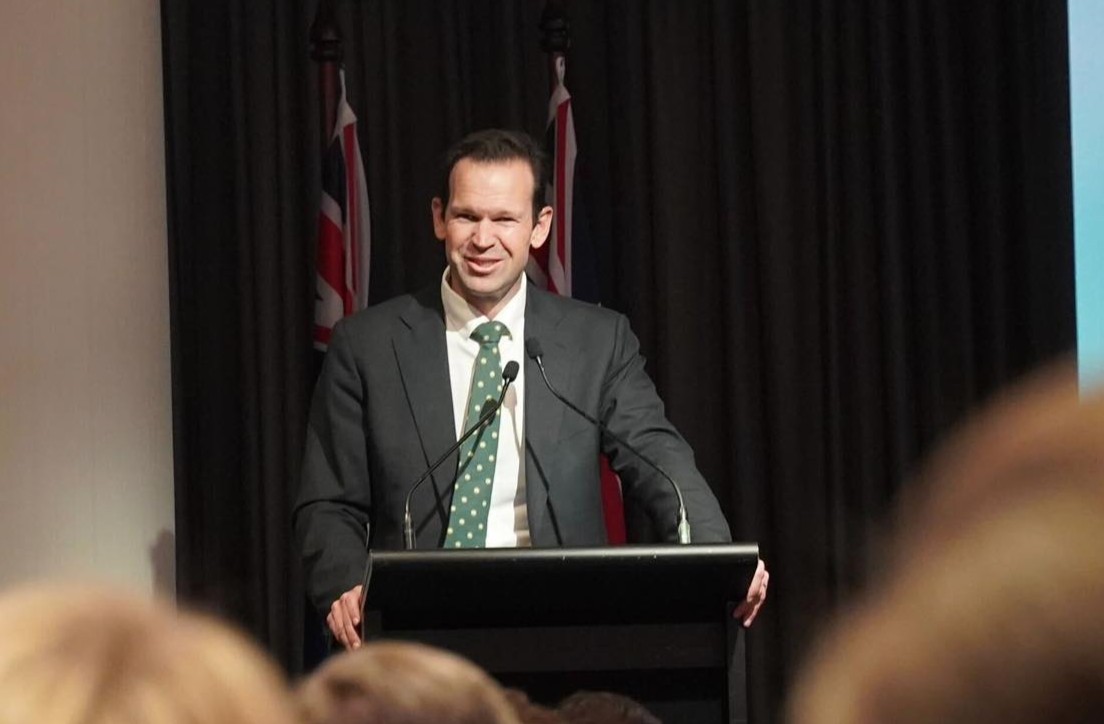
Thank you very much, Andrew, and thank you to the National Press Club for this generous invitation. I also want to thank a couple of my colleagues, Jamie and Susan, for being here today, along with a lot of hardworking staff. Thank you to the journalists, for being here as well. I think Mark from the ACT Liberal Party is here, and Nicole from Nichole Overall from the New South Wales Parliament. Thank you for being here today. Andrew said earlier, it’s my second appearance here at the Press Club, and in between that appearance and now, a few years ago, Anthony Albanese got asked about me on Gold Coast Radio, and I was a bit of a backbencher at the time, and it kind of triggered him.
He went off on a rant about how I like to take photos in front of my tools in my shed, and I sort of gave him a little bit, had a little bit of sympathy for him because we had previously just won the 2019 election, and they’d got a bit of a tower, and he was obviously still smarting about that. He said that all my tools were pristine. That’s what did sort of cut a bit deep. Because, I do use the tools. I do sort of love my shed. It’s one of the greatest things I was able to acquire was a home and also a home with a shed in it where I could make my own furniture that we use.
But I quickly learnt, I quickly learnt when I started making furniture that I could buy things a lot cheaper than I could make them. And, there are a lot of tools, behind me on my shadow board that, I’ve only used once. I’ve spent way too much money at Bunnings, but I take a lot of pride in walking around my home and seeing things that, that I built and beds. We used to have a Wiggles bed that my kids don’t use anymore. They’re too cool. They sleep in, benches we sit on, cabinets we use, a table that I wrote this speech on, things that I made.
There’s something important about real physical things that you take pride in. I even installed a Hills Hoist clothesline a few years ago that triggered other people. But just for the record, that was not a Mother’s Day present. And my wife is right here. She can confirm that. She didn’t want to. She didn’t want to, but it was not a Mother’s Day present despite the fake news saying such. But again, it was something that we made. I’ll just say, you know, Hills Hoist is not even made in Australia anymore.
It’s not made in Australia. So we didn’t install a Hills Hoist. We installed with a company called Austral. I don’t know if I’m allowed to promote companies here on this stage, but Austral is a hundred percent. We’re already here.
A hundred percent Australian made, steel, and I’ll come back to that issue. So, you know, it was a chance, when Albo was triggered by that, it was a chance to reanimate myself with my shed and my tools, and I love them. I also love the shadow board I built because it’s something that if Australia didn’t invent it, definitely popularized here. It’s a bit unclear where it came from, the shadow board. But there’s a guy called Essington Lewis, who’s a great Australian hero. He was managing director of BHP, a great Australian company, and I recognize some of you here today.
And he was a bit fastidious, Essington, and he insisted at the Newcastle Steelworks that everyone used a shadow board to cut down on the loss of tools. And one day, he was walking around the shop floor, and he he noticed a magnifying glass on someone’s shadow board, and he said to the worker, “Well, what’s that for? Why have you got a magnifying glass?” And, the worker shot back at him with a great Australian larrikin spirit, “Well, sir, that’s so I can see me pay.” I love that story because it’s a great Australian story.
But it’s also maybe a little bit relevant now because we probably need some magnifying glasses again to see our pay rise. Young Australians, in particular, have been smashed in the last few years. Living standards, real wages have gone back fifteen years. And that’s before you probably look at the real cost of land and housing. Adam Creighton did that in The Australian the other week. And on his numbers, you really go back to living standards in the 1990s for young Australians facing those costs. No wonder people are angry in this country.
No wonder they are starting to say they’ll vote for non-mainstream political parties. I’ve been angry the past few years at seeing our great country go down the toilet. I’ve been frustrated. I’ve been isolated. I felt that maybe my career was over. But I think we’re starting to get a wake-up call over the past year. We are a country that I believe wants to rediscover our pioneering spirit, wants to start making things again. And I really do think we can recapture our Australian living standards if we focus on that once more.
I think we need to do a few things that I’ll outline today, to do that. We need to scrap this crazy net-zero madness. We need to protect our industries again, so we can defend our nation, and we need to grow our country again. Grow it in many different ways so there are more opportunities, and most of all, people can feel they can have a family, have babies. It’s the most important thing in life. A year ago, when I first ran for Nationals Leader, the Australian Financial Review put a headline out saying that, the Nats’ populism, the Nationals Party populism, was a threat to the economic reset for the Liberal Party.
And look, I’m not here to speak for the Liberal Party, but I’m also not interested in an economic reset. I think given the state of our country, we need an economic revolution. We need major, major changes to get things back going again. And, unfortunately, I think the comfortable and coddled and sometimes second-rate political class in this country right here in this city aren’t thinking big enough. They’re not thinking visionary enough about the changes we need. They remain trapped in the same old thinking of what we had before. It’s as if just one more push on the energy transition, one more economic summit, one more go at sensible tax reform is going to fix things.
I mean, can anyone explain to me how changes to the capital gains tax discount is going to move the needle in a way that will revert the fifteen years loss of living standards we’ve gone through? Because we still remain trapped in, I think, the thinking of the last generation, the thinking of the Thatcher and Reagan era. But I don’t think, microwaved Milton Friedman is going to save the day. It’s not going to cut it, once more. And really, in this town, the chief cheerleader of this status quo, Captain Status Quo himself, is the Prime Minister.
He is continuing to think in these ways. He was here at this stage last week just saying more of the same. More of the same, the same status quo that has delivered, this economic disaster for the Australian people. Effectively now, Albo, who likes to present himself as a DJ, is, now a cover band. We’re seeing the greatest hits of decades ago, but they’re just, they’re not really as good as the original. And before I do seek to scrap a lot of what’s gone before and start again, I do want to recognize why we did those things at the time.
I think a lot of people have forgotten, the reasons, some of those challenges and why they were suitable then. I’ll plagiarize Paul Kelly here in going back to what he describes as the Australian settlement that existed, in his view, up to about the 1970s, where there was broad appreciation for government protection, wage arbitration, imperial benevolence from the British Empire that underpinned our economic growth as a country. But about 50 years ago, people started realizing that that’s not really working anymore, and there was a change.
There was a change. The UK joined the European community. We had stagflation. We’ve been oiled with a couple of oil crises. We’re kind of maybe there again. And there was complete revolution in thinking. And what replaced the Australian settlement became kind of known as the Washington Consensus, a mix of trade liberalization, privatization, deregulation, which swept the world. It swept all, the whole world, and it came here to this country too. For a long time, that worked. It did.
We benefited a lot by the globalization of markets. Our productivity improved significantly in the nineteen eighties and nineties, as did living standards of Australians. The world benefited from the end of the Cold War and the emergence of a whole massive new addition to the global consumption and workforce pool from Eastern Europe and communist China. That helped keep inflation low for a generation. And it’s the world I grew up in. Many of us here did. But that world has gone now.
All of those trends are reversing. The population is aging in most countries. We don’t have those increases in workforce numbers. Spending and debt have gone through the roof. Businesses now are not running themselves to be profitable. They’re following this thing called ESG, which if you don’t know what it stands for, it’s, extreme shortages guaranteed. And you can see that at petrol stations today. China came into the WTO and promised to get rid of its barriers, but it never did, and now we have a constant cycle of protection from different countries.
All of these changes should make us reevaluate whether this former consensus is the right thing for our country, and we should be very clear about how we did deliver those benefits. It wasn’t by mouthing slogans about the market or reform. It was because we took a concerted effort to when we lowered trade barriers, we also lowered the costs of doing business. It was key. It was explicit. It was part of the strategy that if we were to expose our businesses to competition in other countries, then we would have to make sure that they were match fit and could compete with other countries.
Now, of course, instead, we’ve just loaded them up with costs, and we expect them to still survive when they’re thrown to the wolves. We were in a world where trade barriers were coming down everywhere, and while we never quite got to free trade, especially in agricultural goods, you know, there were lower trade barriers. Whereas now, you know, just in the last weekend, the US has whacked on a hundred percent tariffs on our pharmaceuticals. China’s just announced that they’re not taking any more beef this year.
The export quota’s been reached. We’re not in the same world we were. We also were able to achieve a lot of efficiency gains by just sucking more lemon, more juice, sorry, out of the lemon with the infrastructure that’d been built in past generations. In the post-war period, we built the Snowy Hydro. We built lots of power stations. We built new centres like Cairns, with an international airport, a tourist destination. We were able to make all of that work more efficiently and, and that provided a gain. But the crucial thing is it was a one-off.
Once you do that and make those things work better, that’s it. You can’t keep going back to that world. And finally, finally, governments did, did reduce debt and did reduce deficits in the, I just can’t believe this stat, but, you know, I checked it out. In the eighteen years before the GFC, the federal government’s budget deficit was just point two per cent of GDP. In the eighteen years since, it’s been ten times that amount. It’s been two per cent of GDP on average, and clearly that’s not slowing down under this government. So I think, I think all of those conditions have changed, so therefore our policy settings have to change, and, and we have to listen to the Australian people and completely revolutionize how we do things.
And I want to spend the rest of today outlining what I’m terming a Patriot Agenda for our national economic revival. A few things, will challenge some people, but I think are better suited to the times we live in. I think we need a manufacturing renaissance, to protect key industries in this country. And we need to use all the tools to do so, including the use of tariffs. We need to close our borders to mass migration. What we take is far too high right now. It’s putting pressure on all types of services and infrastructure and housing.
We need, we need to deliver energy abundance. We have so much energy in this country, but we’re not using it. We’re locking most of it up through ridiculous bans, and that’s holding our nation back. We should have a new 21st century national works program. We need to build new infrastructure, new dams, new power stations, and including new technologies like space as well. We need to build new cities. Why have we stopped to just a few? We’ve got a massive continent. That’s one of the main reasons people can no longer have a house with a backyard.
We need to do that. And if we do that, if we’ve got people with a home and a backyard, I think people will start having babies again, and we desperately need that given the shocking decline in our birth rate. So I’m not proposing a replay or reset. This, I believe, as I say, is something a little bit more significant. I am proposing a revolution. Some of it will need the slaying of long overdue sacred cows, including a naive belief that open trade and open borders and open flows of people are always and everywhere going to be the best thing for our country.
They can be a good thing. They can be. And they have been in some times in the past, but they’re clearly not the right approach now. Five years ago, The Nationals Party released a paper on how to revitalize our manufacturing sector. Now, in that paper, we did suggest that it was time again to protect some key industries. We did say that the anti-dumping regime needs to be totally overhauled and better suited to the situation we have today. And part of that involves the more judicious use of tariffs.
Now, I don’t agree with Donald Trump. I don’t agree with Donald Trump on a few things lately, but I don’t agree with Donald Trump that tariff is the most beautiful word in the English language. But I don’t think it’s a dirty word either. It’s just a tool. It’s a tool we already use through the anti-dumping regime, but we just do so in a pretty ad hoc, band-aid, knee-jerk fashion. We clearly are not facing an issue now of countries just every now and again dumping goods here.
There is a more permanent strategy, explicit strategy of many other countries, including the United States and China, to steal our industries, to take our jobs, and do so with a strategy that plays that over long term. So to keep those industries here, we should respond in kind. We need a more permanent and coherent strategy to protect, what’s essential to our country. I’ve visited a lot of steel fabrication plants in the last few months, and many of them are on their heads. I visited a place called Jennmar in Mackay just a couple of months ago.
They make roof bolts. So they keep up, keep up the ceiling in an underground coal mine. Pretty important. Very important for safety. They’ve always been Australian-made, made from steel milled in Whyalla, sent to Mackay. They put a thread on it, put some plastic in it, and it goes into the coal mine industry. A great Australian supply chain creates jobs right through the country. But in the past few months, they’ve started to see for the first time the importation of Chinese-made roof bolts that undercut them to a great degree.
They currently, along with other steel plants, have an application in with the Inter-Trading Commission right now. It could take, it possibly will take to the end of the year to resolve. And I don’t know if that’s enough time. And we’ve got to keep our steel industry. We are the biggest exporter of coking coal and iron ore in the world. It is the two things that make steel. Yet, we are no longer self-sufficient in it, and we risk losing most of it. One of our steel mills is on taxpayer-funded support. We’ve got to keep this industry.
We’ve got to have a better plan to do so. I mean, the government’s already put up a white flag on all of this. They’ve already admitted that things aren’t working. In the past year alone, along with that Whyalla steel plant, they’ve also provided subsidies to aluminium, to zinc, to copper, more than five billion dollars. And, and another three billion probably for the Tomago aluminium smelter in the weeks to come. This is protection. This is we’re protecting industry. We’re not doing free trade anymore. But we’re just doing so in probably the worst way, where a few key businesses get government support, and we ignore many of the other small businesses like Jennmar like these other steel fabrication plants who don’t have the political capital.
Now, those subsidies that the government is giving are much, much higher thanks to Labor’s net zero agenda. Nobody can quite explain to me why, that you had Rio Tinto could smelt aluminium in Newcastle and Gladstone for decades using coal-fired power and not need any subsidies. In fact, pay taxes, pay into the national treasury. And then it’s only been since they decided that they would turn their aluminium smelters to green energy to follow renewable energy, that suddenly they’ve needed massive taxpayer support.
Now, I thought the idea was, uh, green energy was cheaper. That was the idea. If it is cheaper, why do they need so much government funding? There are clearly extra costs from going to net zero, and then the government’s also admitted this through its carbon tariff approach. It’s now proposing that we need carbon tariffs to save different industries.
Again, if, if net zero was cheaper, why would we need a tariff on our own industry, uh, to protect ourselves from countries that are not pursuing net zero? That doesn’t add up. And just on that, just on this one, talking about net zero, it was said by, I hadn’t watched the PM’s speech until last night on the way down the plane here that was here last week.
I didn’t realize, I didn’t think after I listened to it all, and I went and searched this, the Prime Minister did not mention net zero once. Not once. I mean, he’ll say to what I’m saying, say, he wants a future made in Australia. He wants similar goals. I’d like to see that. That’s great. But the whole centrepiece of a future made-in-Australia agenda, the whole point of Labor’s manufacturing policy, is to pursue net zero. That’s what it all flows from. And yet the Prime Minister did not even mention that goal here on this stage last week.
Has he dropped it, not told us? They’ve just dropped the eighty-two percent renewable target, just announced today, have they dropped net zero too? Because if they don’t, if they don’t believe in net zero anymore, their whole manufacturing agenda is bankrupt. And nothing shows that bankruptcy more than their response to this last few weeks to the liquid fuel crisis we have. Just like steel, we’re learning we need liquid fuels. And yet now the government is subsidizing the foreign production of oil. We passed a bill last week in the Senate that would subsidize the production of oil in other countries to create jobs in those places.
Yet we put a tax, we put a carbon tax on oil production in this country. The Labor Party has put a tax on the last two refineries we’ve got here in Australia. So we’re taxing our jobs here, refusing to develop our oil and gas here, but, subsidizing it in other countries.
So to recapture our sovereign capability, we’ve got to end this net zero madness. We’ve got to invest again in all types of energy, including coal and oil and gas and nuclear. And yes, renewables too. They need to be part of the mix as well.
But it just has to be a balance. Now, it’s a great shame that we’ve had to go through a liquid fuel crisis for people to start to wake up to this, but I think, they are. And while this is a tough time for many people, and I want to recognize the many businesses that are struggling right now with higher fuel costs, in some cases, the unavailability of fuel, and in many cases, the uncertainty of whether there will be fuel to finish planting regimes and the like around the country.
I do want to give hope, though, that we can solve these challenges because we are in a lucky country. We are in a lucky situation that we are the only country in the world that has its own continent. We have our own continent. There’s a lot of stuff on this continent, including a lot of oil and gas that’s yet to be explored. All we have to do is unlock it. All we have to do is use our country again, and we will solve these problems. It’ll only be through the use of our energy, our energy reserves, our energy resources, that we really have a made in Australia agenda.
It’s the only way. If we do that, to start using our country, we’ll rediscover our pioneer spirit as a nation as well. We need to build things again. As I said earlier, we’ve relied too much on the infrastructure that was built by previous Australian generations, and we haven’t built a major dam for a generation. When we were in last office, we did build the Rookwood Weir. It’s a great water storage, and, and more than five hundred thousand macadamia trees have been grown west of Rockhampton now, thanks to it. But, we haven’t built a major one for a while. We had funded the Hells Gate Dam when we left office, but the Labor Party has scrapped all that dam’s funding, and we need to look again at expanding new farming districts.
Last week, Angus Taylor and I announced that we support and want to see a proper inquiry, a Commission of Inquiry into the Murray-Darling. Part of that is to look at the water infrastructure that’s there and making sure it can stay there, because some of that is getting so old. We’re living so much off the legacy of previous Australian generations that some of that infrastructure is now getting to a hundred years old without major investment. Things like the Burrinjuck Dam just north of here in this town. It underpins so much farming production in the Murray-Darling.
Forty percent of our food comes from there. But if we don’t start reinvesting in those areas and looking at that now, we are risking, not just having fuel security, but our food security in the future as well. We also need to look at new frontiers as well and investment in new things. I’m very proud of the work that Gilmour Space has done in North Queensland. They just launched our first attempt at an orbital, orbital space rocket, a few months ago. It was our first, and that’s great. Great to see Gilmour doing that. But, a lot of people don’t realize that New Zealand in the last few years have launched more than fifty orbital launches.
On some measures in the last few years, year, few years, New Zealand’s only been behind America, Russia and China in terms of orbital launches. So they’re doing– they’ve done about eighty in total. We’ve done one. And this government has deprioritized space. It’s not investing in it, and that is a massive mistake. Our first space port up there in Bowen, it’s a great place. Also, where Adani exports its coal from. I think last time I was here, I spoke more about that. It’s a great place. If you know Bowen, it was meant to be the capital of North Queensland. Got these huge wide streets, beautiful town.
And it could be a lot bigger than it is. And so why aren’t more of these places big cities? Why don’t we grow more? We have a situation in Australia where basically we’ve got two big cities, Brisbane, about half of those, and it’s a very unique population distribution. We really don’t have many cities at all, only a couple, that are between five hundred thousand and a million people. And that really does limit options for Australian families, particularly for young Australians, to go to a place where they can afford to own, where they can have a future, they can have a backyard they can play cricket in, and they can possibly, uh, have a family if that’s what they want.
To deliver those cities, we need, uh, to invest in them. We need adequate services. I was deeply affected recently when, I travelled to Albury and met with doctors and nurses and heard about the shocking state of their hospital.
They’ve got doctors leaving, nurses leaving, because it’s just not viable. People leaving. It’s terrible. It’s terrible. And it shouldn’t be happening in our third-biggest inland city. I’ll be back there on Monday in Albury hosting a health forum with The Nationals candidate for Farrer, Brad Robertson. We need to invest in these places. We have an opportunity with work from home too, to build these new cities, to unleash those opportunities. Because finally, we have a situation where professional jobs can be done not just in our major cities, but also in regional towns.
And to get a family to move to a country area, you kind of do normally need two jobs, not one. And if we have a greater variety of jobs in those country towns, there’ll be more options for people to move. That’ll be great for the people who do stay behind too. If people move to a new town, then there’ll be more space in Sydney and Melbourne as well. And as I say, if we’ve got people with homes and backyards, they’ll probably decide to have children. And I just want to firm up that how important this is.
Our birth rate’s below one point five. If it stays at that level, the rough rule of thumb, the next generation will be our current population times by one point five divide by two.
Divide by two because I think it’s still the case that only women can have babies. Science has gotten fast, but I think it’s still. So, on those numbers, our next generation, people descended from the current Australians alive today, will be twenty-one million. Generation after that will be sixteen million. One after that, we’re just eleven million.
So by the end of this century, just eleven million Australians will be descended from those alive today. That will completely change Australia because we actually do need to have, people that are born here, raised here to hand down the flavour of what is great about this country. Yes, we’re welcoming, we take in migrants. I’m a product of that. But we also need to have children as well, otherwise we just won’t have a country. And so I’ve supported a number of ways to do that. I’ve a lot more to say about this, about giving pa-parents more choice, but it has to be, uh, uh, correcting the imbalance of the tax system, where parents who look after their own children are taxed for that help, sometimes paying twenty thousand dollars or more a year in tax, and that is just too big a cost to bear.
If we do that, if we’ve got babies, we won’t rely on migrants. We don’t have to rely on bringing in so many people as much, which is draining our country, particularly in our universities. I hear from so many young people that they go to classes now and the vast majority of people are not Australian. And I think Australian universities should be there primarily to teach Australian students and to do Australian research. Sure, we can offer services, we can offer places to overseas students, but it’s just gotten so far out of whack under this government, and that student visa scam has to end. And, back in Essington Lewis’s days, when it started in the nineteen thirties, we had a birth rate that was well above replacement level.
We were a confident country. We did have a community that was wanting to defend this nation. Essington Lewis himself, he travelled to Japan in the nineteen thirties, and he saw that war was almost certainly going to come. He came back to Australia and with Holden and Orica set up a company called Commonwealth Air-Aircraft Corporation, on his own bat. No government support. Just did it because he wanted to defend our country. He was patriotic, as was Holden and Orica. And, within a few years, they were making Wirraway aircraft that helped us win the war.
Within a few years. Quite something. Are there Australian businesses that would do that today? It’s taking a long time, but I’m not letting business off the hook on this stuff. A few years ago, someone approached me, wanted to build a diesel refinery in Gladstone. I was Resources Minister, Northern Australia Minister, and I put him in touch with the Northern Australia Infrastructure Facility, who were helpful and tried. It was a good business case to supply diesel to particularly the mining industry. He came a cropper, though. He came a cropper when no Australian bank would give him a bank account.
Couldn’t get a bank account. He wasn’t asking for a loan. He wasn’t asking for some exotic financial derivative or project finance. He wanted to open a bank account to build a diesel refinery, and the Australian bank said, “No.” This is not an isolated story. I’ve helped plenty of people in the coal, oil, and gas industries that can’t get basic financial services from our Australian banking system. And I’m sorry, those banks that did that and made those decisions, they’re not being patriotic. They’re not patriotic Australians, and they have helped put us in this terrible situation where we have to beg for liquid fuels from other countries.
We should never again, as a country, be in a position of begging for resources. We do have the resources here. We are in a situation, though, that if we don’t use our country, we’re going to lose it. We’ve got to use it. We’ve got to use Australia again. We’ve got to extract resources. We’ve got to develop our nation. We just need more of this country.
There are a lot of problems, and I understand people are doing it very tough. There are a lot of problems. But everything that is wrong in this country can be fixed with what is right. Everything can be solved if we just do more and more Australia. I call it Hyper Australia.
My son does, and I’ve stolen it from him. I call it Hyper Australia, but it’s just Australia on steroids. We just need more of it. And if we do that, we will feel like we’re lucky again as a country, and we will have a great future for our next Australian generation
/Public Release. This material from the originating organization/author(s) might be of the point-in-time nature, and edited for clarity, style and length. Mirage.News does not take institutional positions or sides, and all views, positions, and conclusions expressed herein are solely those of the author(s).View in full here.