
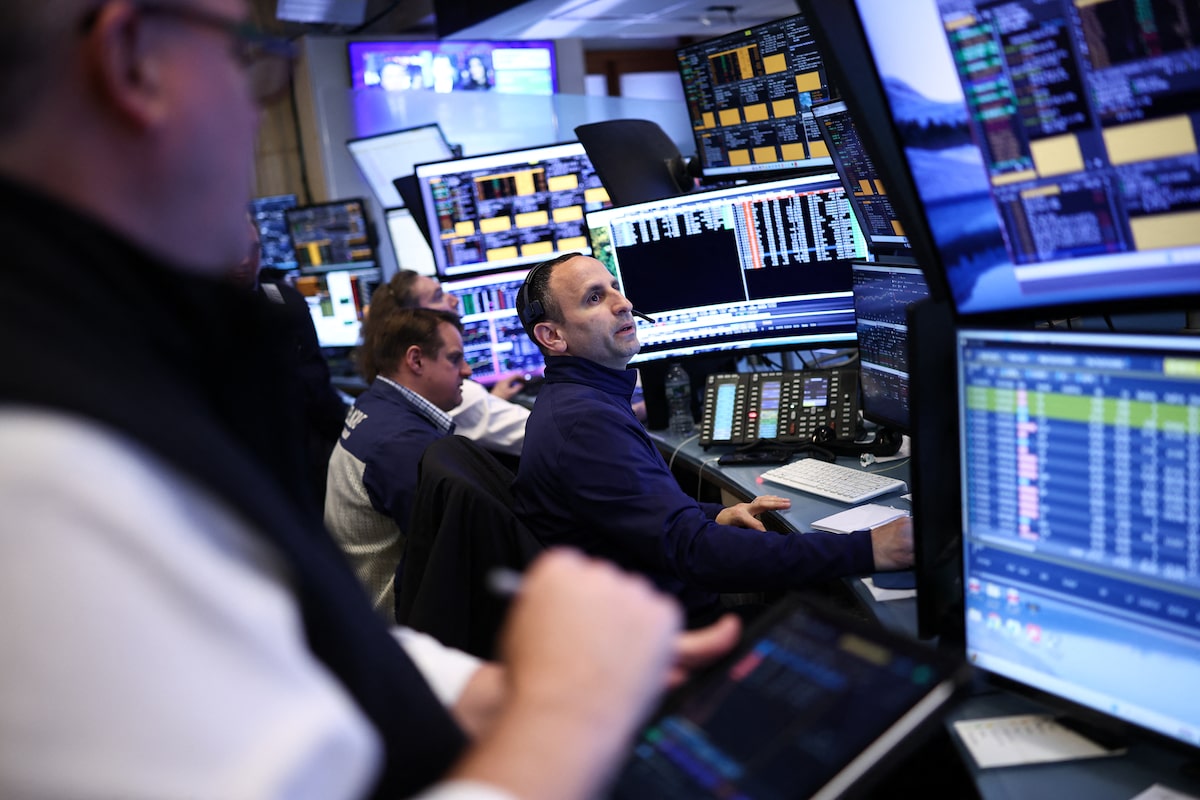
Traders work on the floor of the New York Stock Exchange before the closing bell on Wednesday.CHARLY TRIBALLEAU/AFP/Getty Images
Canadian and U.S. stocks soared on Wednesday after U.S. President Donald Trump announced a pause in the war in Iran, having earlier threatened the destruction of its civilization. The ceasefire is the latest geopolitical about-face in a six-week conflict that has thrown global financial markets off balance and led analysts and economists to warn of lasting economic harm.
In a note to clients on Wednesday, Neil Shearing, group chief economist at Capital Economics, said the world would face economic damage even if the conflict is resolved and energy flows recover by the end of April. With oil prices expected to remain elevated, inflation in major advanced economies is likely to rise further, he said.
To understand how Canadian investors are interpreting the economic outlook and the fragile truce, The Globe and Mail spoke to a range of people with money in the markets to learn how concerned they are about market volatility and the potential risks ahead.
The options-focused portfolio manager
Chris Thom, chief executive officer of portfolio management firm Moat Financial Ltd. in Vancouver, said he doesn’t believe the war in Iran will be fully resolved after the ceasefire. “These sorts of geopolitical events rarely end as quickly as they start,” he said.
But as an investor, he added, market instability has created a “good trading environment” for Moat’s core business of managing money for individuals and families, and its recently introduced Active Premium Yield exchange-traded fund.
He said the company had been adding more exposure to energy firms through cash covered puts. These options give investors the right, but not the obligation, to sell a stock for a set price by a set date. Investors buying puts can benefit from falling share prices, but Mr. Thom said Moat is generating income by selling what amounts to insurance on stocks that it is happy to own at a given price.
“Those option premiums get way more expensive when the world goes crazy like it is right now. So the strategy benefits from volatility like this,” he said.
Oil prices tumble but remain above prewar levels after U.S.-Iran ceasefire
The company’s focus on energy firms reflects a belief that disruptions to global oil supply have been significant enough to create a longer-term impact. Oil settling at US$75-85 a barrel could still lead to “enormous” profits for Canadian energy companies such as Cenovus, Canadian Natural Resources and Suncor, Mr. Thom said.
In contrast, Moat has a lower weighting in consumer discretionary firms, which could be hit by a renewed conflict. “We think that will be what gets pinched if gas prices all of a sudden are at record highs.”
The DIY investor
Stuart Peterson’s grandfather liked to talk about investing and how he lost no money during the Great Depression. “I try to work towards that,” said Mr. Peterson, a retiree in Guelph, Ont.
He said he has a conservative portfolio that aligns with his sense of risk. He has focused his investments on generating income, mostly through Canadian dividend stocks. He maintains a year’s worth of expenses in cash, plus an extra two in fixed-income funds.
Mr. Peterson’s approach has insulated him against market ructions sparked by the war.
“It really doesn’t affect me that much,” he said, adding that the size of his portfolio – just past $1-million – helps to reassure him that he won’t run out of money.
His approach is unlikely to change even if the Iran conflict escalates again and leads to a sharp market downturn: “My plan would be to stay the course.”
Opinion: The painful lessons of the Iran War
He said the “painful experience” of drawing down his portfolio during the 2008 financial crisis, necessitated by his children attending university, was a useful lesson. His portfolio now is based on the idea that he doesn’t have to sell anything.
At the same time, Mr. Peterson said he has been trying to reduce his exposure to American investments and putting the proceeds into Canadian index funds.
“That would be the only change I would make,” he said.
The research analyst
Kelly Hirsch, president of Kaivalya Research in Vancouver, said she had not made any changes to her investments after the outbreak of war in the Middle East in February.
She said that while the war created a “very challenging, volatile situation” for markets, she maintains a long investment timeline that gives room for optimism.
“This instability will lead to innovation and accelerate changes in the longer term that, without the impetus, wouldn’t happen,” she said.
Ms. Hirsch said extreme scenarios can nevertheless be a reminder to take a closer look at corporate governance and accountability structures. The COVID-19 pandemic exposed companies that had prioritized efficiency above all else, leaving no room for error in the event of a significant shock.
She cautioned that understanding governance structures is a complex undertaking that can’t simply be reduced to looking at performance indicators. Considering the backgrounds of company directors to ensure they have expertise managing risks is important, she said, as is understanding whether organizations have clear accountability systems that allow people to take effective action quickly if there’s a problem.
The ETF investors
Still, signs indicate some investors are acting defensively in response to the threat of global economic pain stemming from the war.
In their Canadian ETF Weekly report on Tuesday, TD Securities analysts noted that despite the market downturn during the conflict, Canadian exchange-traded fund investors added $10.5-billion to equities in March, out of total inflows of $19.1-billion.
But the report said the first positive flows into cash ETFs since April, 2025, suggested that some investors are preferring to sit on cash as they await more market clarity. Large inflows of $4.8-billion into fixed-income ETFs also showed many market participants reducing their risk exposure, it said.