
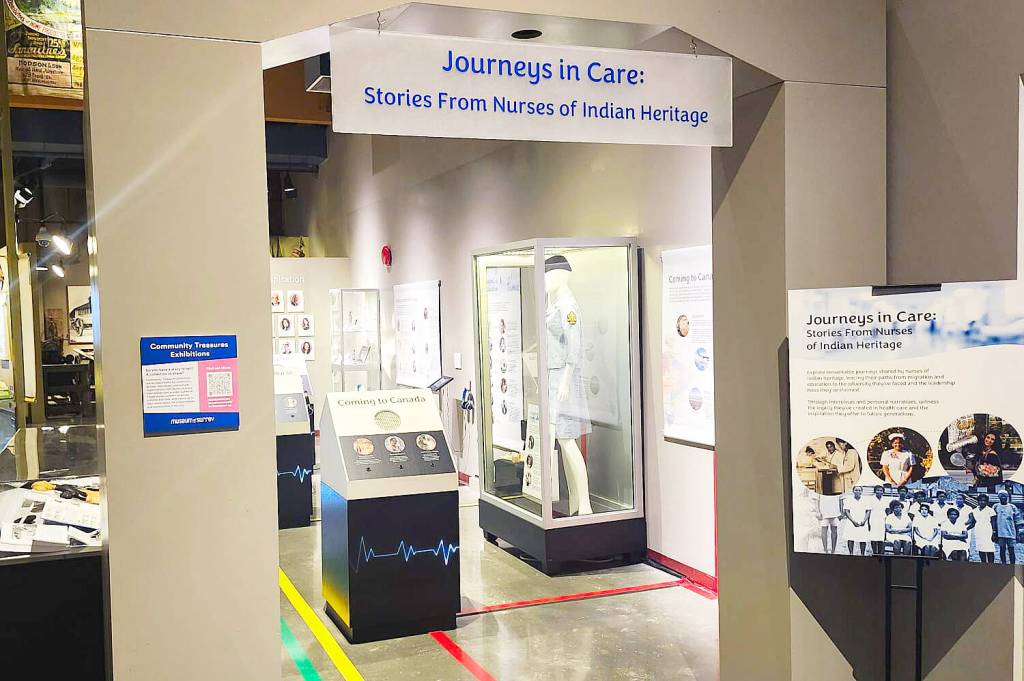
A new Community Treasures exhibit has opened at the Museum of Surrey.
“Journeys in Care: Stories from Nurses of Indian Heritage” chronicles the lives of nurses who emigrated to Canada for a better life and of subsequent generations who benefited from those original trailblazers.
“Explore remarkable journeys shared by nurses of Indian heritage, tracing their paths from migration and education to the adversity they’ve faced and the leadership roles they’ve claimed,” notes a storyboard that’s part of the exhibition.
Found upstairs in the Surrey Stories Gallery (next to the Indigenous Hall), Community Treasures reveals personal stories told through interviews. It explores themes of: immigration, nursing education, entering the workforce, trailblazing, and inspiring subsequent generations. The displays include two video interviews and three audio kiosks where five nurses tell their stories in their own words.
“Witness the legacy they’ve created in health care and the inspiration they offer to future generations.”
Nurses of Indian heritage ventured into various areas of nursing, but public health emerged as a common pathway. Many noted they were the first nurse of Indian heritage in their particular area. With that, they recalled the difficulties of “navigating unfamiliar and sometimes unwelcoming professional spaces.”
Often being the first one, many nurses recount helping to develop health care that helped meet the needs of South Asian communities in Surrey and the province. Because of their heritage, many looked to them to act outside their formal duties—often being and interpreter for both a patient’s cultural needs and/or their language needs.
“Public Health appealed to me because of its focus on disease prevention and health promotion,” Amrit Kaur Rai said, as quoted on an exhibit storyboard. “I began with casual positions and eventually secured a permanent role at the Boundary Health Unit in Surrey. My strong work ethic helped me specialize in communicable disease prevention, sexually transmitted infections, and harm reduction.”
As the demands of nursing education changed over time, isolation—several nurses noted they were the only student of Indian heritage in their classroom—exacerbated the pressure on them.
For Harroop Kaur Sharda, her heritage endowed her with a strength to steer through a new world and to embrace the culture.
“My parents brought with them the strong, vibrant traditions of Sikh Punjabi culture, which shaped our sense of identity, responsibility, and community,” said Sharda, as quoted on an exhibit storyboard. “At the same time, they intentionally embraced Canadian customs and civic life.”
Sharda explained that her parents celebrated Canada Day and Remembrance Day and encouraged their kids to embrace the traditions of our predominantly Christian neighbourhood by celebrating Christmas and Easter.
“This was done with care and intention,” she said, “so, that we would never feel marginalized or ‘othered,’ but instead feel that we belonged fully in Canada.”
Rai’s family immigrated to Canada in 1974. She said both her parents moonlighted with several jobs and she and her siblings had to raise themselves.
“I enjoyed sports—softball and volleyball—but excelled in track and field, particularly long-distance running,” she recalled. “Unfortunately, my parents were unable to support my athletic interests or assist with homework, so I learned to navigate my own path. Determined to secure a stable career, I focused on education to avoid the financial struggles my parents faced.”
Chinnama Baines recalled being shocked, literally, by the change in weather.
“I was unprepared for the coming days,” she remembered. “I did not have any winter clothes for life in Hazelton … I had never owned a coat or even a sweater as we did not need them in South India.”
Daljit Dehal’s parents immigrated to Canada from India in the 1980s. Their hope was to create a better life for themselves and their family.
“They settled in Vancouver first, then ultimately Surrey, a community that became home to many South Asian families navigating similar journeys of adaptation, resilience, and ambition,” Dehal explained. “Growing up, I watched my parents work tirelessly, often sacrificing their own comfort to ensure stability, education, and opportunity for our family. Their perseverance taught me the values of service, humility, and responsibility to community, values that later shaped my decision to pursue a career in healthcare.”
“Journeys in Care” runs until July 19.
The exhibit was curated by Lydia Wytenbroek, with the support of nurses Ranjit Dhari and Balbir Gurm. In total, 19 nurses contributed to the exhibition.
Community Treasures exhibitions are shows brought to the museum through public outreach and engagement. According to the Museum of Surrey, “Community Treasures celebrates the stories of Surrey’s people.”
Entrance to the museum is free. To find out more info, call the museum at 604-592-6956, or email museum@surrey.ca, or visit surrey.ca/museum.
The Museum of Surrey is located at 17710 56A Avenue in Cloverdale.