
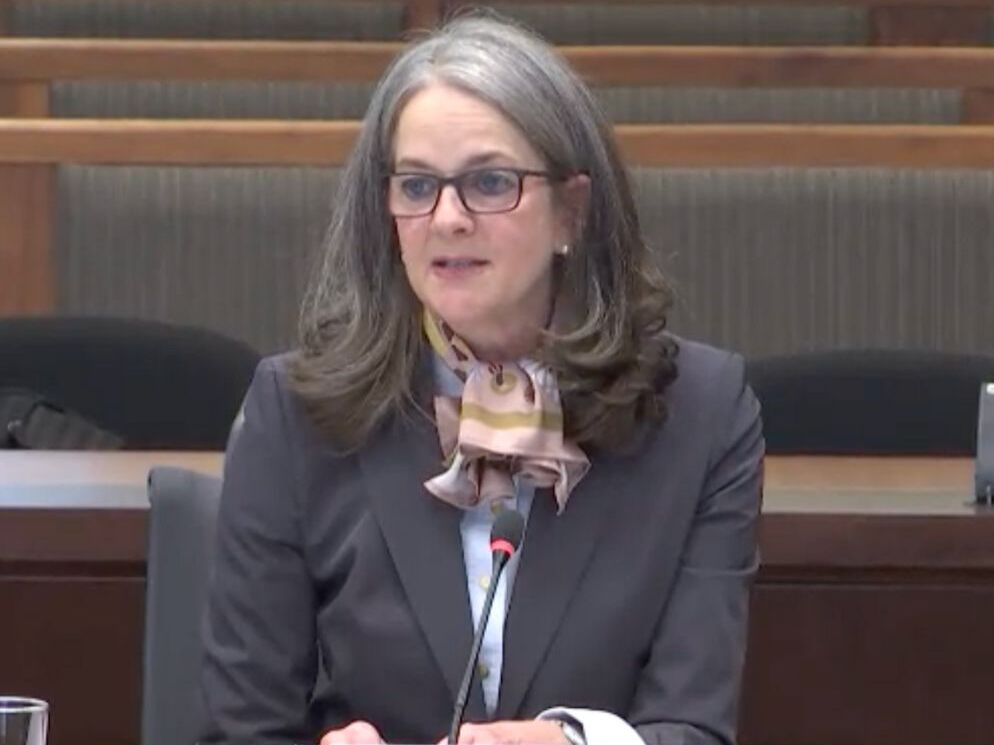
Canada’s new language watchdog says Quebec’s plan to abolish elected English school boards would have a “significant impact” on anglophone education rights — and she says she is prepared to challenge provincial laws that violate minority-language protections.
“The education sector clearly is one of the community’s most powerful tools for the survival of its language and culture, and what I intend to do in my role is to protect official language minority communities across the country,” Kelly Burke said in an interview with The Gazette.
She took over as official languages commissioner on March 30. Her role is to protect the rights of anglophones in Quebec and of francophone minorities elsewhere in Canada.
The appointment of Burke, a Franco-Ontarian lawyer and former teacher, was criticized by the federally funded anglophone rights group TALQ, formerly known as the Quebec Community Groups Network.
It noted that under precedent, the new commissioner should have been someone who has lived the experience of being an anglophone in francophone-majority Quebec.
TALQ also criticized Burke for refusing to say, at her Commons appointment hearing, whether she would back anglophones if Quebec’s Bill 40 school board case reaches the Supreme Court.
With less than two weeks on the job, Burke said she’s still “not quite up to speed on that particular file.”
She added: “We’ll be looking into all matters that we have before the court. I expect that the work that has been underway to represent this office before the courts will continue as it had under my predecessor.”
Under Raymond Théberge, who was commissioner until January, the watchdog intervened in the Supreme Court appeal of Quebec’s Bill 21 secularism law.
The commission supported the English Montreal School Board in its challenge. The board argued that Section 23 of the Canadian Charter of Rights and Freedoms gives English boards the right to decide who they hire, including teachers who wear religious symbols.
Burke said the plan to abolish English school boards raises constitutional red flags.
“Clearly, it has a significant impact on the rights of the anglophone community under Section 23 of the charter,” she said.
“Section 23 provides specifically that minority communities have a right to manage and control their schools. The vitality of the anglophone community resides right within that specific section.”
Under the CAQ’s plan, elected English school boards would be replaced by government-run service centres. A lower court sided with the Quebec English School Boards Association on that challenge; Quebec has asked the Supreme Court to review that decision.
Last fall, Théberge urged anglophones to fight the plan, calling it unconstitutional and vowing to assist a court challenge.
As commissioner, Théberge was outspoken — he criticized a CAQ tuition policy that disproportionately hurt Concordia and McGill universities, and warned that anglophones’ access to health care was at risk because workers were confused by Quebec’s stricter French-language requirements.
Burke also signalled she would be willing to take on Quebec more broadly.
“I think I can generally say today that I would be prepared to challenge laws that are considered incompatible with charter rights,” she said.
Linguistic minority communities, Burke added, must “continue to challenge provincial laws that are considered incompatible with Section 23.”
She noted that Quebec is home to both Canada’s largest francophone population and its biggest linguistic minority.
Burke said that “Quebec anglophones are very strong proponents and allies of protecting the French language and promoting French as well as making sure that their language rights are honoured in English.”
She said her role “is to defend the rights of the anglophone community in Quebec, as I have and will continue to do for the francophone minority communities across the country.”
“In defending the French language, we always have to remember that we are defending it, but not to the detriment of the rights of the anglophone community in Quebec.”
Editor’s Picks