
Seven gray whale deaths in just weeks, and a whale still alive in Puget Sound, are pointing to a deeper crisis unfolding in the Arctic.
SEATTLE — In the waters near La Conner, one gray whale is still alive.
Spotted in the Swinomish Channel, far from where most gray whales are expected to be, the animal has drawn concern from scientists tracking a troubling trend across Washington.
“That one is still alive,” said John Calambokidis, a marine biologist with the Cascadia Research Collective. But what it represents may be more urgent than reassuring.
This time of year typically marks the beginning of gray whale strandings in Washington. But in 2026, the numbers are already ahead of schedule and rising quickly.
“The total of seven. Four of those have been in just the last week,” Calambokidis said. In a typical year, Washington sees about five to six gray whale deaths total.
“What’s troubling is that we’re so early in the year,” he added. “Usually those occur in April, May and June.” Last year, 18 gray whales were found dead, but only one had died this early in the season.
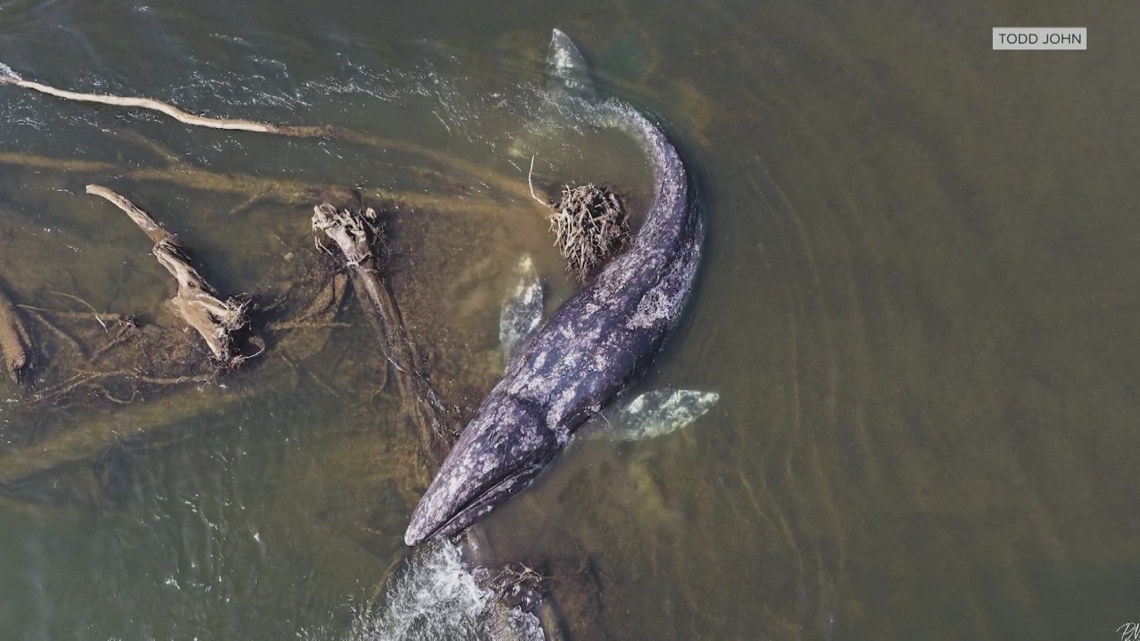
The deaths are scattered across Washington and in some cases, unfolding in unusual places. The most recent whale was found on private property near Anacortes, visible only from above. Another died after swimming more than 20 miles inland up the Willapa River, a rare and disorienting path for a gray whale. And two more washed ashore along Copalis Beach, near Ocean Shores. Together, the cases form a pattern scientists say is difficult to ignore.
At the center of that pattern is a single explanation: food.
“Something is hitting this population really hard and it all looks related to their prey in the Arctic,” Calambokidis said.
Gray whales migrate thousands of miles each year from breeding grounds in Mexico to feeding areas in the Arctic. There, they rely on dense populations of small creatures living on the ocean floor.
But scientists say those food sources are changing.
“If they didn’t get enough to feed in the Arctic last year, this is when they’d be running through their nutritional reserves,” Calambokidis said. In some cases, he said, whales become so weakened they begin to lose their bearings, turning up in rivers, channels and other unexpected places.
“The eastern North Pacific gray whale population is in real trouble,” Calambokidis said. “It’s declined over 50 percent in the last ten years.”
Scientists believe the changes are tied to shifts in the Arctic ecosystem — including warming waters and loss of sea ice altering the foundation of the whales’ food chain.