
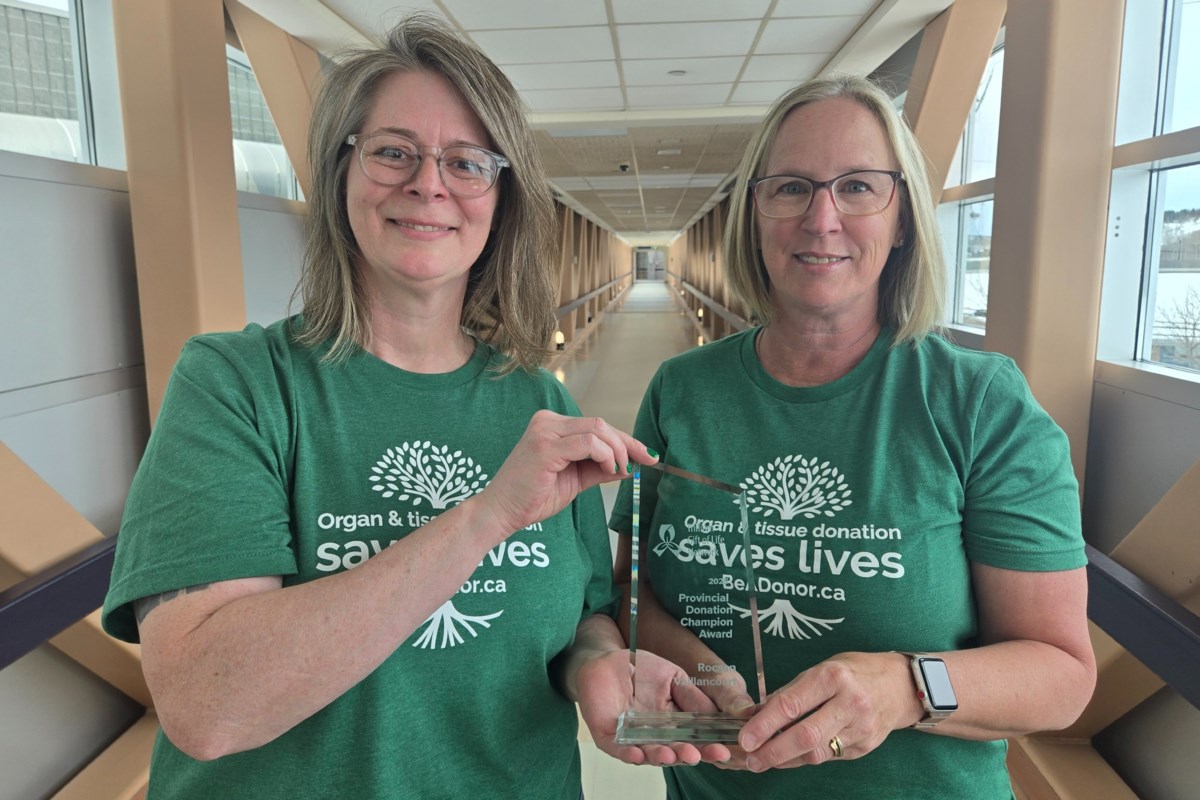
An Health Sciences North MAiD navigator, helping patients who have chosen medical assistance in dying, Rocsan Vaillancourt has been honoured by the Trillium Gift of Life Network for her work to support organ donation
A Health Sciences North staff member who helps people navigate medical assistance in dying has been named a recipient of the 2025 Provincial Donation Champion Award by Ontario Health through the Trillium Gift of Life Network.
The award honours health care professionals across Ontario who demonstrate exceptional advocacy for organ and tissue donation, the network said.
Rocsan Vaillancourt, a registered nurse who guides patients through the process, was nominated for her dedication to ensuring donor wishes are respected and fulfilled. According to a press release from HSN, Vaillancourt was recognized for “consistently identifying opportunities for donation, maintaining strong communication with provincial co-ordinators, and remaining available, even after hours, to support patients, families, and care teams.”
Vaillancourt is also known for educating colleagues and promoting best practices, helping to strengthen awareness and understanding of organ and tissue donation across the hospital, said the release.
But it’s the opportunity to have frank conversations about death that guides her care, she told Sudbury.com.
“People don’t talk about death at all,” she said. “And this is the thing that I have been preaching: talking about death won’t kill you.”
It’s also a chance to offer a sense of control to those patients that feel helpless within a terminal diagnosis.
“Some of these patients, when I meet them and I have those initial conversations about what medical assistance in dying will look like and we start the paperwork process, right then and there, in that room, they will say, ‘My god, I feel like 100 pounds have been lifted from my shoulders’,” she said. “Then they’re assessed, and they find out that they’re eligible, and then, well, I have lost count how many times people have said to me: ‘I feel like you’ve saved my life’.” She said it’s not about “romanticizing medical assistance in dying,” but acknowledging that for some people with a terminal diagnosis, palliative care does not “line up with what they had envisioned for themselves.”
“These people are dying, they have illnesses that are going to cause them to die,” she said. For some, hospice care is the patient’s choice, “but there are some people, this does not line up with what they had envisioned for themselves.”
She said on occasion, there are those in palliative care that call her. While they always attest to the highest level of care received at the hospice, “things have become, undignified,” she said. It’s about loss of independence, power, but also, a sense of themselves.
“There is no medication that can help with that,” she said.
It’s the ability to bring dignity back, that’s “empowering” the patients, she said.
“It’s really giving them that power back, because with these illnesses, they’ve been in and out of the hospital, they have physicians telling them what to do, what to eat, which medications to take, and what they have to do on a daily basis,” said Vaillancourt. “They’re being told how to do everything, and everything is completely out of their control, and for this one moment, they have got control back.”
She also helps families to find resources to help with their grief, noting, “the grief for MAiD hits differently.”
She also, in her way, offers the gift of legacy to her patients by connecting them with the Trillium Gift of Life Network. After a patient is found eligible for MAiD, she checks to see if they are registered organ donors. Though many think that illness and disease could hamper the ability to donate, “there are some people who may not be candidates for organs or tissue, but probably can be candidates for research.”
Vaillancourt refers to organ donation as “an epic legacy,” and one that can change a families’ grief. “A silver lining, I guess you could say, but the fact that they’re able to help someone else makes them feel better.”
And more than anything, Vaillancourt said the work is the greatest she will ever perform. “I am invited into sacred spaces, and it is a privilege to witness these last moments.”
You can find more information about medical assistance in dying here.
To learn more about organ donation, visit BeADonor.ca.
Jenny Lamothe covers vulnerable and marginalized communities, as well as housing issues and the justice system for Sudbury.com