
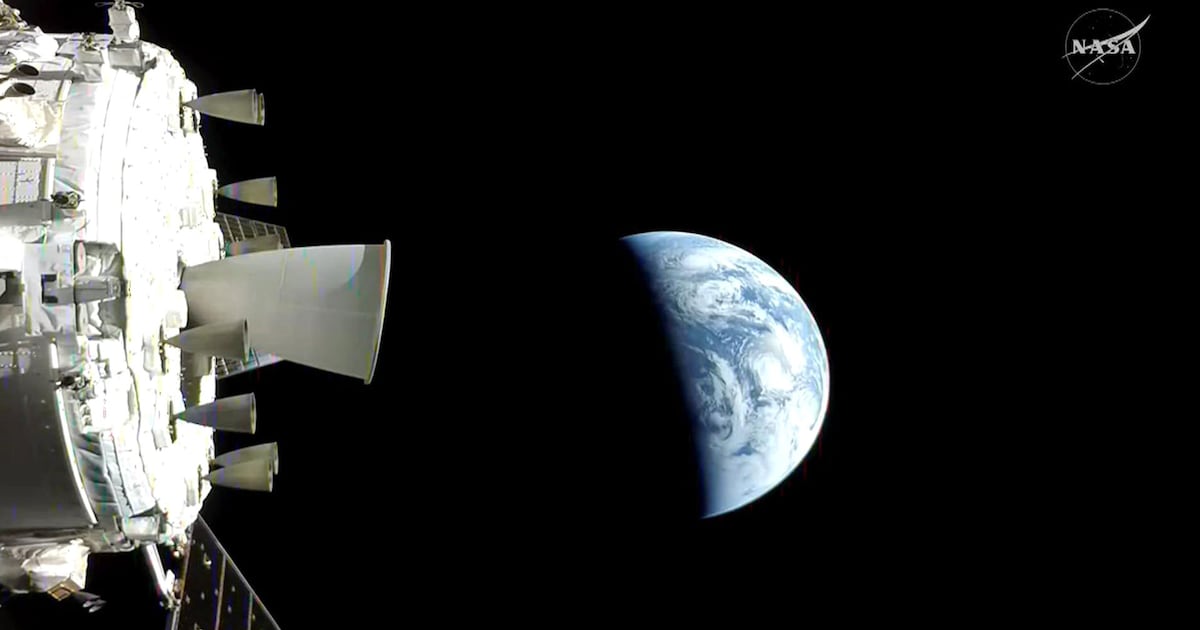
The crew members aboard lunar mission Artemis II are expected to make their return to Earth tonight.
The Orion capsule is set to enter the Earth’s atmosphere Friday afternoon, hurtling towards home at 40,000 km/h as the onboard heat shield protects the crew of four from a 2,700 C fireball expected to engulf the ship.
Canadian Jeremy Hansen – who has spoken to children, journalists, one prime minister and one president from the capsule – has made history with his three American colleagues. They have travelled deeper into space than anyone else before them. Hansen is the first Canadian Space Agency astronaut onboard a lunar mission.
A dynamic dance of parachutes, precisely planned burns and favourable weather will carry the astronauts through the final leg of the mission.
Here is the latest:
Animated simulation shows what the Artemis II crew’s journey back to Earth will look like An animated simulation made by NASA shows how the Artemis II’s crew capsule will descend back into Earth’s atmosphere.
Artemis II itinerary (all times eastern):6:30 p.m.: NASA will begin streaming the crew’s return. CTVNews.ca will provide updates as the capsule descends7:33 p.m.: The Orion crew module and service module, which carries the solar panels, engines, radiators, oxygen and water tanks, separate7:37 p.m.: Crew module raise burn7:53 p.m.: Orion enters Earth’s atmosphere, 400,000 feet above the ground8:07 p.m.: Splashdown in the Pacific Ocean. NASA and U.S. Department of War personnel are expected to assist the crew out of Orion and fly them to a waiting recovery ship10:30 p.m.: Post-splashdown news conference at NASA’s Johnson Space Center in Houston, TexasWhat does re-entry feel like?
Former Canadian astronaut Col. Chris Hadfield says the four crewmates will feel a range of feelings – both physical and emotional – as they return to Earth.
Physically, the final 30 minutes of descent after the astronauts enter the atmosphere is filled with gravity-fuelled whiplash.
The transition back from 10 days of weightlessness – the “ultimate laziness,” as Hadfield put it – feels “crazy unfair,” he said.
“You don’t have to hold your head up or lift a finger.” But as they descend closer to Earth’s surface, they’ll feel themselves getting pushed into the floor of the spaceship, experiencing a gravitational pull several times greater than their bodyweight.
“Even your eyeballs feel strangely heavy,” said the former astronaut, who has been to-and-from space several times during his career.
“When the parachutes start opening, it’s like, crack the whip. … You get snapped around on the edge of the cables,” he said.
Eventually, once the spaceship settles into a parachute-assisted fall, “suddenly, you’re pristine.” At least, until the vessel makes its splashdown, or “bellyflop,” added Hadfield.
Artemis II crew could feel pressure ‘four times their weight’ entering Earth’s atmosphere: Hadfield Former Canadian astronaut Col. Chris Hadfield explains what the Artemis II crew may experience when re-entering the earth’s atmosphere ahead of splashdown.
Key momentsImages of Earth
New, stunning pictures of Earth were taken by mission commander Reid Wiseman using his Personal Computing Device — a tablet that includes a camera — three days into the mission.
The first image was described by NASA mission control at Johnson Space Center in Houston as a “reminder that no matter how far we go, we are still one world, watching, hoping and reaching higher.”
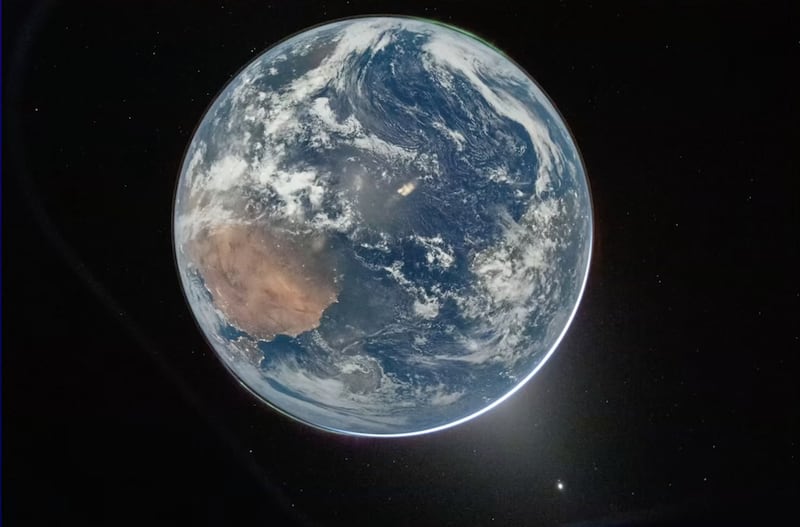 NASA-Artemis-Moonshot This image provided by NASA shows a downlink image of Earth taken by NASA’s Artemis II astronaut commander Reid Wiseman inside the Orion capsule on Friday, April 3, 2026. (NASA via AP)
CNN. See more images here.
‘Organ chips’ onboard
Before four Artemis II astronauts strapped into their Orion capsule to soar toward the moon, a tiny bit of each of them was already on board.
Incubated in a small triangular container stowed on the spacecraft just before launch were four USB-size “avatars,” which rode along with the history-making moon mission. But in many ways, their journey is just beginning.
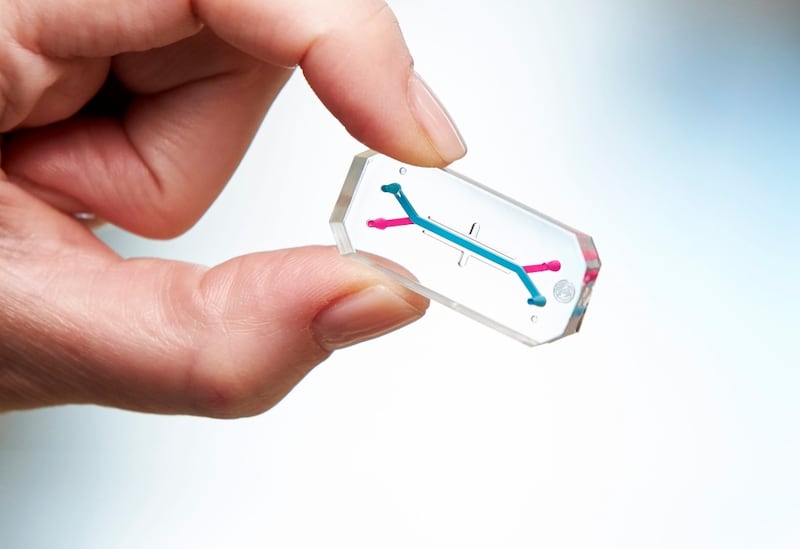 Product image of Emulate’s chip technology This undated product image provided by Johnson & Johnson shows Emulate’s Organ-On-Chips technology, a computer chip designed to simulate functions of human organs to predict which experimental drugs are most likely to be effective and safe in people. (Johnson & Johnson via AP)
Known as organ chips, the avatar crewmates are made with bone marrow tissue derived from cells donated by their full-size counterparts — Reid Wiseman, Victor Glover, Christina Koch and Jeremy Hansen — and researchers believe the experiment could soon unlock unprecedented insights about the effects of space on human health.
CNN. Read the full story here.
Lunar crater named ‘Carroll’
Artemis II astronauts took a poignant page from Apollo 8 earlier this week, proposing deeply personal names for a pair of lunar craters.
Commander Reid Wiseman and his crew asked permission to name one small, fresh crater after their capsule called Integrity and another after his late wife, Carroll. Hansen made the request right before Monday’s lunar fly-around. Wiseman was too emotional to talk.
Carroll Wiseman, a neonatal nurse, died of cancer in 2020.
The Associated Press. Read the full story here.
Music in space
Despite being hundreds of thousands of kilometres from home, the Artemis II crew starts each day with a familiar tune.
Since the mission launched on Wednesday, National Aeronautics and Space Administration (NASA) mission control has played the astronauts, among them Canadian Jeremy Hansen, a wake-up song after a period of scheduled sleep.
On Day 1, they heard “Sleepyhead” by Young & Sick. See the full playlist here.
Jordan Fleguel, CTVNews.ca journalist
A special coin
The Royal Canadian Mint has launched a new collector coin celebrating Canada’s part in NASA’s Artemis II mission.
The coin, designed by Canadian artist Pandora Young, is a $20 fine silver coin — 99.99 per cent pure silver — which illuminates with a blacklight.
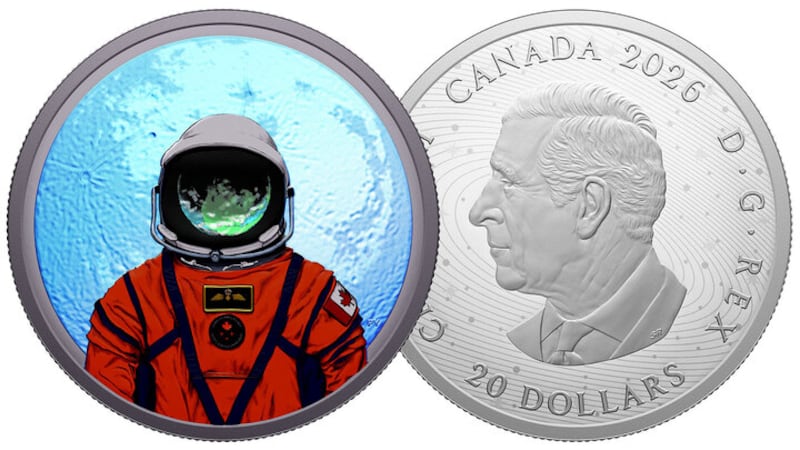 Artemis II coin
Robin Della Corte, CTVNews.ca journalist. Read the full story here.