

Listen to this article
Estimated 4 minutes
The audio version of this article is generated by AI-based technology. Mispronunciations can occur. We are working with our partners to continually review and improve the results.
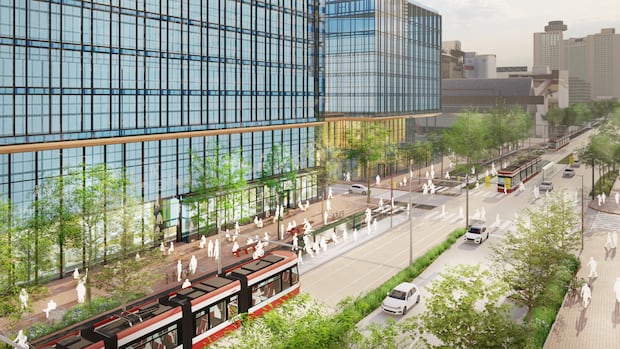
After years of studies and plans, Toronto has finally secured a deal with Queen’s Park and Ottawa for the money needed to make the Waterfront East LRT a reality. But the details of that agreement appear to leave the city on the hook for any cost overruns on the line, an issue that plagued the most recent LRT projects built in Toronto.
The $3 billion cost of the 3.8 kilometre line is being split three ways by all levels of government, it was announced in April. City staff, Waterfront Toronto and the TTC were directed to start designing it in 2019, and the city says the goal is to finish the line in the early 2030s.
But details of the agreement released by the province state that Ontario and Ottawa won’t pay for any cost overruns on the project. Those costs will fall onto the City of Toronto, which is already facing a mounting bill of its own with existing infrastructure upkeep projects.
Toronto’s newest LRTs, lines 5 and 6, built by Metrolinx, both came in more than a billion dollars over budget, though they are significantly longer than the waterfront LRT.
“I have very serious concerns about how this agreement has been put together,” said Coun. Josh Matlow, a member of the TTC board.
He said the transit expansion will benefit the whole region, not just the city.
“I have real concerns that Toronto is seen as a source of revenue for the provincial government rather than Ontario’s capital city that needs support and investment by the province,” he said.
WATCH | Toronto’s long-planned waterfront transit line is getting funding: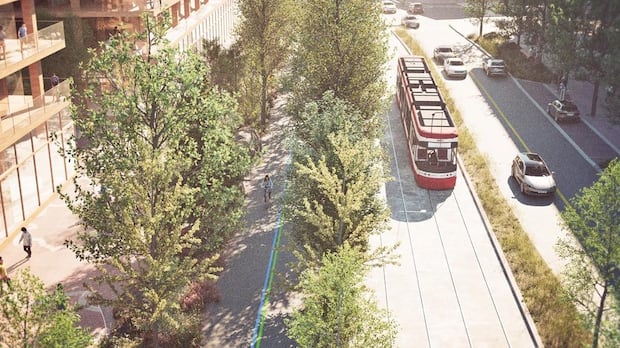
Toronto’s long-planned waterfront transit line is getting funding
Toronto is one (big) step closer to building a light-rail train that would connect the developed Port Lands to downtown.The federal, provincial and municipal governments will each spend $1 billion, for a total of $3 billion, to fund the Waterfront East LRT.
Asked why the mayor would agree to the over-budget aspect of the deal, a spokesperson said the project is in early days and doesn’t have any overruns.
“What is true as of right now is that we are $2 billion further ahead, and the Waterfront East LRT can now actually be built, due to the Mayor’s work,” Braman Thillainathan, the mayor’s press secretary, said.
While the costly and delayed LRT projects most recently built in the city were done by Metrolinx, Prabmeet Sarkaria, Ontario’s transportation minister, has confirmed the provincial transport agency won’t be leading this project.
Sarkaria has said the project will be led by the TTC, but so far the transportation expansion department at city hall has been providing updates on design to councillors. When asked who will lead its design and construction now that the LRT has funding, a city spokesperson said more information will be revealed at a later date.
Cost overruns common, not inevitable: expert
Jonathan English, a transportation consultant who recently wrote a report about the growing cost of transit infrastructure projects in Canada for the standards organization CSA Group, said higher levels of government usually don’t want to be liable for extra costs if they’re not building the infrastructure.
“This is a way to make sure that the city, as it delivers this project, tries to keep as firm a hand on keeping costs from going up as possible,” he said.
WATCH | Could Scarborough get its own LRT?: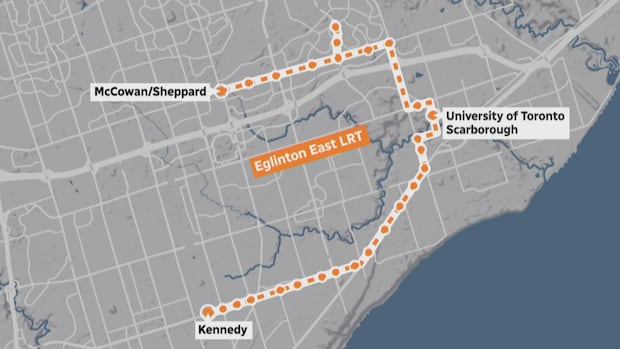
Could Scarborough get its own light-train rail?
The city has proposed an 18-km light rail transit in Scarborough. CBC’s Lane Harrison explains how this issue is taking over the coming mayoral election.
Before even getting into overrun territory, the cost of building the line is already “astronomically high” at face value, English said, with the $3 billion coming out to $789 million per kilometer. He said a lot of the cost will be for construction that needs to happen to integrate the line with Union Station.
One question that is circulating is whether Toronto could be on the hook for even more money: “It’s common to get overruns in big infrastructure projects. It’s not inevitable,” he said.
English said the new LRT could be brought in on budget through lessons learned from the recently completed and over budget lines five and six. He pointed to Ontario’s history of nuclear refurbishment as an optimistic example.
In 2010 the restoration of two reactors went $2 billion over budget, while the refurbishment of the Darlington plan finished $150 million under budget this year.
“I think that there are a lot of opportunities to learn lessons from successful projects.”