
A group of civil rights organizations is ratcheting up the legal pressure on San Jose over longstanding complaints that too often mental health-related emergency calls receive a police response — rather than assistance from mental health professionals.
In a recent letter to Mayor Matt Mahan, lawyers representing local police watchdog group Silicon Valley De-Bug allege the city, which operates the local 911 emergency dispatch center, is violating federal disability law. They argue that by failing to divert a higher number of calls to non-police crisis teams, the city has run afoul of statutes guaranteeing equal access to government support, including emergency response services.
The message sent earlier this month — signed by attorneys with the American Civil Liberties Union, including its local chapter, as well as the Bazelon Center for Mental Health Law — follows an earlier letter sent a year ago threatening legal action against San Jose and Santa Clara County, which operates four emergency response teams.
Representatives for the civil rights groups said while county officials have engaged in structured negotiations over how best to resolve the issue, San Jose dropped out of the process in December.
“We are hoping that the letter will prompt the city to send the experts within the city on its emergency response system to join our conversation and our negotiations with the county,” Susan Mizner, director emeritus of the ACLU’s disability rights program, told San José Spotlight.
In response, City Attorney Susana Alcala Wood said the city’s efforts have succeeded in increasing the volume of calls transferred from 911 to 988, the emergency line for mental health crises and suicide prevention. Among these efforts, the city has worked to raise awareness of 988 and also provided funds for various county outreach teams, though San Jose’s funding has since been discontinued.
“We believe collaboration — particularly with the county — not court action, is essential to achieving meaningful and sustainable improvements,” Alcala Wood told San José Spotlight.
In their letters, the civil rights attorneys blamed a variety of issues for stymieing efforts to ramp up non-police crisis responses, including insufficient funding and a lack of public awareness. But they contend addressing these problems is impossible without San Jose’s active participation in the negotiations.
This campaign gained momentum in 2020 amid widespread calls for police reform following the murder of George Floyd by a Minneapolis police officer. Since then, Santa Clara County has launched a variety of specially trained teams capable of providing support specifically tailored to the needs of people in crisis or the throes of drug addiction.
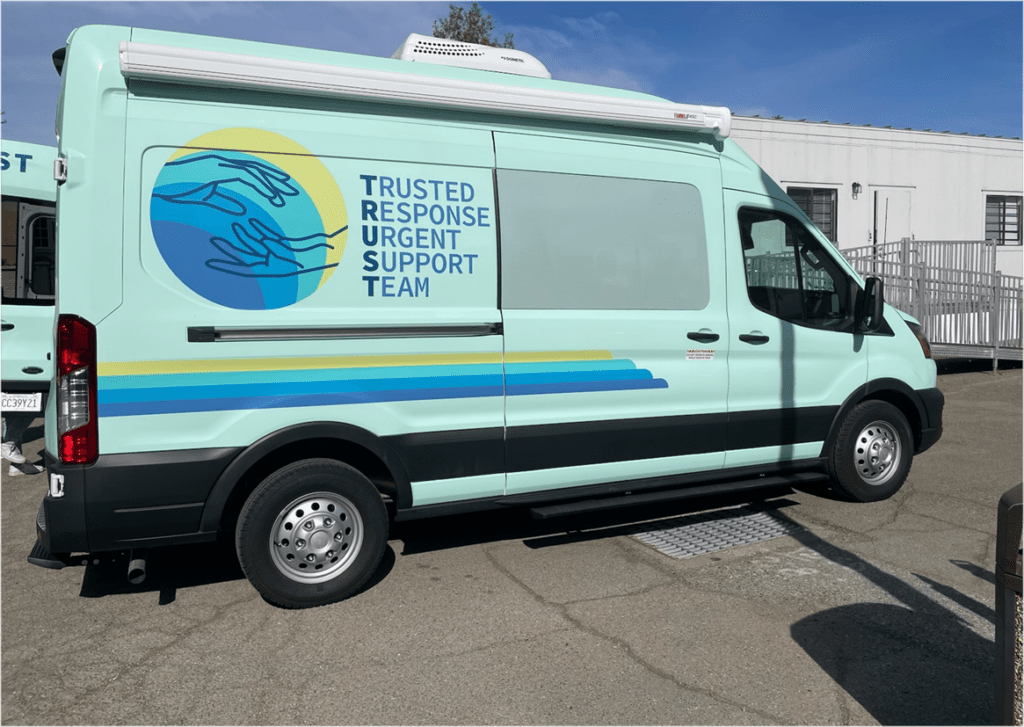 Santa Clara County TRUST, a non-police mobile crisis response team can be reach through its direct line or dispatched through the 988 call center. File photo.
For example, in 2022, at the urging of families who have lost loved ones in police shootings, the county launched the Trusted Response Urgent Support Team or TRUST. These non-law enforcement mobile crisis units operate throughout the county, with members trained in both first aid and mental health crisis intervention.
Advocates for such an approach have argued that sending armed police officers to the scene of mental health crises often escalates the situation, in many cases leading to deadly altercations.
But critics say so far, this reform campaign has not lived up to its promise.
The civil rights attorneys said a review of last year’s 911 dispatch call data in San Jose found the vast majority of incidents that could have been diverted to a crisis team — including mental health calls and welfare checks — still received a police response.
Given such findings, De-Bug founder Raj Jayadev said San Jose’s efforts to pivot to different forms of crisis response have merely been “cosmetic.”
“To truly value non-police crisis response is really a whole re-architecturing of how a city responds to crises right now,” Jayadev told San José Spotlight. “It has to be an entire cultural shift of how a city responds to residents who are in need, and that requires the seriousness that we’re hoping the city would step into.”
The San Jose City Council has repeatedly directed staff to accelerate diversion efforts. However, officials have complained there simply aren’t enough crisis response teams to meet demand, suggesting the city can do little without more support from the county.
“ … The county is the primary provider of health services including behavioral and mental health services for all residents in the city, and the availability and capacity of those services are critical to the city’s ability to do any expansion of non-police response,” Alcala Wood said.

For their part, county officials pointed blame back at San Jose, arguing the primary issue is the decision by San Jose Police Department personnel to dispatch police officers when other response teams would be more appropriate.
“That is quintessentially a city responsibility, not a county responsibility,” Santa Clara County Counsel Tony LoPresti told San José Spotlight.
LoPresti said the county is “pleased” to work with the ACLU as it continues ongoing efforts to improve its system of mental health care and crisis response.
Despite her letter’s discouraging findings, Mizner expressed optimism that progress could soon be within reach.
“We recognize that both the county and the city want to do the right thing here” she said. “That’s why we’re talking first, rather than litigating.”
Contact Keith Menconi at [email protected] or @KeithMenconi on X.