
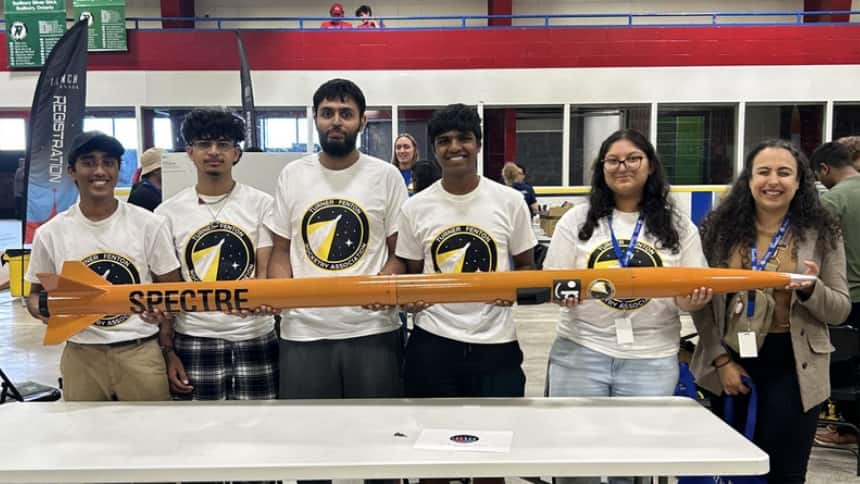
Teens visit middle school to explain how they built their own rocket
⭐️HERE’S WHAT YOU NEED TO KNOW⭐️
A rocket club at an Ontario high school has been building and launching rockets for the past three years.
On April 8, they spoke to Grade 6 students at a nearby elementary school about rocketry.
The goal was to share their passion and inspire younger kids to learn more about rocketry.
Rockets have been on people’s minds lately because of the Artemis II mission to the moon.
Keep reading to learn what it takes to build a rocket. ⬇️⬇️⬇️
Ever since Umaiza Raza watched the Artemis II rocket launch with her family on April 1, she’s been thinking a lot about space travel.
“It was the first time I watched a rocket launch into space,” said Umaiza, a Grade 6 student at Morning Star Middle School in Brampton, Ontario.
“And I thought, like, ‘Wow! This is, like, outside of this world.’”
She started to think maybe she could do something like that, she said.
Umaiza’s chance to get involved in rocket science could be a lot closer than she thought.
At nearby Turner Fenton Secondary School in Brampton, a group of teens have been building their own rockets for the last three years.
On April 8, members of the Turner Fenton Rocketry Association visited Umaiza’s school to share their love of building rockets — and let the middle-schoolers know they can do it, too, when they get to high school.
“We’re all still high school students, we’re just like them,” said group member Elissa Chacko, who is in Grade 12.
“We’re showing them that it is possible and encouraging them that they can do the same.”
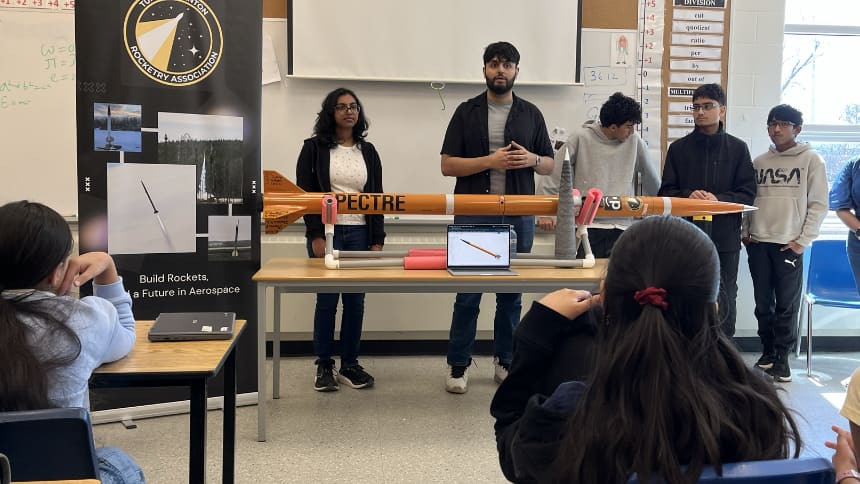
Members of the Turner Fenton Rocketry Association show their rocket, Spectre, to students at Morning Star Middle School in Brampton, Ontario, on April 8. Left to right: Elissa Chacko, Dhyan Soni, Ismail Ait Simmou, Manvir Dhesi and Ishaan Maji. (Image submitted by Peel District School Board)
From water rockets to 3,000 metres up
Dhyan Soni had the idea to start the rocketry club with some friends three years ago.
Every day during lunch, they work out of their school’s auto shop. They started off making water rockets out of two-litre pop bottles.
“We didn’t have the tools, we didn’t have the materials or the knowledge,” said Dhyan, who is now in Grade 12.
“It was just a group of friends going at it and spending time and lunches making rockets.”
But then they connected with rocketry mentors who shared their knowledge, and they found sponsors to fund their materials and activities.
They started building more complicated rockets and learning from their mistakes to make the next ones better, Dhyan said.
Last year, the team was the only high school to compete in a national competition for post-secondary students where you launch your rockets.
Their rocket, named Spectre, reached a height of 3,092 metres.
“It’s really, really satisfying seeing these rockets fly after months of, like, tireless work,” Dhyan said.
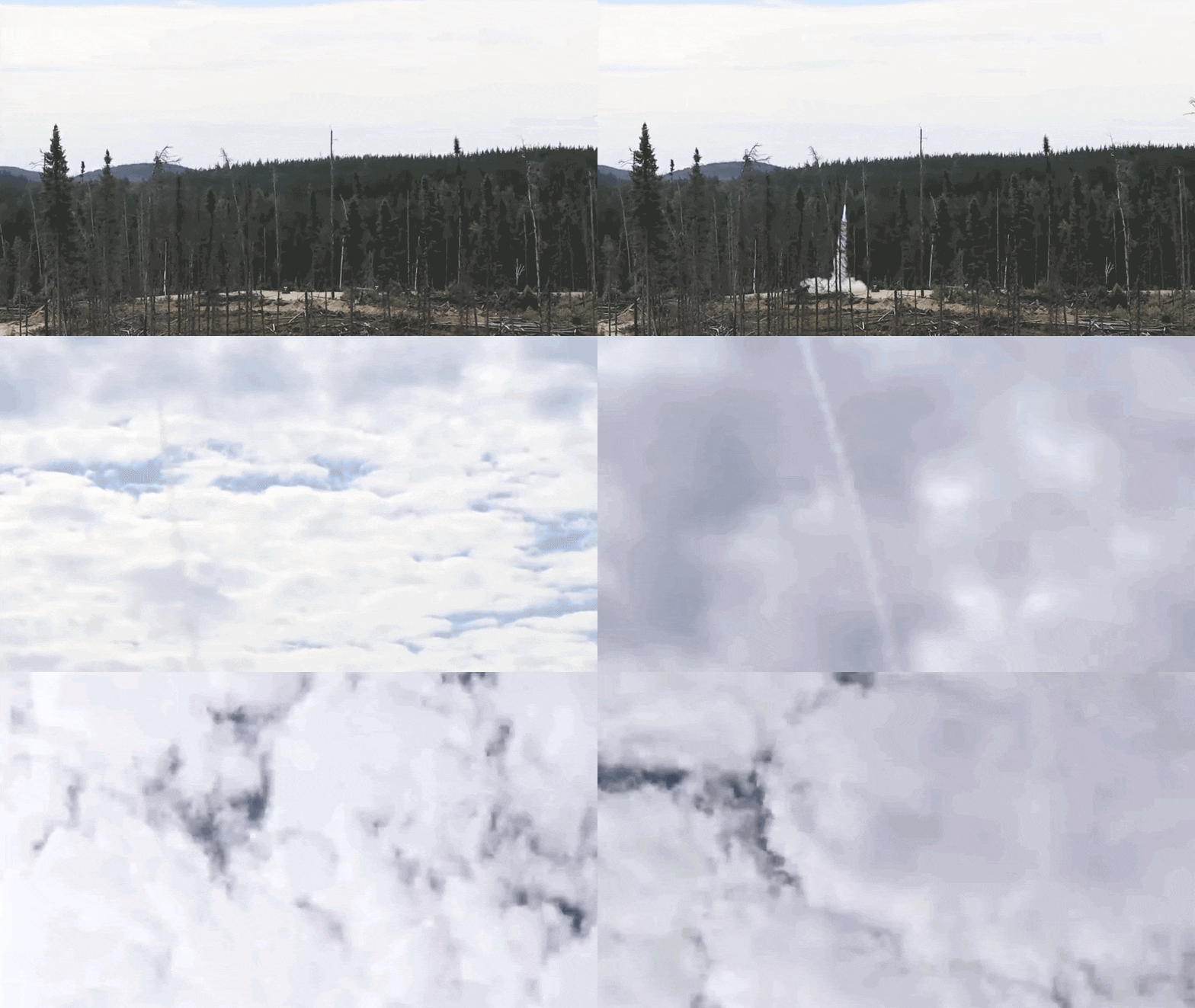
The Spectre blasts off at the Launch Canada Challenge in Timmins, Ontario, in August 2025. (Launch Canada/YouTube)
The group has learned that to build the best rockets, they need people with different skills, such as research, design, construction and data analysis.
This is similar to Artemis II. If you watched the launch, you probably saw not just the four astronauts but also teams of people sitting behind monitors making sure everything went according to plan.
Elissa says one of her favourite parts about rocketry is seeing all these different elements come together over many months.
Then when you see the rocket launch, you realize “all the effort was not for nothing. There was something beautiful that came out of it,” Elissa said.
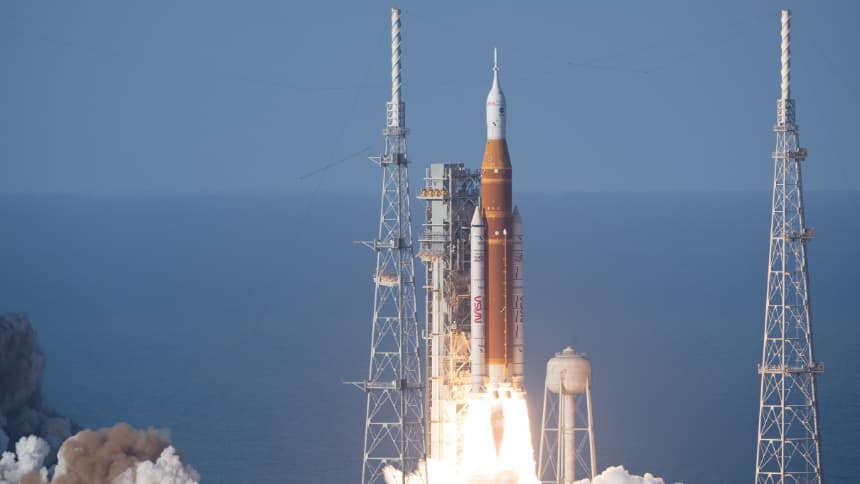
The rocket carrying the Artemis II crew on their mission to the moon blasts off in Cape Canaveral, Florida, on April 1. The rocket club students and the middle-schoolers they spoke to said the Artemis II mission has been inspiring to them. (Image credit: NASA)
Inspired by Artemis II
When the rocket carrying the Artemis II astronauts launched into the sky last week, Elissa said, her experience with the rocketry club helped her to see herself in that position.
“It really inspired me even more and made me realize . . . this is possible and the sky is the limit.”
Dhyan said it was especially meaningful to see Canadian astronaut Jeremy Hansen on the crew because he started out as an air cadet, and Dhyan and Elissa are both air cadets now.
“Seeing the living embodiment of what you can be, it’s incredible,” he said.
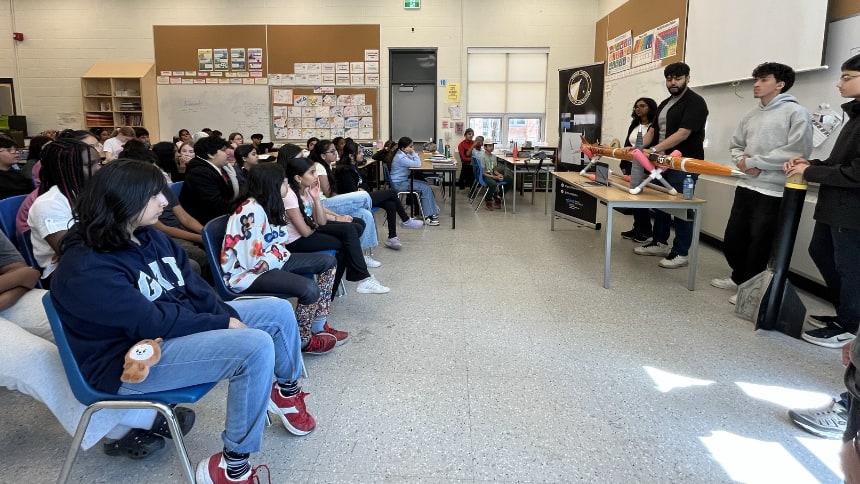
Grade 6 students at Morning Star Middle School watch a presentation by members of the Turner Fenton Rocketry Association. (Image submitted by Peel District School Board)
After the presentation at Morning Star Middle School, some of the younger students said they can see a future for themselves in rocketry, too.
Grade 6 student Sariah Balasal said she liked that the rocket club members showed them the rocket and explained how they built it and prepared it for launch.
Now she’s thinking about joining the club when she gets to high school.
“When I was little, I used to think, like, rockets were cool, but I never really understood it until this week.”
Have more questions? Want to tell us how we’re doing? Use the “send us feedback” link below. ⬇️⬇️⬇️
TOP IMAGE CREDIT: Submitted by Peel District School Board