
 The Metro Vancouver Regional District offices in Burnaby. (Howard Chai)
The Metro Vancouver Regional District (MVRD) is planning a significant reduction in development cost charges (DCCs), according to an MVRD staff report, answering the calls from developers and the real estate industry at large to cut fees and help new construction move forward.
On January 30, the Metro Vancouver Board directed staff to return with proposed amendments to its DCC Bylaw that would roll back the 2026 DCC rate increase, reduce the 2027 DCC rate increase, and extend the transition to a 1% assist factor over two additional years. The Board also directed staff to report back with options to offset the potential reduction in DCC revenue, which is used to fund growth-related infrastructure projects.
Metro Vancouver staff have now returned with two potential options that will see DCC revenue it collects be reduced by either $389 million or $246 million. (There is technically also a third option, as indicated in the report, which is to stay the course and make no changes.)
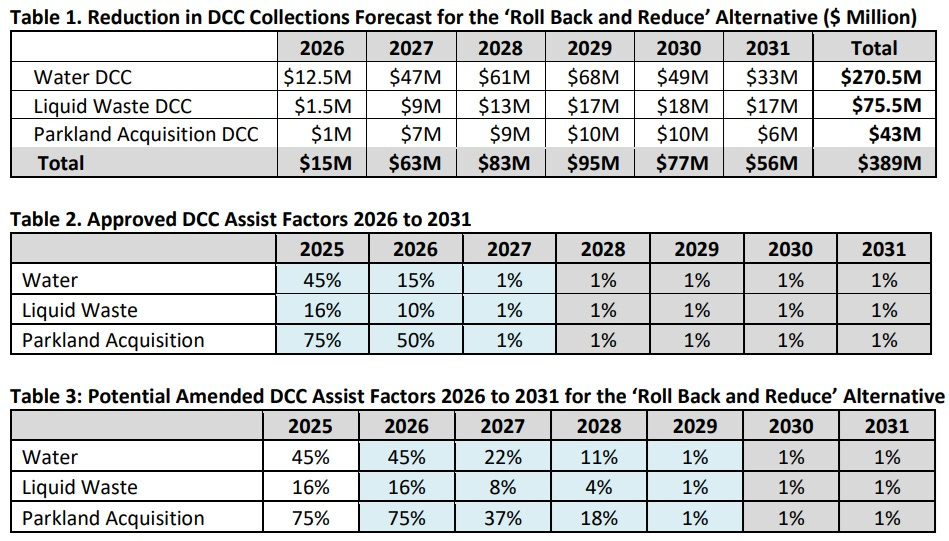
Under the first option, which is the one the Board directed staff to explore in January, 2026 DCC rates would be rolled backed to 2025 rates and the 2027 DCC rates would be decreased. The DCC assist factor is currently set to be reduced to 1% in 2027, but would be pushed back to 2029, when DCC rates would increase correspondingly. The effect is a longer “grace period” for development in the near-term.
With this option, the MVRD forecasts a reduction of $389 million in DCC revenue, split between $270.5 million less in Water DCCs, $75.5 million less in Liquid Waste DCCs, and $43 million less in Parkland Acquisition DCCs.
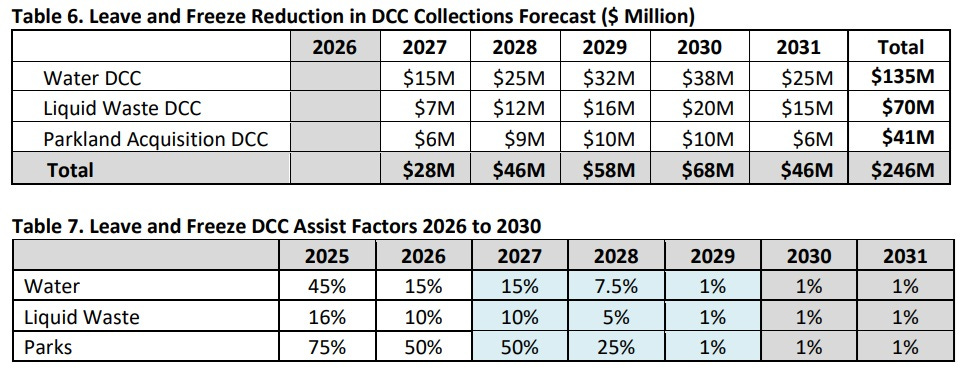
Under the second option, 2026 DCC rates would be kept as they currently are and the DCC rates would be frozen and remain the same in 2027. In this scenario, the assist factor would also be reduced to 1% beginning in 2029.
With this option, the MVRD forecasts a reduction of $246 million in DCC revenue, split between $135 million less in Water DCCs, $70 million less in Liquid Waste DCCs, and $41 million less in Parkland Acquisition DCCs.
According to staff, the rollback of 2026 DCC rates as part of Option A would come into effect immediately upon adoption of the DCC bylaw amendment, which could be as soon as June or July — after approval is received by the provincial Inspector of Municipalities — and there would be no refunds or retroactive rates for 2026.
Although staff did not make a formal recommendation on the two options, they seem to favour Option B as they note that the Metro Vancouver Board has an approved 2026 Budget and that local municipalities have set utility rates based on that budget.
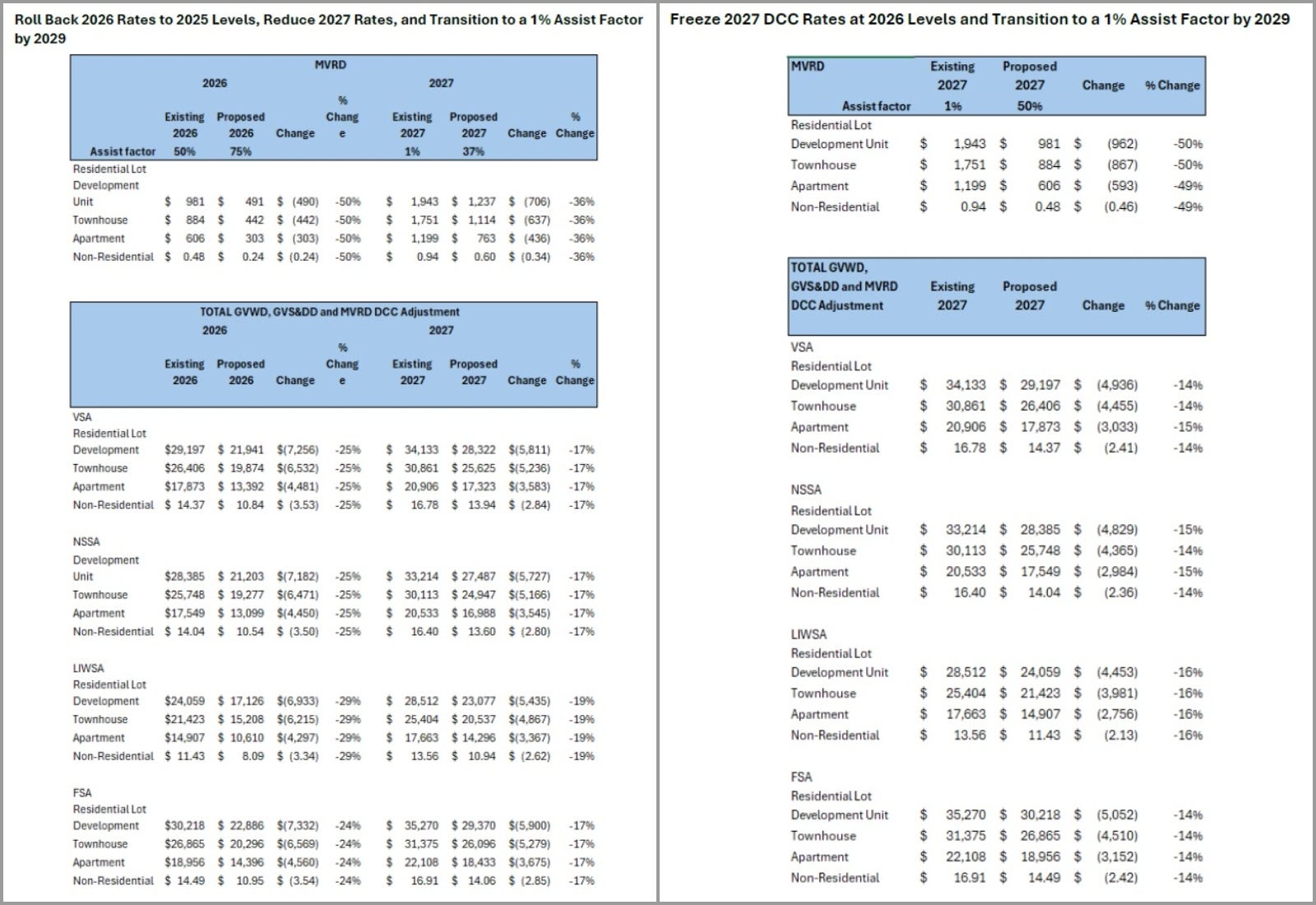 2026 and 2027 DCC rates under Option A (left) and Option B (right).
The flip-side of the DCC issue is how Metro Vancouver will make up for the large reduction in DCC revenue.
The numbers would be different, but staff have outlined the same three options to address the resulting funding gap, regardless of which DCC reduction plan is adopted:
Transfer the projected revenue shortfall to the Household Impact for 2027 to 2031.
Increase the amount of long-term borrowing for growth capital projects for Water and Liquid Waste, and Defer or Utilize Reserves for Parkland acquisition.
Defer additional growth-related projects in the Capital Program for Water and Liquid Waste, and Defer or Utilize Reserves for Parkland acquisition.
“Each option involves trade-offs,” said staff. “Option [1] transfers the cost to existing ratepayers, but supports the development community in advancing new housing in the region. Option [2] results in higher debt servicing and interest costs for Metro Vancouver, and Option [3] increases the organization’s risk profile by deferring additional capital infrastructure projects and deferring park acquisition. Staff do not recommend further Capital Project deferrals.”
Left unsaid in the report, however, is the recent announcement between the Governments of Canada and Ontario, which said on March 30 that they will “cost-match a total of $8.8 billion over 10 years, focused on housing-enabling infrastructure projects” that will support reductions in development charges by up to 50%.
The Urban Development Institute and real estate industry at large in BC have called on the various levels of government to secure such an agreement for BC as well. News of the Ontario agreement broke just ahead of the Vancouver Real Estate Forum on March 31 and April 1, where several speakers alluded to an agreement for BC as currently under negotiation. (Note that in the above rate charts, the Metro Vancouver DCC rates are being reduced by up to 50%.)
Metro Vancouver will be holding a special board meeting on Wednesday, April 15 to discuss the report.