
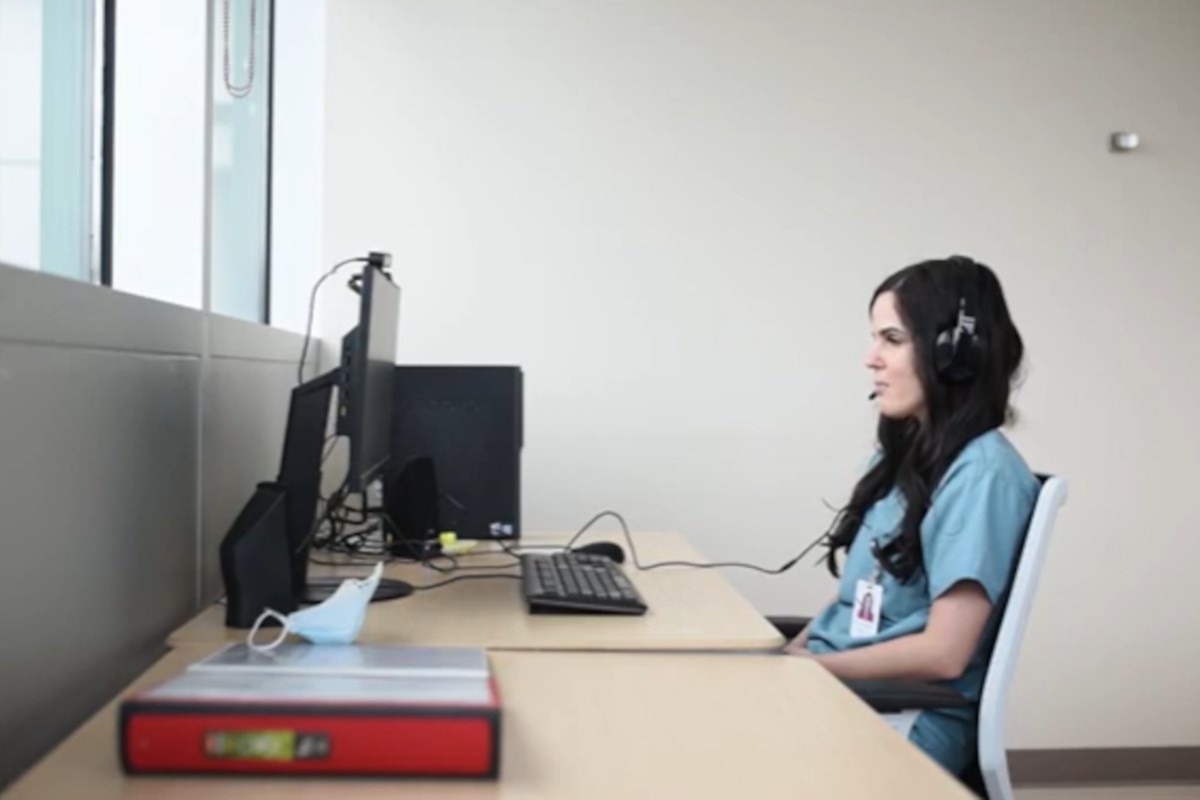
The virtual emergency department in place at Health Sciences North during the heart of the COVID-19 pandemic was described by staff as ‘invaluable,’ but still ended in 2021
Patients loved the COVID-era virtual emergency department at Health Sciences North, with staff reporting “amazing positive feedback” midway through the pilot program in 2021.
More recently, Sault Area Hospital has been using a virtual home waiting room for their emergency department, which management has deemed a success worth expanding.
HSN currently offers neither such option.
In December 2025, Sudbury.com began working on a story about the Sault Area Hospital success with a virtual waiting room and whether such a system could work at Health Sciences North.
That story referenced a 2020-2021 virtual emergency room pilot project that ran at HSN. Sudbury.com’s attempt to gather information about the local pilot project took several months and required a freedom of information request to accomplish.
Why did HSN’s COVID-era virtual emergency department end?
During the heart of the COVID-19 pandemic, HSN was one of 14 jurisdictions in Ontario to receive a share of $4 million in provincial funding for a virtual urgent care pilot program.
(The province called this program “virtual urgent care,” while HSN has called the pilot a “virtual emergency department,” but an HSN representative clarified that these two names reference the same program.)
The program offered patients an at-home option in lieu of emergency department visits for non-life-threatening medical care and was open to 32 patients per day.
(HSN produced a video to promote the program, available by clicking here.)
The program ended in 2021, as HSN Emergency Department medical director Dr. Jeffrey Middaugh explained to Sudbury.com this week, “We did not pursue further funding because we didn’t see that there was a need or benefit.”
The glowing staff review, which Sudbury.com received through a freedom of information request, was written to the province by HSN’s nurse management team mid-pilot program, Middaugh said.
In this report, the team called the program an “invaluable service to our population.”
“We just cannot express enough how amazing the positive feedback has been,” the report said.
“When 100 per cent of your feedback is positive, you’re doing something right! We would be very interested in continuing this initiative as we feel it provides an invaluable service to our population.”
Fair, Middaugh said, “everyone was satisfied with the service.”
However, the public liking a program doesn’t necessarily mean it’s the best use of resources.
Although HSN’s initial report to provincial officials urged the province to continue funding the virtual emergency department, Middaugh said the ultimate staff recommendation after “engaging all the stakeholders” was for the program to end.
HSN had neither the staff nor the patient volumes to sustain it, he said, adding that although positive public feedback factored into their recommendation, “at the same time, if you don’t have people to staff it in the moment, that consideration is dropped.”
Further to this point, he said the best use of emergency department physicians is delivering care to people who need to be seen in-person, and there are various other virtual care options available throughout Ontario.
The virtual emergency department option pulled emergency department staff away from the critical work their time is better spent dealing with, Middaugh said.
This point is echoed in a Canadian Journal of Emergency Medicine article Middaugh cited, which questioned “if virtual urgent care can be safely and more economically provided by non-emergency physicians.”
The journal article was also included by HSN staff as part of their response to Sudbury.com’s freedom of information request. It follows up on 14 emergency department-led virtual urgent care pilot sites in Ontario from December 2020 to September 2021, during which there were a total of 22,278 virtual visits. The pilot programs were funded by an up to $4-million injection by the Ministry of Health as part of their COVID-19 response.
Among all 14 sites, 47 per cent of visits were by patients who had a primary care provider and couldn’t access their family physician in a timely fashion, and 69 per cent said they would have gone to the emergency department if the virtual option were not available. As such, the journal article notes, the program was used by some to receive “expedited advice” as opposed to “emergency care.”
The journal article also notes the “overall impact on emergency department volumes was not significant,” and “future work should focus on health equity to ensure virtual care is accessible to equity-deserving and vulnerable groups.”
On this front, Middaugh said equity is front and centre in any discussions at HSN regarding the implementation of technology.
This, he said, is “sometimes challenging … because technology is not necessarily universally equitable. We want to make sure that when we do utilize these technological advances that we have considered all our patient populations and we are delivering care that is for everyone.”
Sault Area Hospital’s successful virtual home waiting room
The Sault Area Hospital’s virtual home waiting room appears to be a success, prompting the hospital to explore a way to make the program permanent.
The virtual home waiting room is available for those experiencing a list of eligible non-urgent medical complaints, as outlined on the Sault Area Hospital website available by clicking here.
By registering online, patients can wait from a location of their choosing until they’re summoned to the hospital to complete the tail end of their wait.
The pilot program began in August 2025, since which time almost 1,000 patients have used the virtual home waiting room, averaging between 10 and 20 patients per day.
“The program was intentionally rolled out gradually to ensure demand could be managed safely and effectively, and it is designed to be scalable to accommodate more patients as needed,” a Sault Area Hospital spokesperson said in a written response to Sudbury.com.
“By allowing eligible patients to wait at home, the virtual home waiting room helps reduce crowding in the emergency department and improves workflow for staff. Nurses and physicians report less stress and more control over patient flow, allowing patients to be seen more efficiently. Reducing the number of patients physically waiting in the emergency department also supports infection prevention by limiting unnecessary exposure to contagious illnesses. Overall, it has helped smooth demand and reduce delays for non-urgent cases.”
The 90th percentile of patients (time by which 90 per cent of patients are seen) who used the virtual home waiting room took 3.1 hours for a physician initial assessment compared to 6.5 hours among those who went straight to the emergency department. Similarly, length of stay among virtual home waiting room patients was 4.9 hours compared to 10.2 hours among those who went directly to the hospital.
Further, 5.6 per cent of virtual home waiting room patients left without being seen compared to 13 per cent of those who arrived directly to the emergency department.
“Based on these outcomes, the hospital is exploring making the program permanent and working with community health-care partners to expand it to include community walk-ins and family practice settings,” Sault Area Hospital’s communications staff wrote.
“This would allow patients to use a single system, with demand spread across multiple health-care services, not just at Sault Area Hospital, improving timely access to care, reducing emergency department overcrowding, and supporting more efficient use of health-care resources across the region.”
Virtual home waiting room potential at HSN?
“We are currently and always looking at new, innovative ways to ensure patient care is timely, equitable and accessible,” Middaugh said. “There are definitely multiple technological advances that are coming out and we’re seeing being utilized in multiple emergency departments across the province and Canada, and we are constantly reviewing those.”
The virtual home waiting room at Sault Area Hospital is one of these technologies, he said.
That clarified, Middaugh said Sault Area Hospital underwent an electronic medical records system upgrade approximately five years ahead of HSN.
The HSN information technology upgrade was put into place approximately two years ago, and Middaugh said they “need to ensure the system is operating in a stabilized and optimized fashion before we start adding in more information systems, which would include, perhaps, a virtual waiting room.”
Although Sault Area Hospital is smaller than HSN, Middaugh said “there are still a lot of lessons to be learned” from their virtual home waiting room experience.
“There’s clearly a process that goes along with that, from ensuring we have the appropriate information technology resources, the financial resources, the human-health resources,” he said.
Why did this article take more than three months to compile?
Sudbury.com’s attempts to nail down this story is a bit of a long strange trip.
Sudbury.com first reached out to HSN communications staff to inquire about virtual emergency department options on Dec. 22, at which time spokesperson Arron Pickard said they’d “revisit” the inquiry in the new year.
Sudbury.com sought to speak with a representative at HSN regarding the possibilities and potential for a local virtual waiting room similar to Sault Area Hospital’s. However, HSN communications director Jason Turnbull denied our interview request in early January, at which time he also refused to answer various questions sent by email.
In explaining why the request was denied, Turnbull provided two reasons. He said he wouldn’t grant an interview regarding another hospital’s efforts (Sault Area Hospital’s virtual wait room). He also said HSN couldn’t “accommodate” an interview on a five-year-old COVID-era pilot program. Turnbull also told Sudbury.com in an email that an interview could not be granted at that time due to “high demand on our clinical teams.”
Among Sudbury.com’s requests from HSN in early January was a report highlighting the results of the hospital’s virtual emergency department pilot project. Turnbull denied such a report existed.
“Contrary to what you’re suggesting, there is no ‘report’ on the virtual ED,” Turnbull stated. “We are not denying access to something that doesn’t exist. The pilot concluded as it was clear more people wanted to be seen in-person in the emergency department during the pandemic. As we communicated to you, and to other media who seemed OK with our response, we are reviewing the virtual waiting room approach by the Sault.”
In January, Sudbury.com decided to file a freedom of information request anyway seeking any report or reports about the 2020-2021 local virtual pilot program. In mid-March, Sudbury.com’s FOI actually bore fruit.
A response to the freedom of information request from HSN dated March 18 (but received March 30) yielded two reports which fit the description of a virtual emergency department pilot project review. These include an HSN report to the province titled “Virtual Urgent Care Lessons Learned and Sustainability Reporting Template” and a Canadian Journal of Emergency Medicine article which highlighted the results of 14 virtual urgent care efforts set up throughout the province during the pandemic, including the HSN effort.
Since these reports highlighted the results of a “virtual urgent care” pilot project and not the “virtual emergency department” pilot project Turnbull cited in correspondence with Sudbury.com, Turnbull was asked on March 30 whether these programs were one and the same.
It took eight days, two follow-up emails and a phone conversation, but Turnbull affirmed that these programs are, in fact, referencing the same thing.
It was after that, on April 7, that Turnbull offered Sudbury.com an interview with an HSN administrator regarding virtual emergency department options, an interview, it should be noted, he had repeatedly denied in the past. This interview, with HSN Emergency Department medical director Dr. Jeffrey Middaugh, took place on April 9.
Meanwhile, Sudbury.com sent Ministry of Health communications staff an inquiry on April 7 requesting a phone interview regarding virtual emergency department options. As of the time of publication, ministry staff had acknowledged receipt of the inquiry but had not responded in a meaningful manner. This story will be updated in the event they respond.
Under the Ford government, ministry staff routinely ignore interview requests in lieu of written statements which rarely answer all of the questions sent to them, when they respond at all.
Tyler Clarke covers city hall and political affairs for Sudbury.com.