
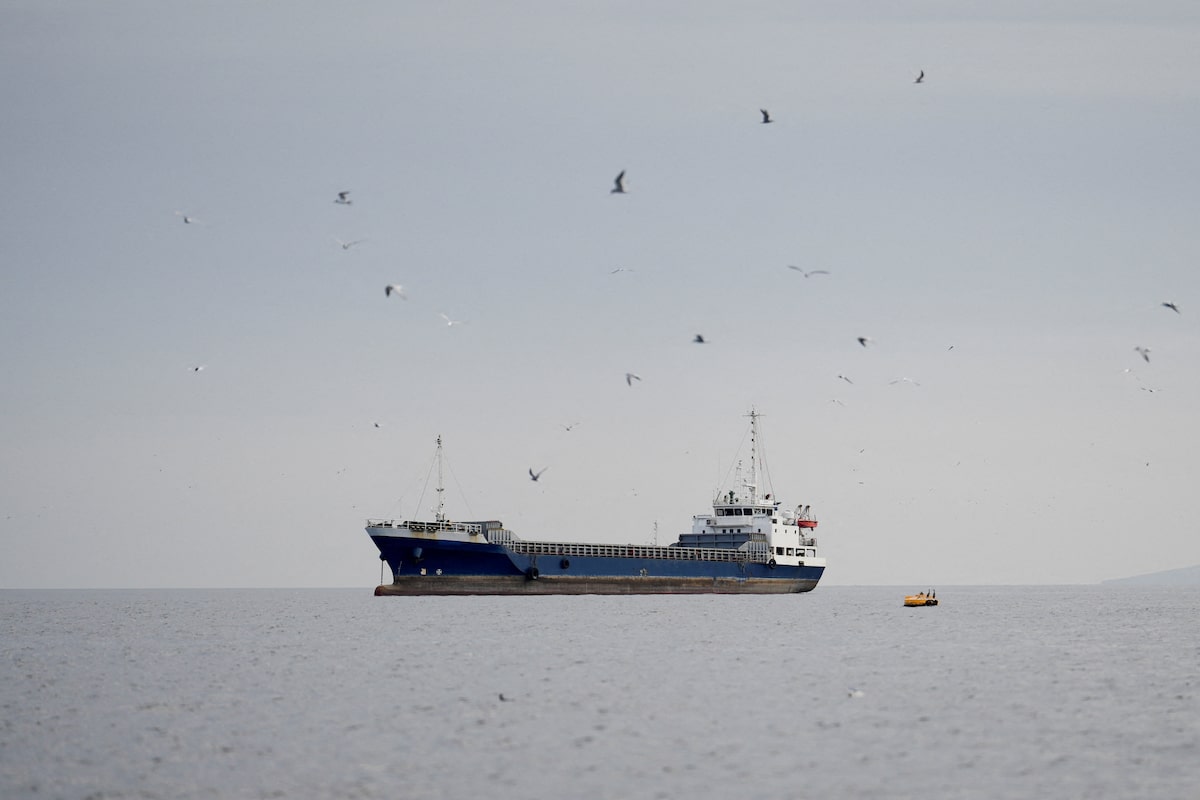
A vessel at the Strait of Hormuz, off the coast of Oman’s Musandam province, on Sunday.Stringer/Reuters
Oil prices surged above US$100 a barrel after U.S. President Donald Trump declared the United States will blockade the Strait of Hormuz, as peace talks failed to yield an agreement to end the six-week conflict that caused severe fuel shortages.
Officials from the U.S. and Iran walked away from their negotiations in Pakistan early Sunday without coming to terms that would bring an end to the war that began on Feb. 28 and has rattled global energy markets.
International benchmark Brent crude was up 8 per cent at US$102.80 a barrel after Asian markets opened. West Texas Intermediate gained nearly 9 per cent to US$104.97.
Prices have risen by as much as 70 per cent since the attacks by the U.S. and Israel began, as Iran has responded by targeting petroleum production in other countries in the region and closing the waterway off its coast that bears one-quarter of the world’s seaborne oil.
Opinion: Trump has broken something, and the prewar economy may never return
Mr. Trump said on social media on Sunday that the U.S. Navy will block the key trade route, intercept ships that have paid a toll to Iran and conduct demining operations.
“Effective immediately, the United States Navy, the Finest in the World, will begin the process of BLOCKADING any and all Ships trying to enter, or leave, the Strait of Hormuz,” Mr. Trump said. “Any Iranian who fires at us, or at peaceful vessels, will be BLOWN TO HELL!”
Iran’s leaders were defiant and gave no signs they would cede control of the strait. Senior Iranian official Ali Akbar Velayati said on social media that the strait is “firmly in our hands.”
The failed negotiations have heightened the risk that the oil shock will drag on. The war and its impact on the key waterway have driven oil prices to four-year highs at times over the past six weeks.
“The market is already not pricing in the supply loss that’s already occurred, let alone the upside risk, so I think we’re going to open steeply higher,” said Rory Johnston, oil market analyst at Toronto-based Commodity Context.
Does the war in Iran signal a structural shift for energy markets?
Iran appeared to have achieved two outcomes: closing the strait to most oil exports, while at the same time continuing to ship its own crude. “Blockading the strait now is trying to reconcile that innate oddity, that Iran has continued to profit – and I think excess profit – from the war, because crude is that much more valuable,” Mr. Johnston said.
The near halt in tanker traffic has led to severe energy shortages in countries that rely on Persian Gulf supply, primarily in Asia. Meanwhile, production in the Persian Gulf states has dwindled amid a combination of shut-in wells and Iranian missile and drone attacks on energy infrastructure.
More than 600 ships were stuck in the region on Friday, according to Lloyd’s List, including 154 laden with oil. On Sunday, a small number of tankers and bulk commodity ships appeared to be moving through the strait, the marine tracking website Vesselfinder.com showed.
Last week, crude jumped to near US$120 a barrel after Mr. Trump threatened to annihilate Iran’s power plants and civilian infrastructure and even destroy its entire civilization if Iran did not allow ships to pass through the strait. Less than two hours before Mr. Trump’s stated deadline, he announced a two-week ceasefire, which seemed to be the beginning of a deal to end the war.
Opinion: Iran won. Almost everyone else lost
Basil Karatzas, of New York-based shipping consultancy Karatzas Marine Advisors, said Mr. Trump’s statement on Sunday heightens the unpredictability over how and when vessel traffic will resume. Meanwhile, the global economy is suffering from higher oil and gas prices as an energy crisis looms.
“There was a lot of uncertainty before. Now it is dialled all the way up,” Mr. Karatzas said. “It’s against the interest of everybody, including the U.S.”
Meanwhile, economic risks are growing as crude oil shipments remain stranded, research house Wood Mackenzie said.
“If a resolution to the war proves unachievable, we expect Brent to trade upwards again, with higher prices and demand destruction ultimately balancing the market,” WoodMac said in a report on Friday. “This would have significant ramifications for the global economy.”
A 2026 Brent crude price average of US$90 a barrel would limit global gross domestic product growth to less than 2 per cent, it said, compared with a prewar estimate of 2.5 per cent. It would also push the European Union and United States into recession. At US$100 a barrel, global GDP growth would fall to 1.7 per cent, and US$200 Brent would cause the world economy to shrink by 0.5 per cent, WoodMac said.