
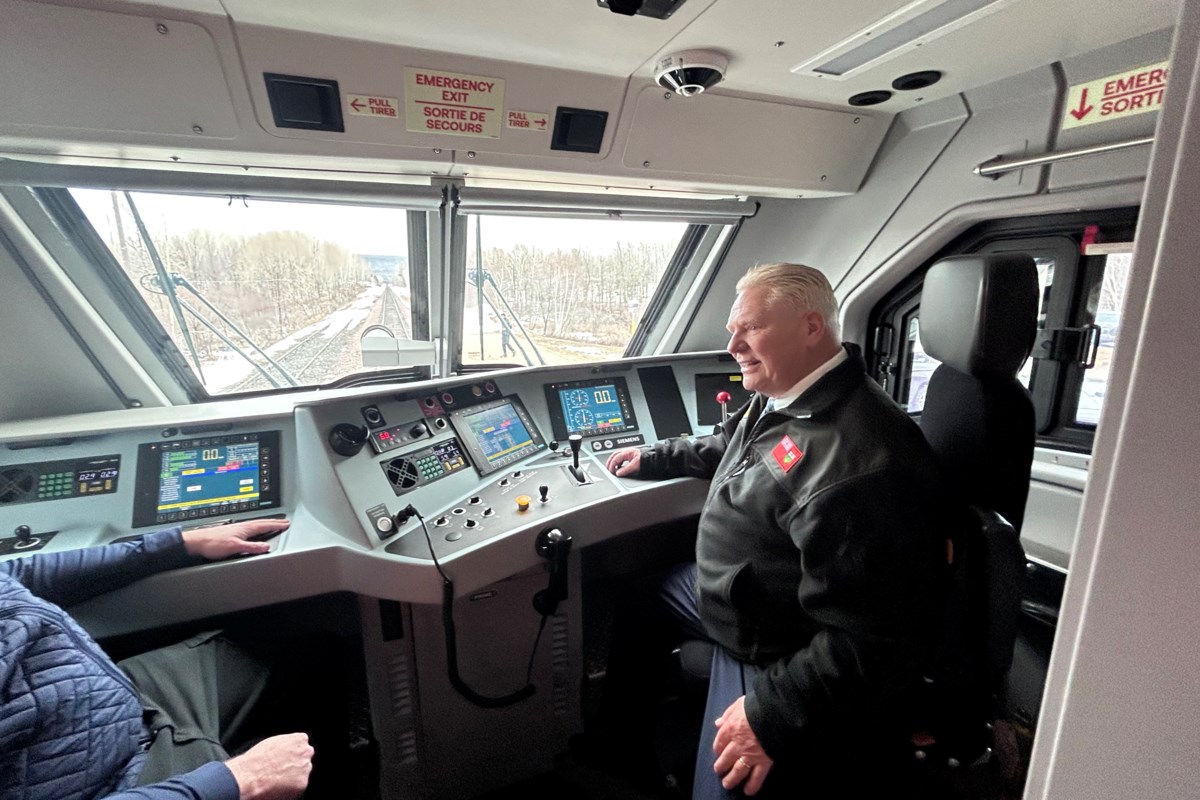
The new service is promising 169 seats per set, wide aisles, accessible washrooms, charging ports, and business-class seating pods for virtual meetings
It was a show-and-tell opportunity for the Ford government to display the first train set of the revitalized Northlander service in North Bay earlier this week.
In a combination photo-op and progress report on the restoration of the iconic passenger service, the first of three Siemens Venture train sets, operated by the Ontario Northland Transportation Commission (ONTC), was on display for a media walk-though on Thursday.
“This is the best announcement the North has ever seen since I’ve been elected,” said Premier Doug Ford at the news conference at the headquarters of the ONTC.
This first train set has been making test runs the length of the 740-kilometre north-south corridor; recently the train rumbled through our area.
The news conference marked another milestone in the landmark return of the service since its cancellation by a previous provincial government in 2012.
The return of the Northlander has been championed for eight years by Nipissing MPP Vic Fedeli, the province’s economic development, job creation and trade minister.
“As you can see, the Northlander is here folks,” said Fedeli, the former mayor of North Bay, in gesturing to the blue-and-yellow colour-schemed locomotive and coaches behind him.
Fedeli spoke glowingly about restoring a “crucial transportation link” to the region with modernized amenities for passengers in seating and accessibility.
The new service is promising 169 seats per set, wide aisles, accessible washrooms, charging ports, and business-class seating pods for virtual meetings.
With 16 stops along the Cochrane/Timmins-to-Toronto route, Ford said the onus is on customers to demonstrate to the province and the ONTC “that they want this train.”
Earlier news conferences suggested a late 2026 start date, but Ontario Northland CEO Chad Evans placed no timelines on a service launch.
The first train set has reached substantial completion of its ‘burn-in’ testing phase, which will be followed by a revenue service demonstration phase. On-board staff will begin training to familiarize themselves with the systems and stops along the entire length of the corridor.
Evans said a second train set has arrived in Toronto for “static testing,” which could take weeks. A third train set is to follow.
Once all the train sets reach completion of testing, a start date of service will be announced, he said.
“We won’t announce that start date until we are confident that we can operate and safe, accessible service throughout the North.”
Evans pushed backed against a reporter’s comment that the Northlander schedule may not be workable for some residents in the region.
The schedule calls for southbound departures, originating in Cochrane, to leave the station at 10:15 p.m. for arrival in Toronto’s Union Station just before 11 a.m. the next day.
As part of the business case, Evans said the schedule was formulated after Ontario Northland staff conducted extensive community consultations.
The “overwhelming” response from prospective riders, he said, was that the train arrive in Toronto in the mornings in order to make medical appointments, business meetings, and attend sporting events.
Evans said it’s not usual for Northerners to depart in the early hours of the morning to reach destinations in southern Ontario.
“We’re happy to offer a service that meets the needs of what we heard when we did that consultation, and we’ll continue to listen to people as we roll out the service.”
Tickets are not yet for sale, but estimates of fares were unveiled earlier this week. Evans said the fares are competitively priced at 10 per cent more than a comparative bus ticket.
There are discounts for students, seniors, military personnel and those travelling to medical appointments.
“I think it’s affordable,” Evan said. “We heard from the start of those consultations … that people wanted an affordable ticket.”