
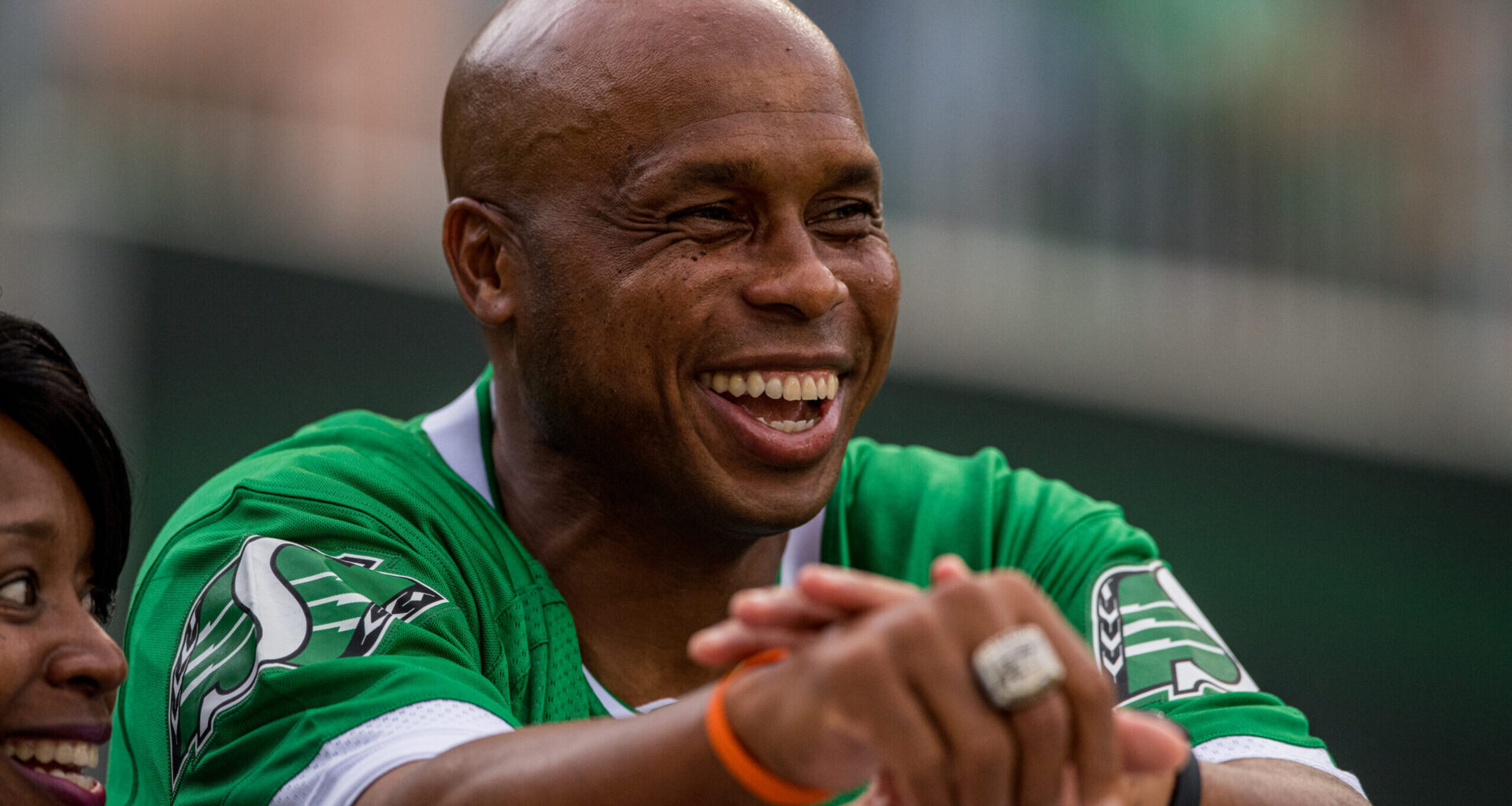
Twenty years ago this past Sunday, the Saskatchewan Roughriders completed a blockbuster trade from which the team derives enduring benefits. Then-GM Roy Shivers acquired two future Grey Cup-winning quarterbacks — Kerry Joseph and Darian Durant — in one deal on April 12, 2006. Success on the field, spearheaded in so many ways by Joseph and Durant, was the catalyst for franchise-record profits and, ultimately, a new stadium. Our three-part retrospective began on Sunday with a 20th-anniversary focus on the trade. Today, the emphasis shifts to a 2007 season that changed everything. The series concludes on Tuesday with Durant’s reflections on the early part of what became a legendary career.
Wearing helmets instead of hard hats, Kerry Joseph and Darian Durant helped to build an ultra-modern Mosaic Stadium.
Both of them excelled at quarterback for the Saskatchewan Roughriders during a transformative period in team history — a stretch in which the Green and White celebrated CFL supremacy, record profits and, ultimately, approval of a venue that was utterly unthinkable on April 12, 2006.
On that day — 20 years ago this past Sunday — Joseph and Durant became Roughriders in a trade that was impactful for reasons extending far beyond victories and touchdowns.
In one grand transaction, then-General Manager and Director of Football Operations Roy Shivers solidified a foundation for everything we see and savour today.
“We had the fans in a frenzy,” Durant reflected. “They loved us.
“We would go all over the province. We were sold out every game. We were at every autograph signing. We did everything we could to make sure there were 30,000 people in Taylor Field every week.”
Shivers, ironically, was not with the organization by the time the dividends from the trade were fully realized. He was dismissed near the midpoint of the 2006 season, 12 months before Rider Nation celebrated an elevation that, in many ways, was without precedent.
After three consecutive 9-9 seasons, the Roughriders of 2007 enjoyed a 7-2 start. The sixth and seventh victories, in back-to-back home games, were classics. Those contests, witnessed by the team’s first two capacity crowds of the season, were trendsetting.
Beginning on Aug. 18, 2007, the Roughriders sold out 17 consecutive regular-season or playoff games at historic Mosaic Stadium.
Moreover, the team played before sellout crowds 40 times in a span of 48 games.
On the morning of the 48th game — against the B.C. Lions on July 14, 2012 — it was announced that a new 33,000-seat stadium would be built on the grounds of what is now known as REAL District, a few blocks away from the Roughriders’ traditional turf.
Such was the culmination of a process that began in the summer of 2007, when Roughriders tickets suddenly became scarce.
“There’s no doubt that (the 2007 season) was a critical piece in how we were successful in getting the new stadium,” said Roger Brandvold, who joined the Roughriders’ Board of Directors in 2005 and was named the Chair five years later.
Joseph enjoyed his finest CFL season in 2007, receiving the league’s Most Outstanding Player award three days before quarterbacking Saskatchewan to a 23-19 Grey Cup victory over the Winnipeg Blue Bombers.
The shocking trade of Joseph on March 5, 2008 eventually opened the door for Durant, who was the Roughriders’ starting signal-caller in the 2009, 2010 and 2013 Grey Cup Games.
Three Grey Cup appearances in four seasons.
Four West Division championships — and two Grey Cup wins — in a seven-season span.
Franchise-record profits.
And a brand-new home.
Joseph and Durant were pivotal players in that era — not the only ones by any means, but among the most prominent.
“I think about those two gentlemen in the sense that their leadership stuck out,” Brandvold reflected. “They really led on the football field.
“We always talked in the boardroom about, ‘How can we take away obstacles to success for the football team? What’s stopping a player from wanting to play in Saskatchewan?’
“That really helped us have this conversation around a new stadium — or at least about upgrading old Mosaic so that it had a better locker room and facilities for the players.”
The latter scenario was in tune with a blueprint that was unveiled on Dec. 2, 2004, just six weeks after Jim Hopson was introduced as the community-owned team’s first paid President-CEO. Previously, the buck had stopped with the Board Chair, who served on a volunteer basis.
Hopson assumed the new and, in many ways, overdue role on Jan. 1, 2005, when much of the chatter concerned the feasibility of a reimagined Taylor Field.
At an early-December media conference in 2004, the Roughriders had unveiled an ambitious plan that was to cost $12 million over eight years.
With the objective of staging the 2012 Grey Cup Festival, the team targeted stadium expansion and enhancement.
Ideally, the number of permanent seats would increase to at least 32,000 — and perhaps as many as 35,000 — from 27,732.
A two-storey structure, overlooking the south end zone, would include the community-owned team’s offices, an expanded Rider Store, and a substantially improved Green and White Lounge.
Upgrades were also to be made to the Roughriders’ locker room, weight room and meeting rooms.
The sound system was to improve, as was the stadium’s east side in general.
Newer, less-abrasive artificial turf was another part of the package.
So was a video board — the SaskTel MaxTron — which was installed and operational in time for the 2005 regular-season home opener.
And, yes, there were plans for a dome!
There was talk of a retractable bubble that would cover the playing surface during the winter and enable the City of Regina-owned facility to be used by various community groups.
Those were the parameters within which the team was operating as the calendar turned from 2004 to 2005 to 2006.
Then came April 12, 2006.
For starters, Shivers made a deal with the Hamilton Tiger-Cats to obtain the first overall selection in a dispersal draft consisting of veterans from the suddenly defunct Ottawa Renegades.
Principal among them was Joseph, who had thrown for 4,466 yards and rushed for another 1,006 during what turned out to be the Renegades’ farewell season.
Just like that, Joseph was a Roughrider.
Another element to the deal — a seeming afterthought at the time — was an exchange of negotiation-list quarterbacks. Saskatchewan obtained the rights to Durant in return for those of Reggie Ball.
That was, in hindsight, one step toward taking a wrecking ball to a dear, but deteriorating, stadium that had been the Roughriders’ full-time home since 1936.
Nobody perceived it that way at the time.
In 2006, the average attendance actually decreased — to 25,293, from 25,566 in 2005.
There were three sellouts in 2006 at the newly renamed Mosaic Stadium … but two of them were for Rolling Stones concerts.
The Roughriders were again in the 25,000s to kick off their 2007 home schedule. After drawing 25,862 customers, Saskatchewan played before gatherings of 26,981 and 26,840.
Good, but not great.
However, the attendance count of 26,840 was announced during a July 28, 2007 game in which Saskatchewan eviscerated Edmonton 54-14.
Joseph rushed for two touchdowns and produced two other majors through the air as the Roughriders ignited a five-game winning streak and, well, EVERYTHING.
Edmonton was the opponent in back-to-back home games in the summer of 2007.
Part 2 of Saskatchewan versus Edmonton was delayed 59 minutes by a fourth-quarter thunderstorm that led to a power outage.
The game was suspended at 10:32 p.m. Three minutes later, there was darkness. It didn’t help that the stadium’s backup generator would not function. (Mick Jagger’s rallying cry — “Start Me Up” — fell on deaf ears.)
Play resumed near midnight, with the Roughriders trailing 32-27, and Edmonton’s lead went down the drain.
“When we think about the rainstorm, we think about the fans,” Joseph recalled. “We were in the locker room underneath the stands and you could hear the fans who stuck around through that storm starting to chant and stomp.
“And then there was the momentum switch, when we came out and won that football game.”
Saskatchewan responded with 12 unanswered points, six of which resulted from a touchdown run by Joseph. The fans who stuck around to the end were rewarded by seeing their team sport a 6-2 record for the first time since 1976.
Following a bye week, Saskatchewan played host to Winnipeg in the Labour Day Classic.
It more than lived up to the label.
With six seconds remaining in the fourth quarter, Joseph crossed the goal line to complete a 27-yard TD run. Saskatchewan won, 31-26, in what turned out to be a Grey Cup preview.
From that point forward, there was an insatiable appetite for all things Roughriders.
“Everything was gelling,” Brandvold remembered. “There was this groundswell of fans saying, ‘I need to get a ticket. I need to find out what is really happening here.’
“Then they’d get out to a game and realize, ‘Man, this is a lot of fun! It’s exciting and there are good people around me, et cetera, and I want to be a part of this.’
“And then there was our merchandise. It just flew off the shelves. I’d be watching a guy wearing what was probably a $125 jersey, all labelled up, walking into the Rider Store and buying another one. It was like, ‘They may never get these on the shelf again for a while, so I’d better get another one.’
“Everything was coming together.”
On the field and as a business.
After announcing a deficit of $130,000 on its 2001 operations, the team produced six-figure profits in four of the next five years.
The $689,608 surplus from the 2003 season was enhanced by a $2,000,205 windfall resulting from that year’s Saskatchewan-based Grey Cup Festival.
The team proceeded to lose money in 2004 ($178,531) before returning to the black in 2005 ($243,391) and announcing another profit in 2006 ($350,601).
Another key development in 2006 was the Lorne Calvert-led provincial government’s forgiveness of a $2.8-million loan.
Then came 2007 and the Roughriders’ first of eight successive seven-figure surpluses:
2007: $1,737,377.
2008: $1,628,607.
2009: $3,148,500.
2010: $6,600,000.
2011: $4,516,321.
2012: $1,128,833.
2013: $1,136,218.
2014: $2,202,831.
It gets better. The 2013 figure did not include the Roughriders’ share of profits from the 2013 Grey Cup Festival: $9,285,145!
On top of that, construction of the new stadium — which officially opened in 2017 — was nicely underway.
“The dynamite stick had been lit in ’07 and we realized, ‘We’d better get our heads together and figure out something bigger and better,’ ” said Brandvold, a 2017 SaskTel Plaza of Honour inductee.
“There were lots of great ideas. There was lots of heavy discussion. It just required that continuous momentum. In ’07, we proved we could do it. As we got through ’10 and ’11 and into ’12, we could prove that it was consistent and that it wasn’t a flash in the pan. The fans were going to continue to show up.
“You also have to have all the right partners, like a Brad Wall, who’s prepared to grow his community, and a Mayor (Pat) Fiacco, who wants to commit and make the city of Regina better and the province of Saskatchewan a better place for everyone to live and enjoy.”
Wall and Fiacco were at the forefront on July 14, 2012, when the Province of Saskatchewan, the City of Regina and the Roughriders signed a Memorandum of Understanding that would facilitate construction of a $278-million, 33,350-seat open-air stadium. (There had been contemplation of a domed facility, but the projected costs were prohibitive.)
Brandvold was the Roughriders’ Chair at the time of the announcement. Also conspicuous was Hopson, whose influence on the Roughriders from a business standpoint rivalled the impact of Joseph and Durant on the field.
“Having a full-time CEO, giving the team the leadership on the business side, combined with the success on the field really jump-started that capability of, ‘Let’s sell out Mosaic,’ ” Brandvold reflected.
“We moved away from being football-player-centric (marketing-wise) to being fan-centric. I think that strategy was brilliant. We also got sponsorships onside, led by Steve Mazurak.
“We had this leadership model developing within the organization. Whether you were in business or whether you were on the field, we started to excel in strong leadership and therefore bringing people along in the organization … and bringing fans along.
“I think it all started, for sure, with people like Kerry Joseph, but it was combining with other strategies that we had put in place, such as (hiring) Jim.”
Hopson served as President-CEO for a decade before stepping down in 2015 and being succeeded by Craig Reynolds — under whose effective leadership the Roughriders won a Grey Cup last November.
A series of induction ceremonies ensured that, even in retirement, Hopson would still be in demand. He was enshrined in the Plaza of Honour (2018), Canadian Football Hall of Fame (2019) and Regina Sports Hall of Fame (2022), to name just three of the many testaments to his contributions.
Following a lengthy battle with colon cancer, Hopson passed away on April 2, 2024. Just 47 days earlier, he had been taken by surprise during a visit to Mosaic Stadium.
Seated beside his wife, Brenda, Hopson was overjoyed to discover that the facility’s Football Operations Auditorium had been named in his honour.
A plaque outside “The Hoppy,” as it is now known, reads in part: “During Jim’s tenure as the Club’s first full-time President and CEO, the Roughriders appeared in four Grey Cup Games — winning championships in 2007 and 2013 — and established benchmarks for excellence on and off the field As well, he was a key driver in the process that culminated in the official opening of this world-class facility in 2017.”
Durant was able to play in it — just once.
Traded to Montreal on Jan. 13, 2017, he started for the Alouettes at new Mosaic Stadium on Sept. 29, 2017.
“I can see the good and bad from that,” the legendary quarterback reflected. “I’m glad I was able to play in it, for sure, but I hate that I wasn’t able to play in it wearing the green and white.
“My only wish is that I would have been able to be in that locker room for one year.”
That state-of-the-art locker room, mind you, might not exist without the efforts of Durant and his teammates during a pivotal period in Roughriders history.
“It’s just crazy to see, because when I came to Saskatchewan in ’06, I used to hear about the telethons and the debt the team had been in,” Durant said.
“To go from that, I have to be thankful for the guys who came in with me — guys like Andy Fantuz — and having Jeremy O’Day there, having Geno (Makowsky) there, having Chris Szarka and Neal Hughes and Luc Mullinder there.
“The guys who were there … I think we built that, right?”