
A team of Japanese scientists has developed a high-resolution X-ray telescope capable of detecting an object just 3.5 mm wide from a distance of one kilometer. Tested using a unique ground-based system that simulates starlight.
The project brings together researchers from Nagoya University and the SPring-8 synchrotron facility, combining expertise in astronomy and precision engineering. Their findings, reported in Publications of the Astronomical Society of the Pacific, highlight both a technical achievement and a new direction for smaller, high-performance instruments.
Observing the universe in X-rays remains key to understanding extreme cosmic environments. As stated by the researchers, events such as solar flares, stellar explosions, and matter near black holes emit intense X-ray radiation that carries critical physical information.
A Mirror Built With Nanometer Accuracy
The heart of the telescope lies in its mirror, a component that must meet unusually strict requirements. X-rays do not behave like visible light and can only be reflected at very shallow angles. This requires surfaces shaped with nanometer-level precision.
To meet this challenge, the team used a precision electroforming method developed at SPring-8. As reported by the study published in Publications of the Astronomical Society of the Pacific, they produced a nickel mirror measuring60 mm in diameter and 200 mm in height.
This mirror differs from conventional designs in one key aspect. It is a single seamless shell. Without joints or seams, there are fewer opportunities for misalignment or deformation. As Ikuyuki Mitsuishi, the project leader at Nagoya University’s Graduate School of Science explained:
” The mirror is like a very precise funnel for X-rays. If any part of the funnel is even slightly out of place, the X-rays miss their target and the image blurs.” He added, “It must also survive the intense vibrations of a sounding rocket launch while retaining its optical precision.”
Recreating Starlight in the Lab
Before sending the telescope into space, researchers needed to verify its performance under realistic conditions. This posed a fundamental difficulty, since starlight reaches Earth as nearly parallel rays due to the vast distances involved.
To replicate this, the team designed a dedicated testing system at SPring-8. According to the researchers, they placed a 10-micrometer X-ray source roughly 900 meters away from the mirror. At that distance, the rays remain sufficiently parallel to simulate those coming from distant stars.
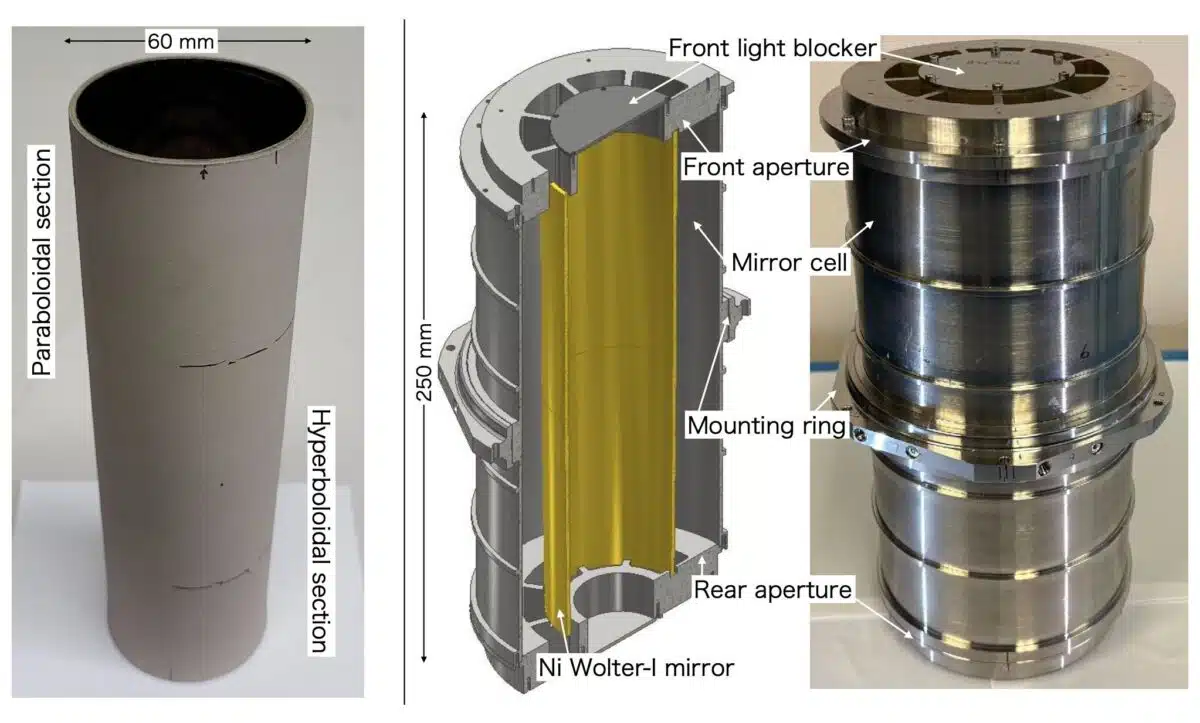 Compact X-ray mirror design shown inside the telescope and ready for launch. Credit: Fujii & al.
This approach enabled precise measurement of the telescope’s angular resolution. Ryuto Fujii, first author of the study, stated that:
“It’s the first ground-based system capable of accurately evaluating the performance of high-resolution X-ray space telescopes at hard X-ray energies, and it is available to researchers worldwide who want to develop and test similar technology.”
A Successful Test In Space With FOXSI-4
The telescope was later flown aboard FOXSI-4, a sounding rocket mission launched from Alaska on April 17, 2024. The mission carried seven X-ray telescopes designed to observe the Sun’s activity.
Based on the mission data, the instrument successfully observed an active solar flare, confirming its capabilities in real conditions. This flight marked the first participation of a domestically developed Japanese high-resolution X-ray telescope in an international sounding rocket program.
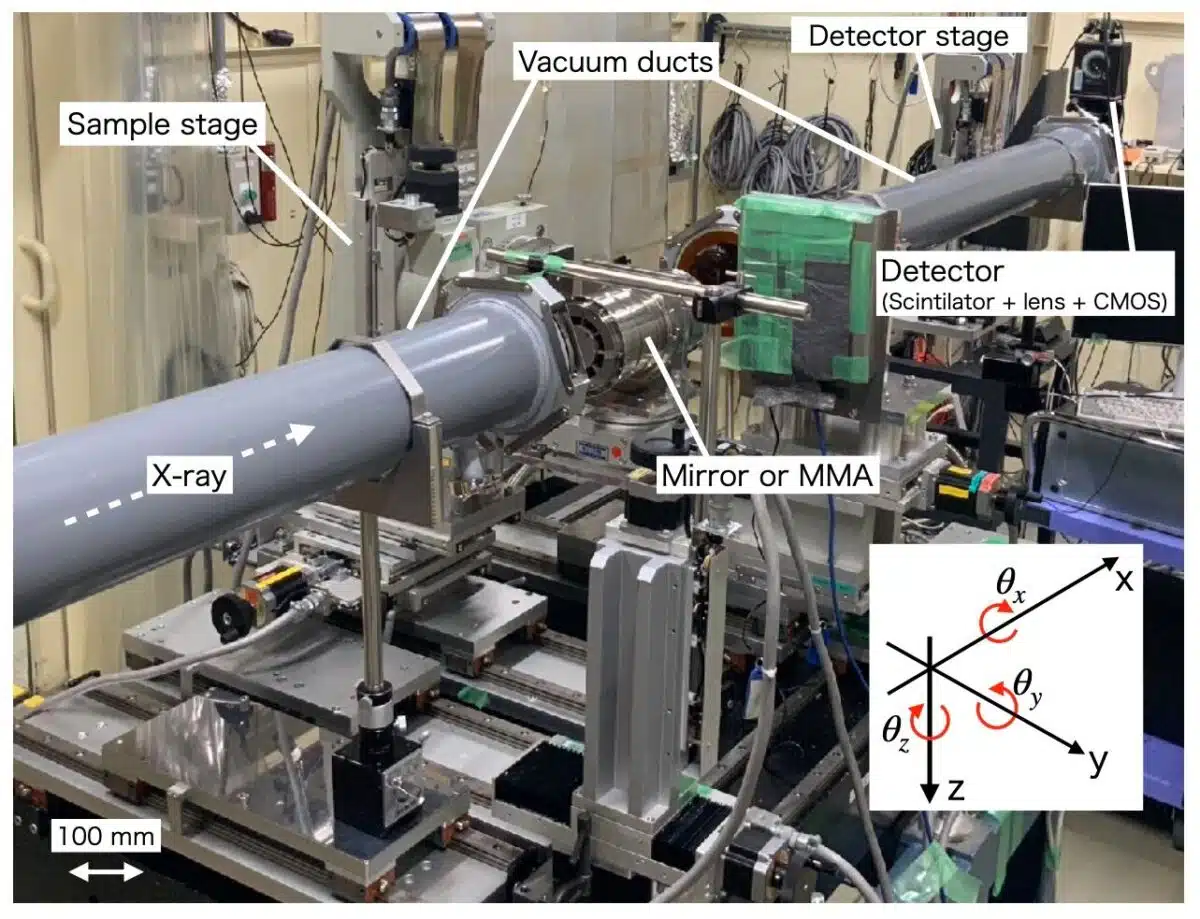 X-rays travel 900 meters before reflection and detection in a vacuum setup. Credit: Fujii & al.
Researchers identified that the main limitation in image sharpness comes from tiny imperfections along the mirror surface. These findings provide a clear direction for improvement. An updated version of the telescope is planned for FOXSI-5, scheduled for 2026.
In the longer run, the goal is to shrink this technology so it can fit inside CubeSats, those tiny satellites about the size of a shoebox. The research team stated that no mission has yet used high-resolution X-ray optics on platforms this small, which could make space-based X-ray observations much easier to access.