
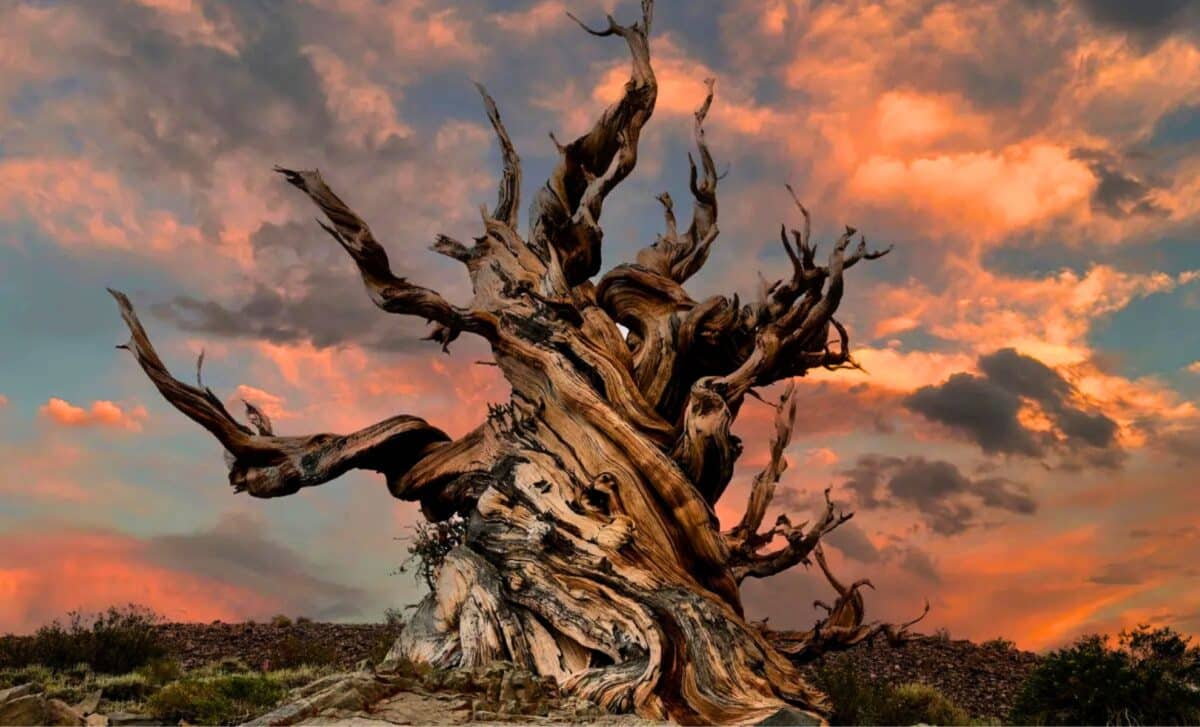
Scientists have sequenced the genome of the Great Basin bristlecone pine, the oldest known individual non-clonal organism on Earth, in a study that may eventually help explain how the species survives for more than five millennia. The research, coordinated by the University of California, Davis and published March 17 in the journal G3: Genes|Genomes|Genetics, provides the first complete reference genome for Pinus longaeva and opens a new line of investigation into the genetics of extreme longevity.
Some bristlecone pine trees alive today began growing before the construction of the Egyptian pyramids. The sequenced genome spans 23.8 billion base pairs, making it roughly eight times larger than the human genome, yet it encodes only slightly more protein-coding genes. Researchers identified 21,364 of them. The remainder is largely composed of repetitive sequences that appear to have accumulated without damaging the organism over millions of years of evolutionary history.
What the Genome Actually Contains
Tissue samples were collected from bristlecone pine needles and seeds in California’s White Mountains under a permit from the USDA Forest Service. Scientists at Johns Hopkins University then performed genetic sequencing using a combination of short-read and long-read approaches, producing a highly contiguous assembly with a scaffold N50 size of 1.2 gigabases. The chloroplast and mitochondrial genomes were assembled separately as complete circular chromosomes.
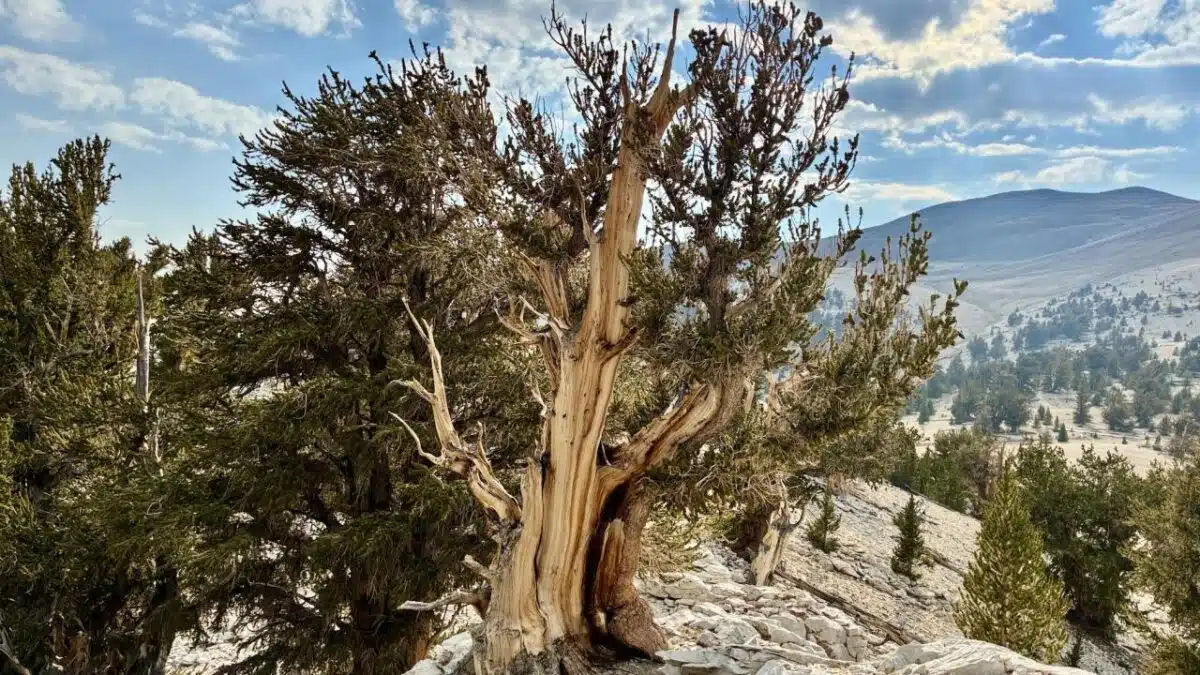 The bristlecone pine tree is the world’s oldest living non-clonal organism. This one grows in California’s White Mountains. Image credit: Kat Kerlin/UC Davis
Two features attracted immediate attention as possible contributors to longevity. The bristlecone pine carries genes associated with disease resistance, specifically a class known as nucleotide-binding leucine-rich repeat receptors, and its telomere lengths are longer on average than those of other conifers. Longer telomeres are generally associated with slower cellular aging.
However, the study’s authors note that neither feature showed strong enough evidence to confirm a direct role in the tree’s lifespan. Further research is needed before any mechanism can be established.
The Scale of the Technical Challenge
Assembling a genome of this size presented significant computational demands. Steven Salzberg, a professor of biomedical engineering at Johns Hopkins University, said the scale made the project genuinely difficult. “Assembling a 24 billion base pair genome that is eight times the size of the human genome is a significant technical challenge,” he said. The bulk of the genome, he noted, consists of repetitive junk DNA sequences that the bristlecone pine appears to have carried through millions of years of evolution without apparent harm.
 Kat Kerlin, UC Davis.jpg) Bristlecone pine trees dot California’s White Mountains. Resilient and long-lived, they thrive in cold, windy, rocky, high-elevation mountains of California, Nevada and Utah. Image credit: Kat Kerlin/UC Davis
Bristlecone pine trees dot California’s White Mountains. Resilient and long-lived, they thrive in cold, windy, rocky, high-elevation mountains of California, Nevada and Utah. Image credit: Kat Kerlin/UC Davis
David Neale, a UC Davis professor emeritus of plant sciences who led the project and previously helped sequence the coast redwood, giant sequoia, and whitebark pine genomes, described the result as a foundational resource rather than a finished explanation. “Sequencing one tree does not give us clear insights as to the genetic basis of longevity,” he said. “But having a reference genome sequence as it applies to human health and everything else is a necessary reagent in modern biology.”
A Species That Does Not Seem to Age From Within
One of the more thought-provoking aspects of the bristlecone pine’s biology is that it does not appear to undergo biological senescence the way most organisms do. Senescence is the process by which cells age and die without being replaced, eventually leading to the organism’s death. Bristlecone pine trees do not seem to carry the genetic markers associated with this process, and when they die, the cause tends to be external: fire, storm damage, insect infestation, or physical damage, not old age in the conventional biological sense.
 Kat Kerlin, UC Davis (1).jpg) A bristlecone pine tree in Nevada’s Great Basin National Park. Image credit: Kat Kerlin/UC Davis
A bristlecone pine tree in Nevada’s Great Basin National Park. Image credit: Kat Kerlin/UC Davis
Neale acknowledged that the idea of a potentially indefinite lifespan is difficult to dismiss when studying something that can survive five thousand years. “Maybe, by having an equivalent study in something that lives to be 5,000 years versus something, or someone, that lives to be 100 could be informative,” he said. But he also cautioned that the bristlecone pine may simply be a biological outlier with no direct parallel in other species.
Why the Genome Matters Beyond Longevity Research
The bristlecone pine is not currently listed as a threatened or endangered species, though individual trees have died from heat, drought, and bark beetle activity in recent decades. Constance Millar, an ecologist with the USDA Forest Service’s Pacific Southwest Research Station, noted that the White Mountains populations have persisted through climate extremes continuously for nearly 11,000 years, since the end of the last ice age.
Having a reference genome gives land managers and conservation scientists a new tool to study how the species responds genetically to environmental stress and to identify which populations carry traits best suited to future conditions. The authors expect the genome to be used not only by forest researchers and land managers, but also by scientists working on the broader question of what controls longevity across different forms of life.