
The mixed reviews over Formula 1’s 2026 regulations have already got tongues wagging over the future trajectory of the championship’s next powertrain formula; German publication Auto Motor und Sport has suggested that a turbocharged V8 is one of the favoured options amid the early discussions over F1’s ‘roadmap’ for 2031 and beyond.
A great quantity of F1’s fanbase would welcome this, especially those that prefer the noise. With the addition of a turbo, the roar might be a bit more restrained versus an unshackled naturally aspirated unit, but it’s hard to argue that the turbo-V8s used in the World Endurance Championship don’t have their prowling, brooding charm.
The V8 is innately familiar to long-time fans of F1; a V8 era preceded the switch to turbo-hybrids, the much-loved Cosworth DFV was a 3.0 V8 that stood the test of time through the 1960s to the 1980s, and V8s were interspersed through the turbo and NA fields later in the last millennium before V10s became the dominant form.
It was 20 years ago when the most recent V8 generation was introduced into F1. Reaction was, of course, mixed; everyone loved the banshee-like screeches of the V10s, and the more refined V8 noise didn’t necessarily capture the same imagination. But, just as James Bond fans grew to love Roger Moore after Sean Connery left the role, many have fond memories of the V8 age and grew to enjoy the 2006-2013 era.
Primarily, the switch to 2.4-litre V8s was driven by cost; V10s had become expensive to develop, and the restrictions on architecture for the V8s (including a mandatory 90-degree V-angle, and a 98mm bore) and on materials kept development costs down. Keeping power in check was also in the FIA’s agenda; the V10s could run at over 1000bhp, and cutting two extra cylinders out of the package brought power figures down to around 750bhp.
There was plenty of representation too from works suppliers as Mercedes, Ferrari, Renault, Toyota, Honda, and BMW all produced V8 units, as did Cosworth – which supplied Williams with its fragile but fast-revving CA2006 unit, which later formed the basis of the CA2010 widely used by the ‘new’ teams of 2006.
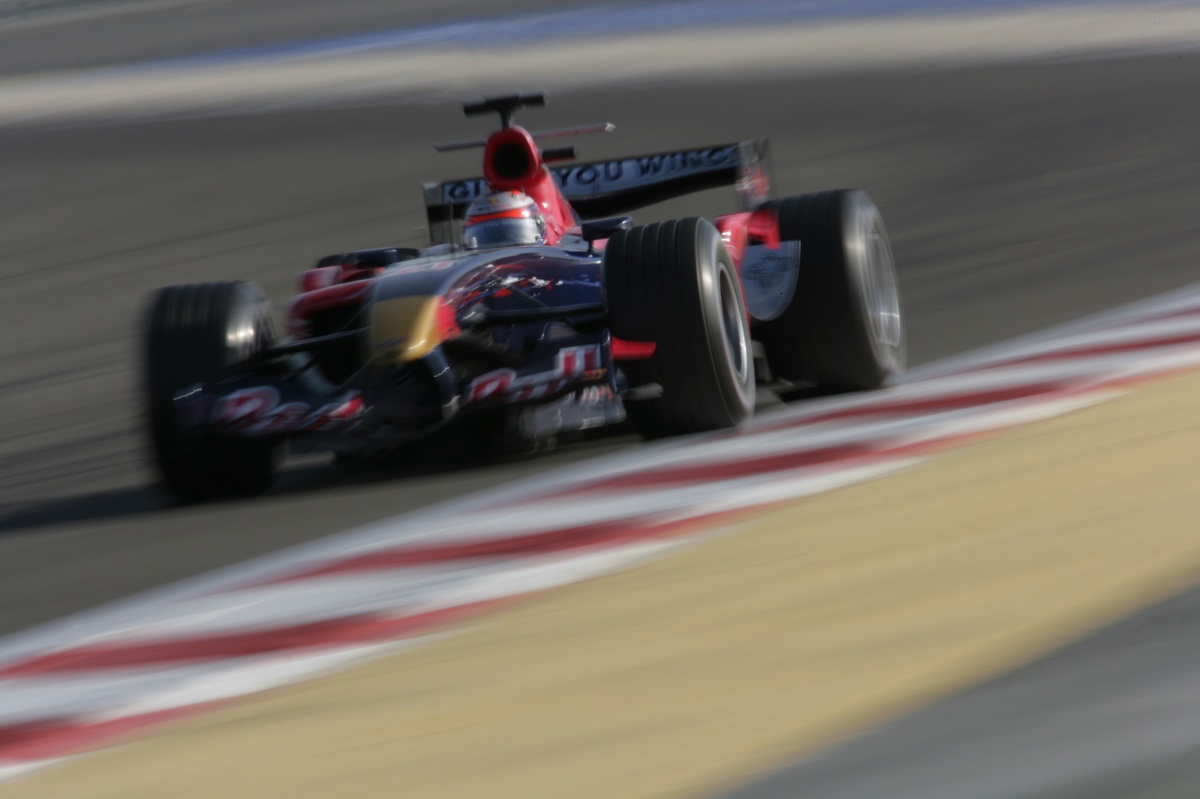
Yet, there was one outlier amid the V8 revolution: Toro Rosso. Red Bull purchased the Minardi team late in 2005 with the intent of turning it into a junior operation, largely to prepare the drivers in its extensive junior programme. It had intended to do this by rotating drivers in the second Red Bull car, but this ultimately set back Vitantonio Liuzzi as the car-sharing deal with Christian Klien was eventually called off. Liuzzi and American hopeful Scott Speed got the Toro Rosso seats for 2006.
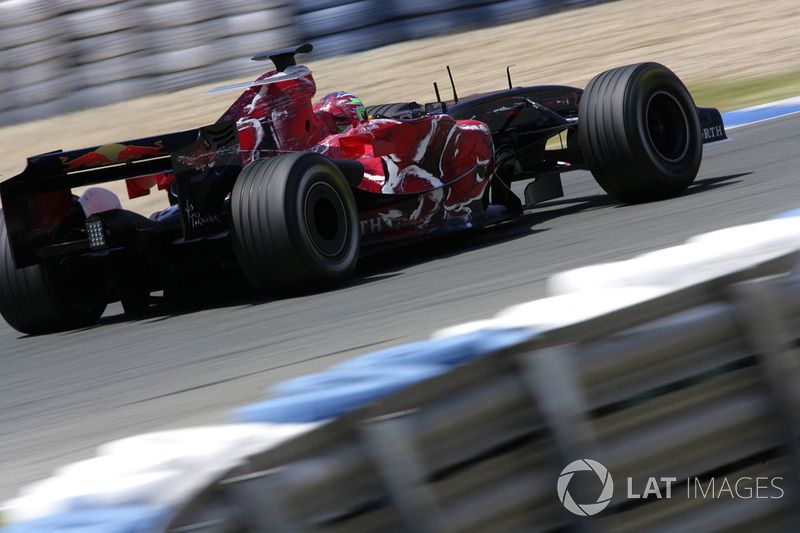
Toro Rosso’s STR1 housed F1’s final V10 engine
Photo by: Lorenzo Bellanca / Motorsport Images
It was good news for Minardi. Perennially underfunded, the Faenza squad had finally received some extra capital and a direct line to the in-house Red Bull Technologies arm. Through the loophole of giving the intellectual property of Red Bull’s RB1 to RBT, Toro Rosso could run its parent team’s 2005 car with a few alterations to the aero package. Everything else was effectively the same, as Red Bull dipped its toe into producing “customer cars” – which became a subsequent bone of contention later in the 2000s.
This included the Cosworth V10 engine. Minardi, a Cosworth customer in 2005, had been granted special dispensation to run a rev-limited V10 given its precarious financial state. Paul Stoddart’s arrival at the team had kept the moribund Italian team alive back in 2001, but his personal wealth was not enough to bankroll the team beyond a hand-to-mouth existence. By 2005, it was reliant on paying drivers, advances in TV money, and concessions in the regulations.
The restrictions included a 16700rpm limit, and a 77mm air restrictor to keep the V10 ringfenced below the peaks in its power curve. To match the restrictor plate, the rollhoop intake was reduced in size to minimise the overall losses, and the FIA maintained a stance that the restrictor could be closed even further should the V10 remain too powerful.
“I don’t think it was the goal to put the V10 as the worst engine. I think it should have a fair chance and I think that’s what we have.” Gerhard Berger, 2006
When the team became Scuderia Toro Rosso, other teams (chiefly, the Midland team) began to kick up a fuss. The team was no longer a spendthrift backmarker, but one now funded by a multinational and thus theoretically had the resources to outspend its traditional rivals.
While the FIA made steps to create some degree of equivalence in power between the new V8s and the sole remaining V10, those in the lower midfield had suggested that the old Cosworth TJ2005 unit would have a performance advantage nonetheless. Even at restricted revs, the torque advantage of the V10 off the line was also cited as a potential threat at the starts.
Toro Rosso, meanwhile, was adamant that its engine was not advantageous in any way.
“I don’t know where they think our performance will be so good,” team principal Franz Tost said at the time. “During the tests, we were 1.0 to 1.5 seconds (per lap) behind the others, and we are 5-8km/h behind the others in terms of top speed, and therefore I don’t know where they have got the information that we are faster and our package has such a good performance that we can do good results.
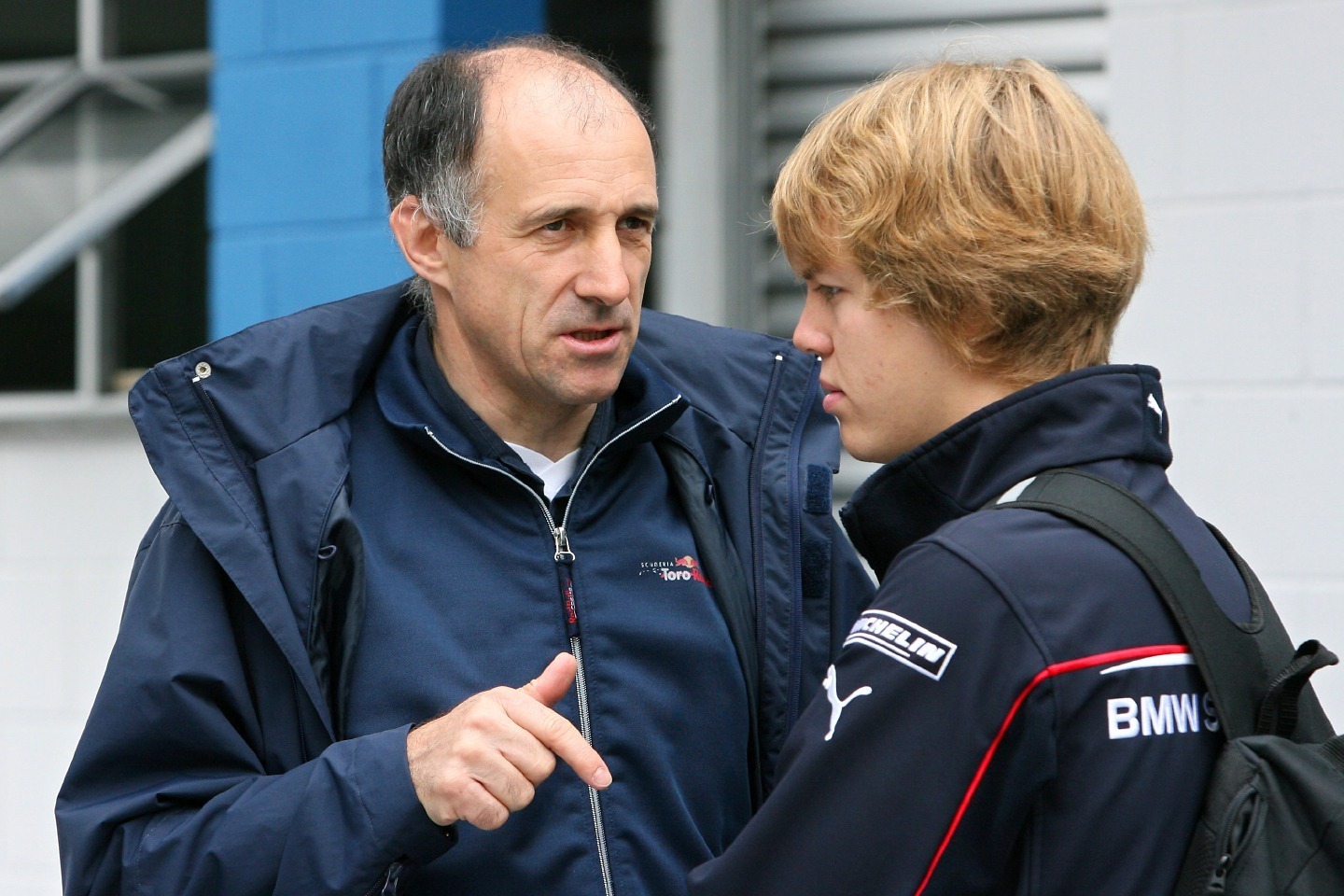
Tost (speaking to a young Sebastian Vettel) ran Toro Rosso (later, AlphaTauri) for 18 years
Photo by: Red Bull GmbH and GEPA pictures GmbH
“I hope that they are right, but realistically in qualifying we are not able to be within the first 10 because there are six works teams, with 12 cars, and apart from this we have Williams with two cars.
“There are other competitors with a really good package; therefore, I don’t know how they can say Toro Rosso has such a good performance. I hope they are right because I would be very happy about this, to be honest.”
This was contextualised at the time by the manufacturers’ early struggles with the V8s, and in getting them to consistently work at their peak power. Some of the manufacturers found that by pushing the engines to above 20000rpm, it could start to pull a bit more performance out of them at the cost of putting the components under more strain.
Still, the advances across the board with the V8 engine hadn’t quelled fears that Toro Rosso might be able to bloody the noses of the more established operations. When Liuzzi plonked his car sixth in the Bahrain opener’s FP2 session, further worries began to escalate: then-Mercedes chief Norbert Haug suggested that the team could challenge for a podium, estimating that the V10 still held a distinct power advantage of around 70bhp.
New Toro Rosso shareholder Gerhard Berger, who took on 50% of the team in kind for Red Bull purchasing 50% of his haulage business, disagreed. According to the Austrian, Liuzzi’s lap was largely a result of bolting on fresh Michelin tyres, while other teams were aiming to preserve their engines by running at lower modes – at the time, engines had to last two grand prix weekends.
“I’m 100% sure that we don’t have the best engine,” Berger stated during the Bahrain weekend. “There are some V8s that are stronger than ours but I’m also sure that we don’t have the worst engine. And I don’t think it was the goal to put the V10 as the worst engine. I think it should have a fair chance and I think that’s what we have.”
While both Toro Rosso drivers made it into Q2 in the new qualifying format, this was helped by Kimi Raikkonen’s Q1 suspension failure and Ralf Schumacher’s session becoming unstuck by a red flag. On pace, Toro Rosso was above the Midlands and the new Super Aguri outfit, but never a real threat to the rest of the midfield pack.
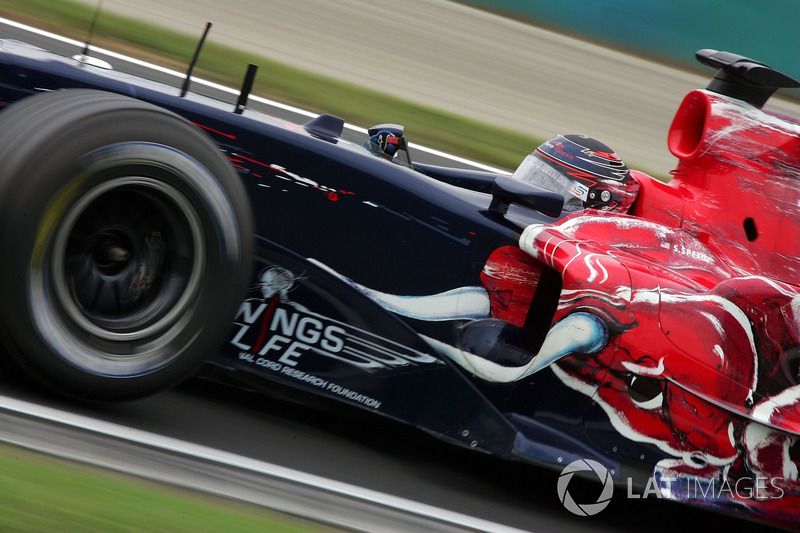
Speed was not the demonstration of nominative determinism that Red Bull had hoped for
Photo by: Sutton Images
Some of the difference would have been down to the chassis, effectively a year-old car that had been very slightly reworked to ensure Toro Rosso skirted the boundaries of what would be considered a customer car. When it came to the engine, the only real point of comparison was the difference between Cosworth’s ‘05-spec V10 and its ‘06-spec V8, one of the highest-revving engines on the grid in the back of Williams’ FW28.
The Toro Rossos still had good straightline speed, helped by the extra torque out of the final corner at Bahrain. Liuzzi was sixth in the speed trap across both qualifying and the race, with Speed seventh in his eponymous rankings during the grand prix.
Yet Williams’ technical director Patrick Head felt that the V10, in rev-limited form, had less output than the new V8. Speaking at 2006’s Malaysian Grand Prix weekend, Head suggested that F1 had avoided a bigger furore in that only a smaller team was running to the rev-restricted rules with an engine lacking optimisation for its new operating conditions.
Although the season opened with dissent over Toro Rosso’s use of the V10, the din soon died down as the Italian squad was not competitive
He explained that, if manufacturer was able to opt into the alternate engine regulations, it could potentially have secured a considerable advantage by reworking the engine hardware.
“I think from what I’ve seen of power curves, run at its maximum, it’s certainly below the V8 from Cosworth,” Head explained. “The thing about it is that it’s so under-stressed, in effect, that it can be run at its maximum every lap of the race, every lap of qualifying, every lap of practice. That gives a certain advantage.
“The other thing is that it would have been a much bigger problem, I think, if one of the manufacturer teams had decided to go that route because the Cosworth V10 engine never had variable trumpets and as I understand it, it has not been optimum-tuned for the lower revs, for the restricted intake, and I’m sure that for any of the manufacturers – because you are allowed to run with those engines in exactly 2005 specification, so with variable trumpets, if you’d re-done the camshafts and the ports and all the rest of it, to optimise it for those rules – I’m sure there would be a few people howling like hell now.”
BMW chief Mario Thiessen agreed, noting the advantages of the V10. “I see three advantages of a restricted V10. One is peak power, even if you apply the restrictions in a very crude way by putting in a plate into the air trumpet, I would expect it to have a higher peak power – maybe not too much.
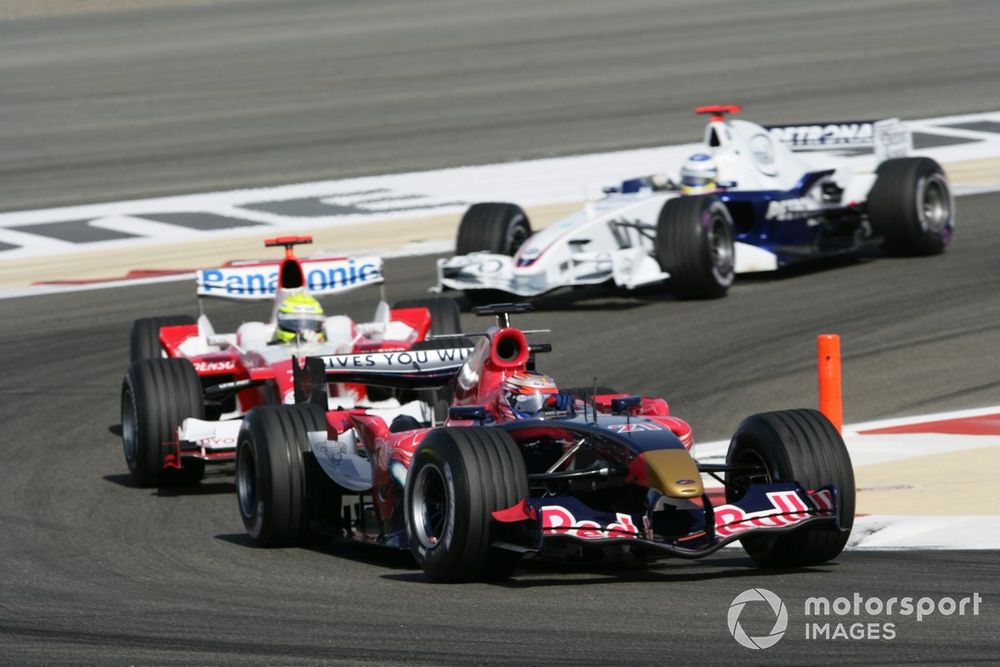
The Toro Rosso’s high torque V10 made them difficult to pass – but the team managed only one point in 2006
Photo by: Glenn Dunbar / Motorsport Images
“Second one is higher torque, which should put you in a position at the start to overtake maybe one or two cars, and at the exit of a corner, to accelerate much quicker. That’s what we saw in Bahrain.
“And the third advantage is, as Patrick said, that this engine is good for several thousand kilometres and you can basically go at qualifying pace throughout the race. Those are the major differences from a technical perspective.”
Although the season opened with vehement opposition over Toro Rosso’s use of the V10 engine, the din soon died down once it became apparent that the Italian squad was not particularly competitive. It managed just a single point thanks to Liuzzi’s efforts at the United States Grand Prix, albeit helped by a multi-car pile-up at the opening corner.
Red Bull, meanwhile, had found Toro Rosso a replacement engine package for 2007. Since the V10 wasn’t going to be developed, it was pointless keeping it for 2007 (the final year that rev-limited V10s would be permitted) – and Red Bull needed to palm off its Ferrari engine contract as it had secured a deal for Renault’s V8s for the following year. Much to Ferrari’s displeasure but eventual grudging agreement, Toro Rosso was given the Ferrari deal, closing the chapter on F1’s V10 age for good.
It’s just a shame that, for such an iconic component of F1’s history, the revered V10 departed from the championship with the merest of whimpers.
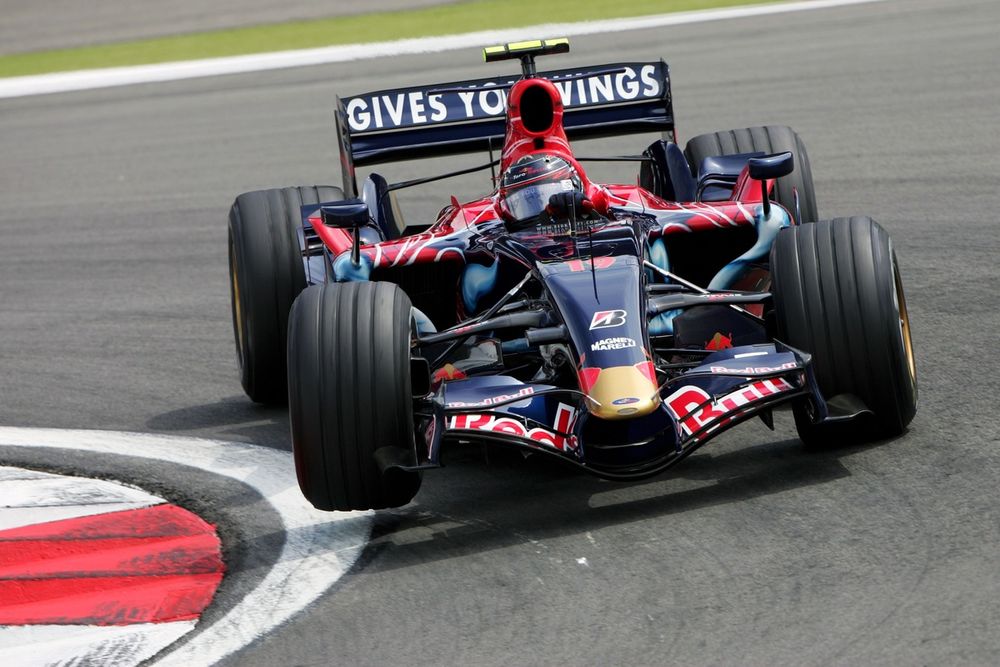
Toro Rosso switched to Ferrari engines (and a version of the Adrian Newey-designed Red Bull RB3) in 2007
Photo by: Sutton Images via Getty Images
We want to hear from you!
Let us know what you would like to see from us in the future.
– The Autosport.com Team