
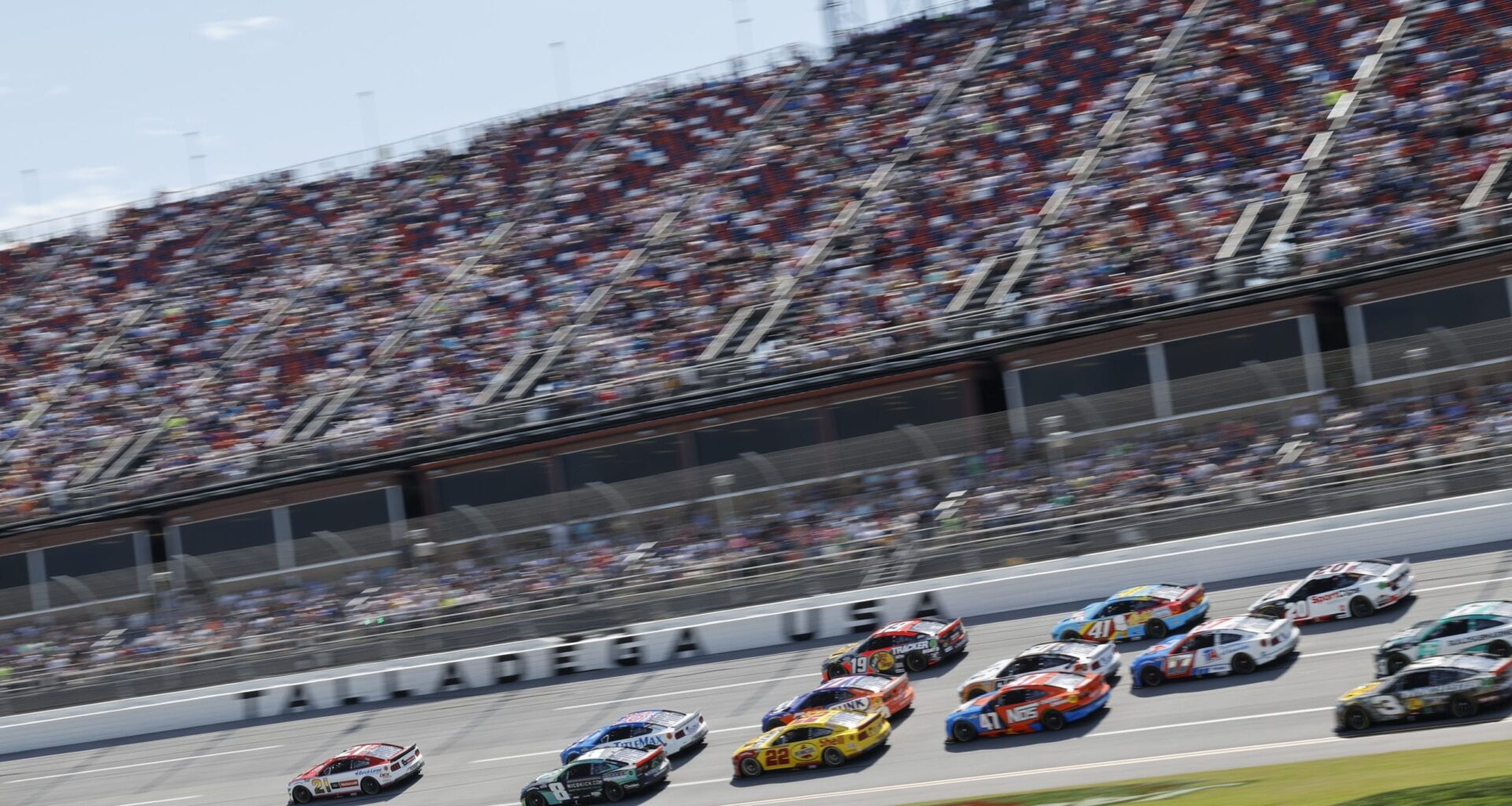
TALLADEGA, AL — NASCAR will adjust stage lengths for the Cup Series race at Talladega Superspeedway later this month, a change aimed at limiting fuel-saving strategies that have shaped recent superspeedway events.
The April 26 race at Talladega will feature revised stage breaks, with Stage 1 ending on Lap 98, Stage 2 on Lap 143 and the final stage running to the scheduled 188-lap distance. The race is scheduled for 3 p.m. ET and will be televised on FOX with radio coverage on MRN and SiriusXM NASCAR Radio.
NASCAR Executive Vice President and Chief Racing Development Officer John Probst said the decision follows discussions with teams after the season-opening Daytona 500 and reflects a preference for sporting adjustments rather than midseason technical changes.
“Coming out of Daytona we have been working hand-in-hand with a lot of our race teams trying to largely break into two categories things we could do,” Probst said on NASCAR’s “Hauler Talk” podcast. “One are sporting related things… The other being in a technical bucket, which would mean car changes.”
Probst said NASCAR and team officials were hesitant to modify car components such as spoilers or engine power during the season due to concerns about unintended consequences.
“As we went through all of our options… there’s a little bit of reluctance to just make wholesale changes to any of the technical stuff in the middle of the season,” he said.
Instead, NASCAR chose to realign the stage structure. Traditionally, superspeedway races feature two shorter stages followed by a long final segment. For Talladega, NASCAR reversed that approach by shortening the final two stages.
“Going into Talladega, we’re going to flip that and adjust the lengths of the final two stages such that we’re confident that the last two stages are short enough to be made without a fuel stop,” Probst said.
The opening stage could still present strategic variation, with teams potentially choosing between one or two pit stops. Probst said that dynamic could influence the entire field.
“It could be interesting… if there’s some that try to do it on one stop versus some that try to do it on two,” he said. “We think that if there are some that try to do it on two, they may drag the group that tried to do it on one along with them… so it’s got the potential there for some pretty interesting strategies.”