
Irish electricity prices were the eighth most expensive in Europe in 2024, according to research from the Economic and Social Research Institute.
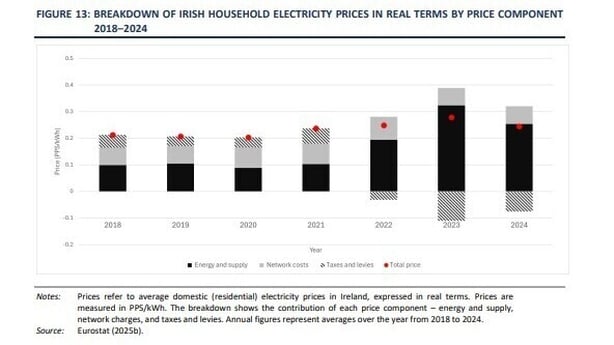
Irish prices would have been the highest in the continent were it not for VAT reductions and energy credits introduced by the government to shield consumers from rising costs.
ESRI senior research officer Dr Muireann Lynch said: “While interventions such as energy credits have alleviated much of the burden for Irish consumers, Irish electricity prices have been among the most expensive in Europe during the 2018–2024 period of analysis.”
The ESRI said that network costs paid by consumers had risen in recent years to pay for the purchase of emergency electricity generation.
It said that future network investments would also increase costs to consumers.
It added that the regulator for the electricity sector, the Commission for Regulation of Utilities, had predicted that annual costs may rise by between €59 to €106 by 2029 and 2030.
It said that recent rises in these network charges were small in comparison to fuel price increases.
The ESRI’s research showed that Irish electricity prices tended to track natural gas prices.
It said while many countries has reduced their reliance on gas-fired generation Ireland has been less able to diversify from gas fired generation.
It said that renewables provided protection against fuel price volatility.
Read the report in full
ESRI data on electricity prices here
Speaking on RTÉ’s Morning Ireland, Dr Lynch said that the data on energy costs covers the Ukraine war but not the more recent Middle East conflict.
“If we look at how much it costs to actually generate the electricity and transport it to our homes and businesses, we are pretty consistently in the top three in Europe across that six-year period [of the research,” she added.
We need your consent to load this rte-player contentWe use rte-player to manage extra content that can set cookies on your device and collect data about your activity. Please review their details and accept them to load the content.Manage Preferences
“However, when you take into account taxes and levies, then we fall to more like eighth. And this is in what we call nominal terms. So this is in terms of the number of euro that you pay, no matter what country you’re in.
“The energy and supply is where Ireland is a real outlier. We’re very, very high on that. So what’s driving that? It’s a really good question. We do not have the data to answer that question completely.
“A large part of it seems to be driven by the fuel mix, the fact that we are so heavily reliant on gas compared to other European countries.
“However, there’s also a question of whether or not the lack of competition in the Irish market compared to other markets would be having an impact because this is exactly where we would expect that to show up as well.”