
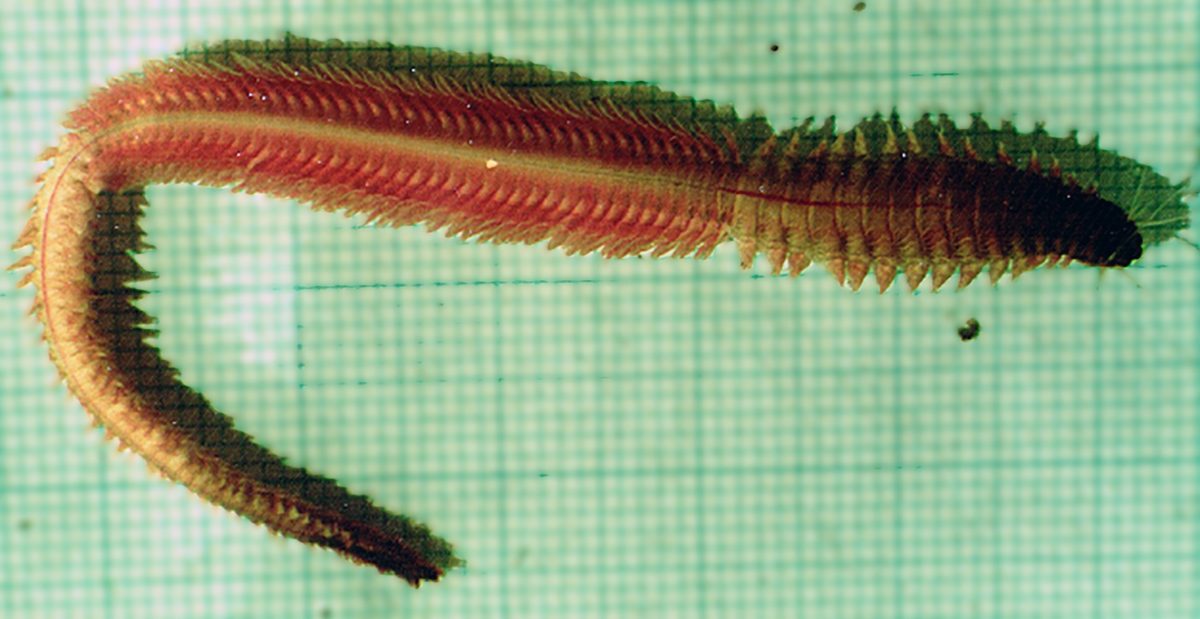
Jellyfish enjoy seasonal produce too. When the bottom-dwelling worms of Denmark’s fjords rise up in summer to spawn, they are predated by the resident jellyfish. The discovery, reported in Hydrobiologia, reveals a previously overlooked link between seabed and open-water food webs.
Jellyfish are opportunistic feeders that swim around in open water where they use their tentacles to capture prey, such as zooplankton, fish larvae and tiny crustaceans. Polychaete worms are an enormous group of marine worms, which tend to spend most of their lives in burrows under the seabed. For this reason, the worms were considered off menu to the jellyfish. Not so!
Researchers studied jellyfish collected from two Danish fjords and found they had been eating polychaete worms. Over the course of a year, around 50 jellyfish were found with worms in their gut.
“Although jellyfish are known to be omnivorous and generally consume whatever they encounter, it is the first time this behaviour is documented,” says Hannah Yeo from the University of Southern Denmark.
The worms were found in the guts of two different species; the common moon jelly (Aurelia aurita) and the invasive comb jelly (Mnemiopsis leidyi).
The worms get eaten on summer nights when they leave their burrows in the thousands to spawn. This creates a feeding opportunity for the local carnivores, including trout and other predatory fish.
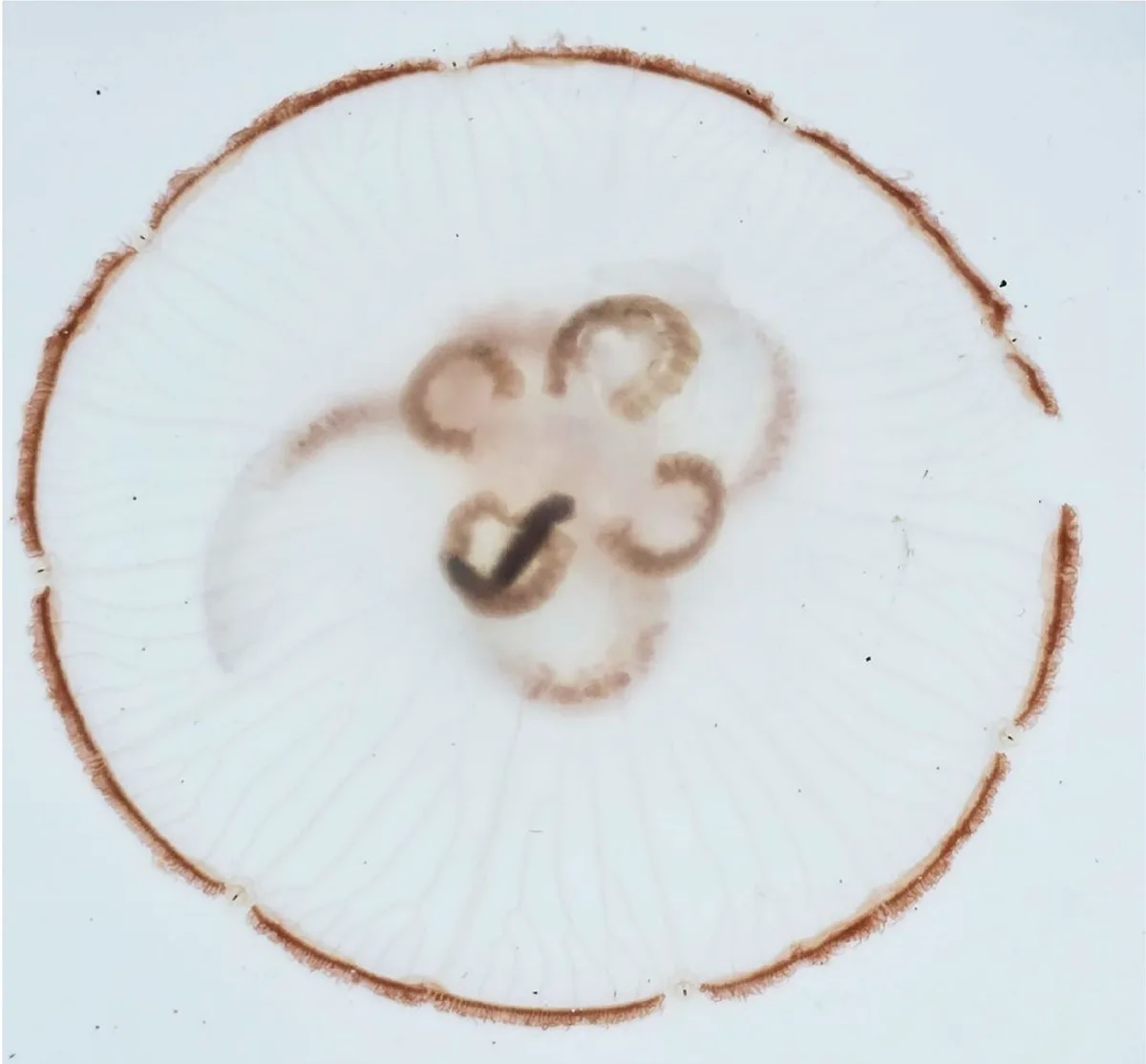 The researchers found one and sometimes two polychaete inside the jellyfish. This aurelia aurita jellyfish has two worms in its gut. Credit: Hannah Yeo/SDU
Forty five of the 166 A. aurita and three of the 71 M. leidyi studied had eaten worms. But according to team member Erik Kristensen, “it takes only a couple of hours for the jellyfish to digest these worms, so there were probably more cases than the ones we observed.”
In the bigger picture, polylchaetes are probably not a major food source for the jellyfish, but they do represent a concentrated seasonal burst of energy in summer that may help jellyfish to thrive. This is concerning because M. leidi is an invasive species. If populations were to expand rapidly, it could disturb the ecosystem.
The study also tells us something about the flow of energy inside the fjords. In open water, this flow is typically seen as one-way: organic material sinks down to the seafloor where it feeds bottom-dwelling animals. Here, energy also moves upwards, when bottom-dwelling animals rise into the water column and are eaten. The same thing could be happening elsewhere, so future models of coastal ecosystems need to take this into account.
Top image: Alitta succinea was one of two species found in the gut of jellyfish. Photo- Erik Kristensen/SDU
More wildlife stories from around the world