
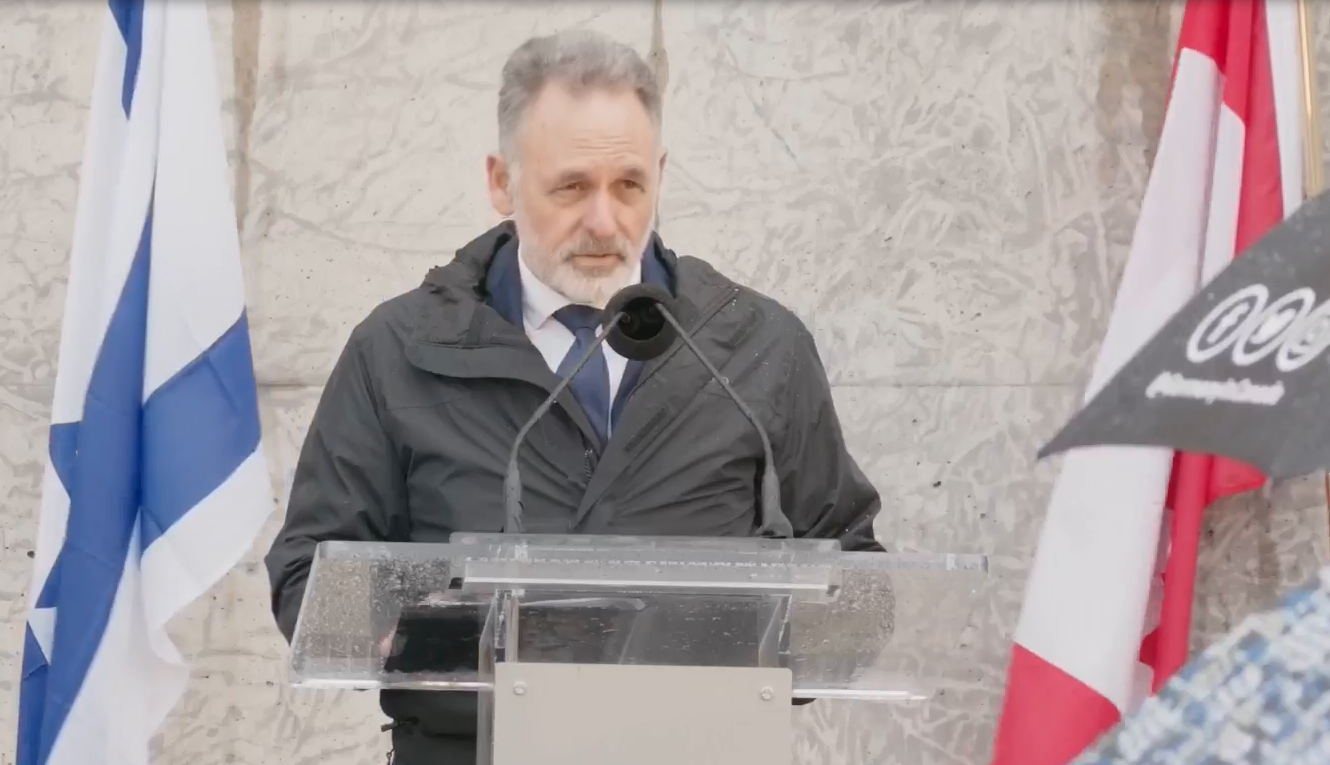
The Yom ha-Shoah (Holocaust Remembrance Day) commemoration at the National Holocaust Monument in Ottawa Tuesday morning, April 14, was a moving tribute to the victims of the past, with an eye to the future.
Organized in partnership with the Centre for Israel and Jewish Affairs, the Jewish Federation of Ottawa, Canadian Society for Yad Vashem, the Government of Canada, the National Capital Commission, and in partnership with the Israeli embassy, this year’s theme, Helping Hand, Then and Now highlighted heroism, allyship, memory and the duty to act.
Many hands held umbrellas aloft in Ottawa Tuesday morning as the rain continued to fall covering the ground and streaming rivulets of water down the face of the stone monument, where people stood to speak.
Rabbi Idan Scher of Ottawa’s Congregation Machzikei Hadas remarked that while 6 million Jews were murdered and “entire worlds gone,” when you meet a Jew in Canada today, whose family is from somewhere touched by the Holocaust, then very often, “you’re not just meeting the descendant of a survivor, you’re meeting the living legacy of courage, of goodness, because alongside the darkness, there were individuals, non-Jews, who made a different choice. They refused to bow to hatred. They refused to participate in evil. They refused to stand by at unimaginable personal risk. They said, even if the world has lost its moral compass, I will not and because of them, because of those choices, countless lives were saved. Generations were born, communities were built.
“So much of what we see around us today: families, communities, contributions to this country exist,” said Rabbi Scher, “because someone, somewhere decided ‘I will not be a part of this,’ and that’s the legacy we remember today, not only the depths of human cruelty, but the very heights of human courage and goodness.”
A very thin line
The line between hatred and harm is not as wide as most wish it were, he added. “It’s a very thin line, and often the only thing standing on that line is one person, a single person who will ask the question, ‘What can I do?’ During the Holocaust, there were those who asked that question and answered it with action.”
Business and community leader Salma Siddiqui, an early supporter and fundraiser for the monument, spoke of “the lesser known, but powerful history of collaboration between Jews and Muslims during the Holocaust, an era when many Muslims risked their own safety to protect and support their Jewish brothers and sisters. I’m especially proud that Canadian Muslims are now officially recognized as donors to the sacred project. In Canada, we have a unique opportunity to support one another and to stand in solidarity when it matters most.”
Israeli Ambassador to Canada Iddo Moed reflected on a Toronto seder, with “28 faces gathered around one table together to tell the ancient tale of persecution and redemption: Together friends and family, Canadians and Israelis, Jews and non-Jews, three generations, a Holocaust survivor, her grandchildren, her sons, the sons of Holocaust survivors, as I am, together.”
Moed said the tale of Abraham and Jacob and of Joseph is also a prototypic tale of antisemitism. “The haggadah does not only tell us our story, it commands us to relive it in its own words, in each generation, each person must see themselves as if they were the ones who escaped Egypt, who faced hatred in the extreme, of their extinction. My host, my parents, the entire generation, need no help fulfilling this commandment. They lived the Holocaust together, together they barely survived it, and together our people remain scarred by it, every day.”
Today, said Moed, “Canada, like so many of the world, marches headlong into the ‘30s of a new millennium,” and appears to be doing so, “to the same antisemitic drumbeat that ushered Europe into the 1930s. On this day of remembrance, I fear that Canada and the world have forgotten, or have been made to forget, perhaps wish to forget, the darkest patterns of the Holocaust.” This year, he added, “Canada and many other countries around the world seem to have banded together to turn blind, hostile eyes to the plight of the Jewish populations and to that of their homeland of Israel.
“As in Egypt, it begins with lies, false and hateful accusations, accusations of uprising by the Jews of Egypt, then genocide of the Gazans by Israel. Now, equal ingredients – Holocaust denial and blood libel, intended to delegitimize and to destroy, to twist truth and to murder the memory to hateful ends and means, and today, as it was then, is once again tolerated and rewarded by those in power and in some cases even promoted in our schools.”
Hatred echoed across generations
Moed noted that on Passover he read partially from a treasured haggadah, of the kibbutzniks from the time of Israeli independence “presenting a people who worked with their hands,” recalling the message of resilience and of action. “Its call to action, complementing the words of the haggadah as it should be, as it was meant to be, the telling, not only commanding us to relieve its story by remembering, but reminding us that we must act.”
For Pastor Isaac Gimba of Nepean’s Meeting Point Ministries, the Holocaust is a mirror that is held up to every generation, “asking a very simple yet piercing question: What will you do when hatred rises again?”
Evil rarely begins with violence said Pastor Gimba, but rather with words, narratives, silence, and indifference. “When good people say nothing, darkness finds room to grow… Hatred did not end with Adolf Hitler. It did not vanish with liberation. It has in different forms, echoed across generations, even to our present day” he said, when narratives are formed quickly often without understanding, “and repeated until they seem true. There are voices in our world today that distort the truth, that inflame divisions. Israel is sometimes portrayed not as a nation defending its existence, but as something to be feared, blamed or eradicated. This is not only inaccurate, it is dangerous, because truth matters, and truth requires courage.”
Pastor Gimba quoted the Book of Joshua as a call to moral courage, but also “a call to action.” The question today, he said, especially for young people, is “will you be silent, or will you stand…I want you to know that you are not alone. A helping hand today may look like the Christian and Jewish community working strategically together, standing shoulder to shoulder in solidarity when it’s inconvenient, speaking the truth when it’s unpopular, refusing to amplify falsehood and choosing instead to stand on friendship and mutual understanding.”
Agnes Klein, a Holocaust survivor, found the theme especially pertinent. “Helping Hands is a fit metaphor, description, if you will, of communities coming together to help each other in many and varied forms, from the many stories of health and protection afforded to Jews during World War Two, to those afforded to other persecuted minorities, whether based on religious or national grounds or both.”
Acts of total selflessness, bravery and even heroism were part of what allowed her family to survive in relative safety, ranging from the chief editor of the local newspaper, a Roma, who allowed them to stay rent free in the lodging allotted for Jews at that time, or “the Romanian gentleman who fronted, for some consideration, a small business for my late father and a partner to remain employed until the end of the war and earn a living.”
Bhagwant Sandhu, a retired director of the federal public service, reminded those assembled of the commonality of Judaism and Sikhism, of nationhood and peoplehood. “The central ethos of Sikhism is to always stand up and fight for justice and fight against inequality. The most cherished prayer that we have is Deh Shiva bar mohe ihai,” he explained. “It asks for the courage to stand up against intolerance, against discrimination, against hatred, and this is where Sikhism and Yom ha-Shoah talk to each other: One compels us to action, and the other reminds us what happens when we stay silent, when we do nothing, when we just turn the other cheek.”
National Holocaust Monument committee co-chair Lawrence Greenspon quoted fellow member Andrea Freedman’s reflection when recalling the famous words about the Holocaust by Lutheran pastor Martin Niemöller:“First they came for the Jews in Israel, and it was called complicated. Then they came for Jewish students on Canadian campuses, and it was called protest. Then they came for Jews in the streets of our cities, and it was called isolated fringe, not reflective of who we are. Then they attack Jewish institutions, people, synagogues, schools, businesses, and there were empty words, but no real consequences. What starts with the Jews never ends with the Jews. It spreads where silence and inaction are easier than courage, and where indifference is mistaken for neutrality. Freedom endures only when it is defended, not in words alone, but in the choices we make and the actions we are all willing to take.”
Always be ready
On Monday night in Montreal, several hundred people attended a moving commemoration held by the Montreal Holocaust Museum at the Jewish community campus. MHM co-president Jacques Saada saluted the assembled dignitaries, including the consuls-general of Israel, Belgium, the United States and others, reminding them, “do not consider that you are attending a function. What you are doing here is showing concrete support for human decency, for the fight against antisemitism.”
It was antisemitism’s protean nature that Israel’s consul-general in Montreal Eliaz Luf spoke of: “Antisemitism has never disappeared. It persists, adapting to new forms, finding new voices and always rearing its ugly head. Here in Montreal and across Canada, antisemitic incidents are on the rise at an alarming rate, becoming common, creeping into everyday life. We cannot allow that to happen.” He noted “the recent decision by the Vanier College here in Montreal to cancel its annual Holocaust commemoration ceremony shows how quickly people can forget.”
In every generation said Luf, “the Jewish people must always be ready to defend ourselves, no matter what and no matter when. This is who we are, we carry responsibility not only to remember what happened, but to ensure it never happens again. The State of Israel as the Jewish state carries an important responsibility to confront antisemitism wherever it arises. It carries this responsibility with seriousness and unwavering commitment to the survivors and to future generations.”
The evening’s program included a number of survivors lighting memorial candles, hearing tributes from children and grandchildren, the promises of the second, third and fourth generation, and a rousing rendition of the Partisan Hymn.
At Montreal’s event there was only a smattering of city councillors from various boroughs while Montreal Mayor Soraya Martinez Ferrada held a small candle-lighting ceremony in the halls of Montreal City Hall on Monday.
For his part, Prime Minister Mark Carney’s April 13, message recalled that “the Jewish community is facing a resurgence of antisemitism at home and around the world,” and noting his government’s response in the form of the Combatting Hate Act. “The responsibility to confront antisemitism belongs to all of us, and that responsibility begins with remembrance. Our remembrance is vigilance, so that ‘Never again’ is always true. Our duty is deliverance, from intimidation and hate. Our goal is transcendence – a society where Jewish people and all Canadians can live openly, freely, and safely.”
Joel has spent his entire adult life scribbling. For two decades, he freelanced for more than a dozen North American and European trade publications, writing on home decor, HR, agriculture, defense technologies and more. Having lived at 14 addresses in and around Greater Montreal, for 17 years he worked as reporter for a local community newspaper, covering the education, political and municipal beats in seven cities and boroughs. He loves to bike, swim, watch NBA and kvetch about politics.