

Depending on who you ask, 32″ inch wheels are either about to take over mountain biking as soon as this spring, or a bunch of overblown hype that might never happen.
It’s hard to say because there are still just a handful of bikes around, mostly prototypes and handmade customs. Or there could be a ton of them waiting in warehouses. Who knows? The internet is rarely good at middle-grounds or reason, so we decided to ask some very reasonable humans who might have some actual insight. Insight not just into what’s happening, but what happened last time.
We talked to three icons of Canadian cross country – Catharine Pendrel, Geoff Kabush and Sandra Walter – to find out what they think of the 32″ future and what we can learn from how the change from 26″ to 29″ (and to 27.5″ then back to 29″ again) played out last time.
Is it all Hype? Are there real advantages? Will this happen anytime soon? And will shorter riders be left behind? Let’s find out.
 Catharine Pendrel on her way to winning the second-round UCI World Cup event in Houffalize, Belgium in April 2013. Photo credit: Rob Jones
First words: Hype or cross country beast?
Before we get into the details, is this even a discussion worth having? Or just a bunch of marketing being over-sold as a performance advantage.
“I don’t think we can ignore it,” says Catharine Pendrel, adding that of the few riders she knows with time on the big hoops, “Their feed back was very positive.”
Sandra Walter is more cautious, with good reasons that we’ll get into below.
“I think it’s still too early to tell,” Walter says. “I honestly wasn’t paying too close attention to the 32″ talk last year, but I guess it’s becoming a thing.”
Geoff Kabush has had time on 32″ wheels. While he can’t spill the beans on which bike, his long-time sponsor Maxxis is perhaps the brand doing the most to push this new standard. Or, at least, as the first and currently only brand to make a 32″ tire (others have committed, but there’s no rubber on the ground) the brands that’s been most brightly in the spotlight.
“Going from 26″ to 29″ was pretty dramatic and I’d say 29″ to 32″ is significant but just slightly less so,” Kabush shares. “There are definitely some very noticeable differences in riding dynamics. Big whips might be a little harder for the kids.”
Kabush is quite specific about what the new wheel size can offer, and what might hold it back.
“The advantages to me were pretty obvious; rolling speed, obstacle rollover, climbing traction as expected,” Coach K explains. The drawbacks are more subtle related to increased rotating weight and geometry design challenges for small people.”
Those advantages proved enough for Kabush to chase down Sam Whittingham of Naked Bicycles to build a custom 32″ titanium gravel bike. Why gravel? More on that tomorrow.
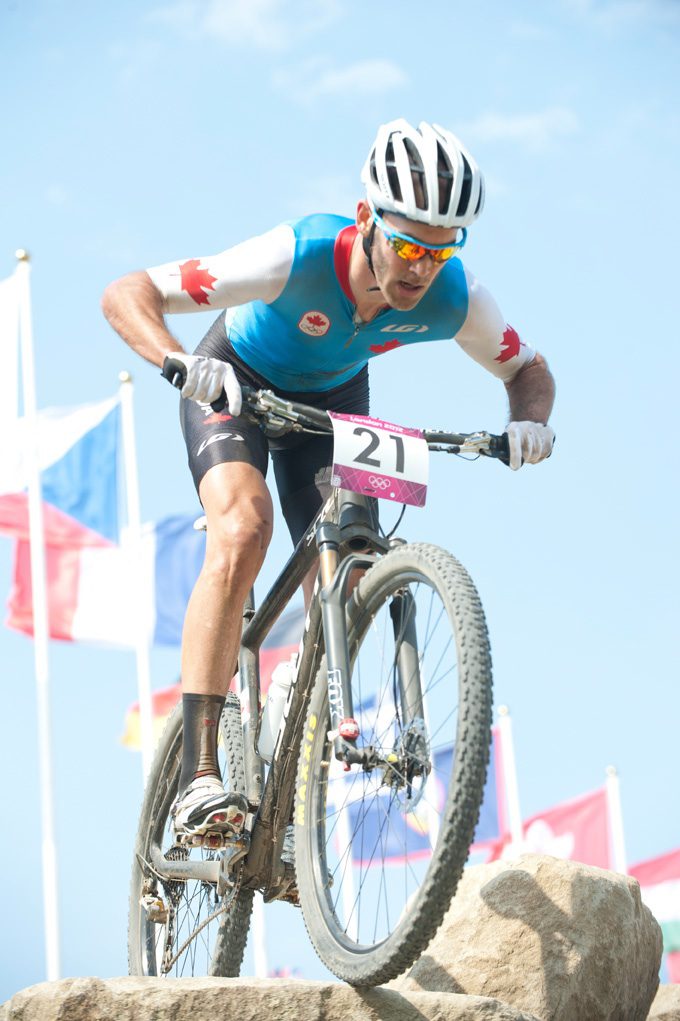 Kabush racing the 2012 Olympic XCO in London.
From 26″ to 29″: As it actually happened
Looking back at it now, the switch to 29″ seems like it was inevitable. No brands offer 26″ cross country bikes any more for adults and almost no brands offer fully 27.5″ bikes. At some point, 29″ won the wheel-size war. It’s easy to forget how long the first wheel size debate raged on. And how there was just as much hype when 29″ first appeared as we’re seeing with 32″ now.
Kabush says the transition wasn’t necessarily immediate or smooth.
“The first year or two of 29in full suspension designs weren’t very refined, competitive component development lagged, and the durability of some of the first 29in wheels were pretty bad. So the advantages weren’t so obvious. 27.5″ for XCO only complicated things,” Kabush recalls. He took longer than some to switch in part, he admits, due to sponsor issues. By 2012, when he did switch, there was a full range of competitive components available.
“It was pretty dramatic. At the World Cups, it felt like 29/26 split went from 10/90 to 90/10 split in that one year around 2011 or 2012. Once everyone had a competitive 29″ option, the advantage for XC was obvious,” Kabush says, adding “Companies that got there first had a decent advantage in that gap.”
While XC was the proving ground, Kabush points out that the more exaggerated example is in downhill, where the Santa Cruz Syndicate’s early move to 29″ while the rest of the field was hand-wringing about big wheels earned the team some massive success. Greg Minnaar’s mentioned the same in interviews earlier this year.
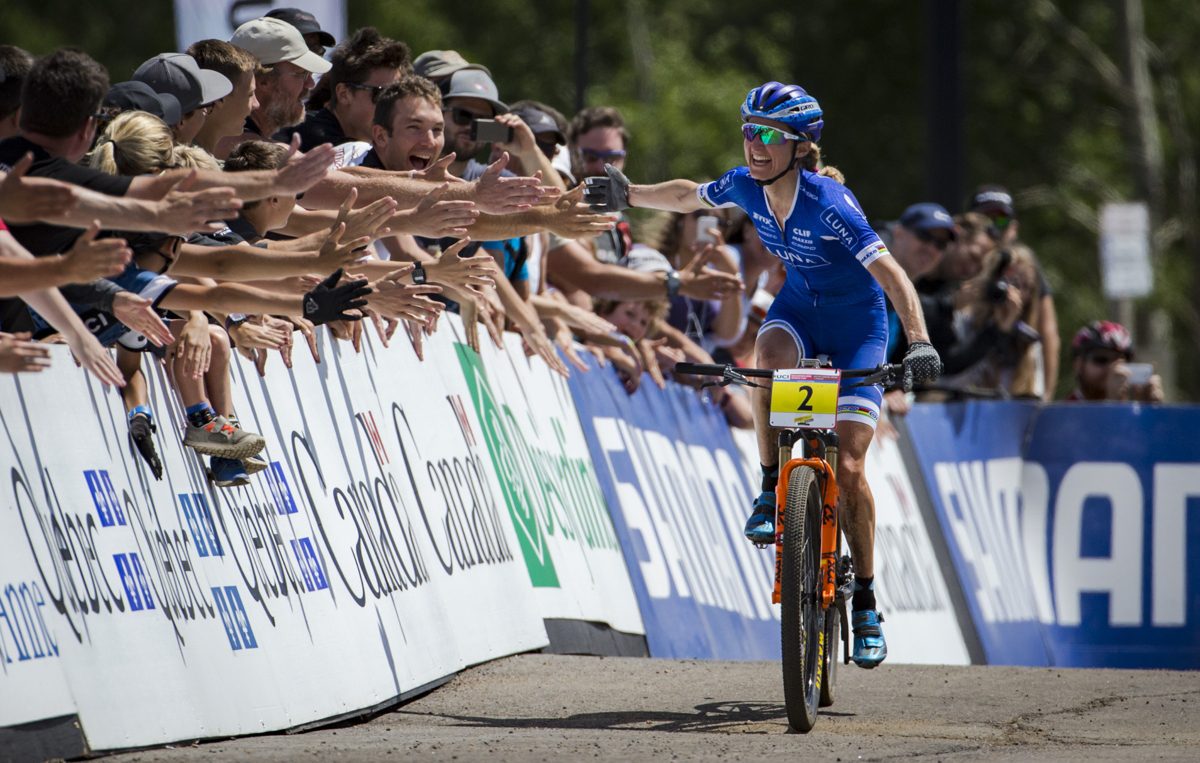 Catharine Pendrel racing Mont-Sainte-Anne in 2018. Image: Mathieu Belanger/Gestev
There’s more to a bike than just wheels, There’s more to a wheel than just its diameter
Catharine Pendrel points out that, in the women’s field, the switch to 29″ was much slower.
“In the beginning the tire options were so bad for 29 that it was hard to believe that “they just roll over everything” when following people as they pinged around,” Pendrel recalls with a laugh.
Instead, the Rio Olympic medallist was more focused on another rapidly evolving part of bike design.
“As an early adopter of full suspensions I stayed on 26 longer than most and let tires and geometry catch up to be on the right fit and feel. My switch was more to make it easier for the team to all be on the same equipment.”
Pendrel points out that at London in 2012, the women’s podium had all three wheelsizes represented. In Rio, 26″ disappeared, but the other tech differences remained. There was a full suspension bike, a hard tail with a dropper and a hardtail with a fixed post. That wider tech picture, she says, should serve as some caution to the 32″ hype.
“I think, if 32″ are faster they will be adopted more quickly, but it’s about having the right options to fit all sized riders, conditions, etc. Even dropper seat posts were a pretty slow adoption and now people feel like they don’t know how to ride a bike without one.”
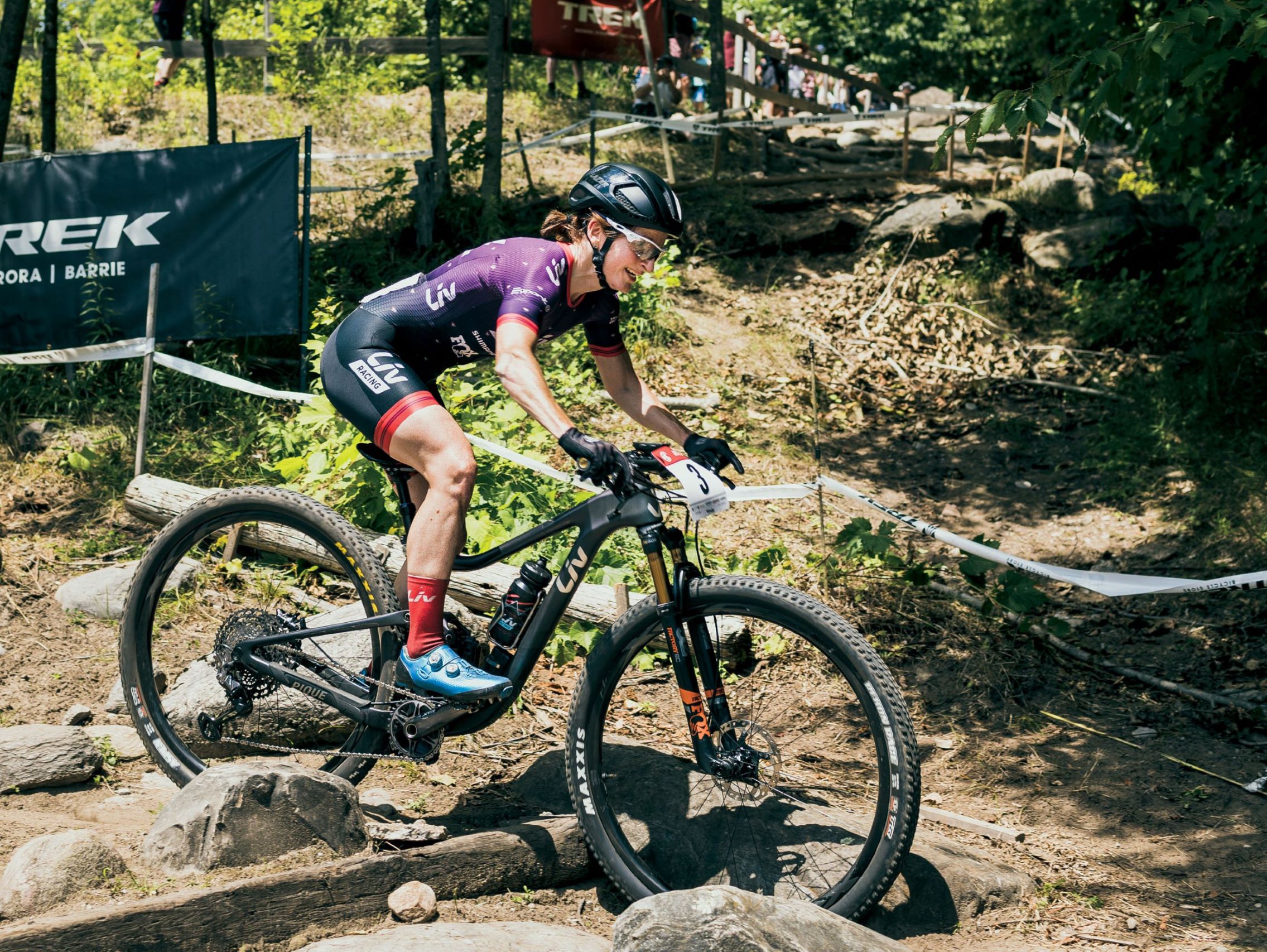 Walter races the 2022 Canadian championships, well into her 29er era. Photo: Matt Stetson
A not-so-small note on fit
As Pendrel noted, the women’s field took much longer to make the move. Canadian fans may remember Emily Batty was still landing World Cup podiums on a 27.5″ as late as 2018. Sandra Walter says she didn’t make the switch until halfway through the 2019 season, more than a decade after the 29″ standard started to appear.
Even in 2019, Walter says she was “quite reluctant” to make the switch. “I was also reluctant to switch from 26″ to 27.5″ before that.” Her move to big wheels was, ultimately, pragmatic. “All the new bikes were 29ers. I had to get with the program. I don’t regret it though.”
Walter says her reluctance was simple.
“The biggest factor both time was bike fit. I’m a small rider and I was skeptical that I could get the right fit. I felt that there would be more compromise in fit to make the big wheels fit on a small frame.”
Walter says of why she held off for so long.
“I do think many earlier 29ers didn’t get the geo right,” Walter adds. While that aspect was sorted out by 2019, Walter adds that, as a rider without full factory-level support, availability wasn’t the only obstacle. “I was also reluctant because my personal tire and wheel inventory had invested a lot in 27.5″. So it stung financially to make the switch.”
Walter’s still racing World Cups and other events, but doesn’t see big wheels in her future. Maybe.
“I think the challenges will be very similar to when 29ers were introduced. So, if it’s up to me, I won’t be the first one to jump on the 32er bandwagon, if ever. But I’m also someone who said I’d never ride a 29er and look at me now.”
Walter does think there’s another option.
“I’m not saying there isn’t a place for 32ers in mountain biking but maybe not for smaller riders. I do see a certain amount of common sense in relative sizing. Some brands do this already, where XS models come with 27.5″ wheels and larger ones with 29”.
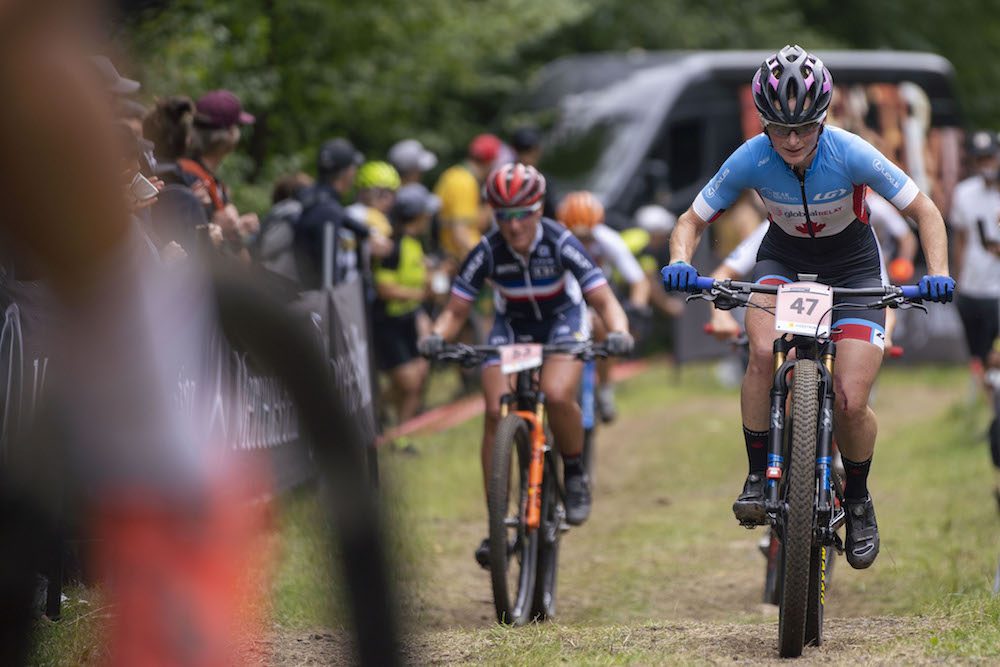 Sandra Walter racing her third UCI World Championships at Mont-Sainte-Anne in 2019. Photograph by Nick Iwanyshyn
What was it like to race during the first switch?
With the current hype train blowing so much steam into the importance of wheel size, I wanted to know what it was like to be on a start line with two, or even three different wheel sizes. Did it make a difference in strategy? In expectations of the riders that weren’t on 29? Or was it still just racing?
“I don’t think there was a large scale change,” says Walter. “A specific example I did experience was having a hard time gauging my distance from the rider in front of me. I was still on 26″ wheels but if the rider in front was on 29″ their rear wheel would actually be closer to my front wheel.” That, she says, led to a lot of rubbing tires.
Bigger picture, Walter says racing speed increased and features grew.
“I think that was the way the sport was headed anyway,” Walter says. “There was a lot of other technology involved during that time, for example in suspension and geometry, that contributed to that. Plus, the level of technical skill and race craft was constantly rising in the field, and still is!”
 Catharine Pendrel, Sandra Walter and Haley Smith at Mont-Sainte-Anne. Photo: Nick Iwanyshyn
Will this create an unfair, or even uneven playing field?
With 32″ starting to appear in races, and racing at the top end tighter than ever, I asked all three Canadians if they saw this technical change potentially leading to a divide in the field between the 32″ haves and have-nots, or fit-nots.
“I think the 26-27.5-29, hard tail/dually, 3 chain rings 2- 1 chain ring, dropper no dropper, revolution of the past 10-20 years have shown us that technology changes things but not dramatically right away,” Pendrel says. “Whether on 26 or 29 or 32, everyone can ride the same terrain, speed and comfort may differ.”
Walter also thinks it could be a while before we see wholesale change, again.
“If it ever happens, it won’t happen overnight. R&D, production, and a lot of other things you don’t even realise. It’s a big risk financially and I don’t believe the industry is currently in a risk-taking kind of place,” Walter argues, adding “But that’s just me looking from the outside.”
Kabush thinks that a more mature industry will make this second switch a bit smoother. While boutique builders were first out of the gates with 32″ bikes, he sees that major brands leading the move on a wider scale leaving mid-sized brands to decide how much of a risk they want to take.
“It’s not an easy time in the industry to be making big bets on new platforms,” Kabush admits. “I don’t think anyone will be at a competitive disadvantage by the 2028 Olympics. Most brands are quite far along in the 32″ bike development path and might have launched them sooner if COVID and the industry downturn hadn’t pushed model releases back by a year or two.”
 Geoff Kabush in his Scott-3Rox racing days, still on a hardtail at the 2015 Mont Sainte Anne World Cup. Photo: Dean Campbell
Advice to younger riders: Legs and heart, not wheels
So, what does a young racer looking to invest in their next bike do? Should they be worried if a sponsor doesn’t appear to have anything big in the works, or if they don’t think they’ll fit a 32″ bike? None of the three Canadians sees much cause for concern.
“I think the current 29″ bikes are pretty amazing and will still be plenty competitive with the right set-up,” Kabush says. “If I needed a new XC bike, I would have no hesitation buying a new 29″ bike right now and I wouldn’t be holding my breath waiting to buy a new 32″ bike. When they do launch, there will still be some refinement happening. We are blessed to live in a time of many amazing bikes these days.”
“Until it is super available, it’s just not an option for everyone,” Pendrel adds. “We can let the world series teams test them and be ready to follow suit if that’s the direction the industry heads”
Walter adds there’s pragmatic considerations to holding off.
“If you’re a young rider and privateering, you want to be able to share wheelsets with your friends or borrow a tire from a buddy. Or find spare parts at a shop if you’re travelling somewhere for a race,” the Coquitlam racer explains. “I think it’s safe to stick with 29″ for the foreseeable future. It’s still the standard.”
At the end of the day, there are more important factors in racing.
“I believe Jenny Rissveds would still be winning World Cups if she was on 27.5″ wheels,” Walter says. “Obviously modern bikes are constantly improving in many ways, but it’s riders that win races, not bikes. ”
Pendrel agrees. The way she sees it, it’s simple:
“Legs and heart will still rule racing.”